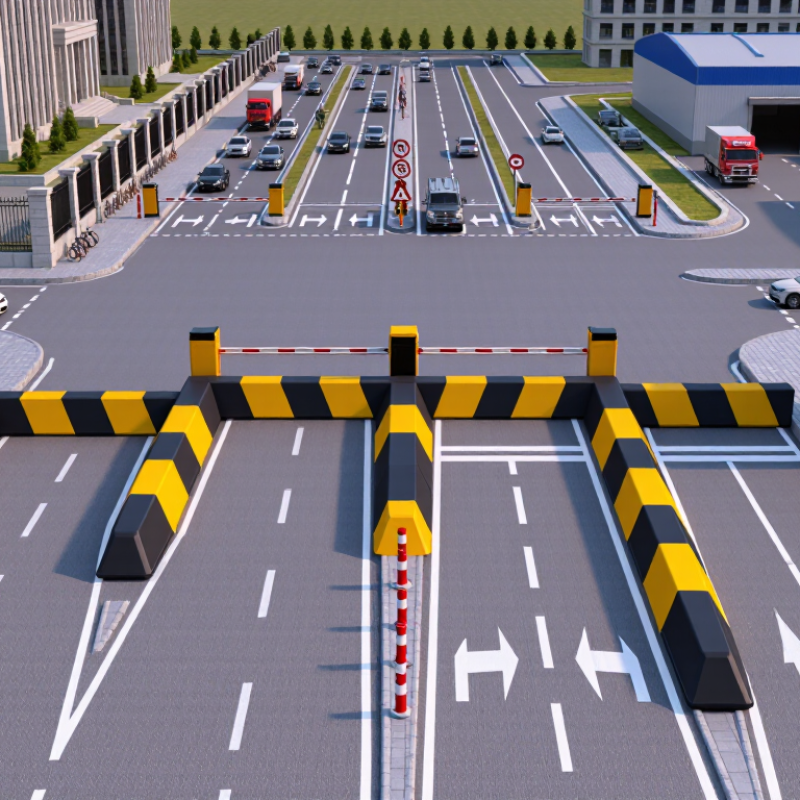
| Typical Application | Commercial entrances, parking facilities, and sites with moderate vehicle threats. | Government, utility, transport, and critical-infrastructure access points. | High-risk perimeters, controlled facilities, and locations requiring certified vehicle impact resistance. | Threat assessment, traffic volume, available road width, and required security level. | Choose according to the site risk assessment rather than appearance or price alone. |
| Visible Height | Approximately 250–400 mm | Approximately 400–600 mm | Approximately 500–700 mm | Confirm that the raised height provides adequate obstruction without blocking required sight lines. | Higher wedges generally provide stronger physical obstruction but may require greater civil-work depth and clearance. |
| Roadway Coverage | Commonly supplied in modular sections for single-lane or partial-lane coverage. | Typically configured for a full lane, with additional sections for wider entrances. | Usually engineered as a full-width system with reinforced foundations and heavy structural components. | Measure lane width, turning radius, curb position, drainage channels, and emergency bypass routes. | Use a continuous protected width with minimal unprotected gaps. |
| Impact Performance | May provide deterrence and access control; certification varies significantly by model. | Often available with independently tested vehicle-impact ratings. | Designed for severe impact scenarios and may meet recognized crash-test standards when properly installed. | Request the exact test standard, vehicle mass, impact speed, penetration result, and test configuration. | Do not treat a product description such as “crash-rated” as sufficient evidence without test documentation. |
| Crash-Test Documentation | May be limited to factory specifications or non-certified testing. | Typically supported by a formal test report for a defined vehicle and speed condition. | Should include an independent laboratory report and installation conditions matching the proposed site. | Check whether the test covered the complete system, including foundation, controls, and end terminals. | Select the lowest tested performance level that still meets the site’s documented threat assessment. |
| Actuation Type | Hydraulic, electromechanical, or pneumatic systems may be available. | Hydraulic actuation is common where high force and reliable cycling are required. | Heavy-duty hydraulic systems are often preferred for large, high-load barriers. | Review local climate, power quality, available hydraulic-service expertise, and duty cycle. | Choose an actuator that can complete the required cycles without overheating or excessive wear. |
| Typical Raising Time | Approximately 3–8 seconds | Approximately 3–6 seconds | Approximately 4–10 seconds | Confirm whether the stated time is measured under normal load, cold conditions, and emergency operation. | Balance speed with stopping distance, safety, structural load, and site operating procedures. |
| Emergency Lowering | May use manual release, battery backup, or mechanical override. | Should include a clearly accessible manual or powered emergency-lowering method. | Should include redundant controls and a documented safe-state procedure. | Test operation during power failure, fire alarm activation, communications loss, and control-panel faults. | Require a fail-safe plan that allows emergency services to pass without compromising security unnecessarily. |
| Vehicle and Pedestrian Safety | Requires warning signs, signal lights, audible alerts, and vehicle-presence detection. | Should integrate inductive loops, photoelectric sensors, traffic lights, and interlocking controls. | Normally requires multiple detection zones, anti-tailgating logic, and protected pedestrian routing. | Verify detection of motorcycles, bicycles, low-clearance vehicles, pedestrians, and objects on the wedge. | Use redundant detection and prevent the wedge from rising when an authorized vehicle remains in the danger zone. |
| Control Integration | Remote control, keypad, card reader, or basic access-control input. | Access-control, intercom, CCTV, loop detector, and building-management integration. | Redundant security controls, central monitoring, event logging, and emergency-system integration. | Confirm interface types, cybersecurity requirements, operating permissions, and audit-log retention. | Prefer open, documented interfaces to reduce dependence on a single control platform. |
| Drainage and Environmental Protection | Requires effective drainage in the pit to prevent water accumulation and corrosion. | Should include pit drainage, corrosion-resistant finishes, and sealed electrical components. | Requires engineered drainage, robust coatings, protected hydraulic components, and cold-weather provisions where applicable. | Assess groundwater, rainfall, flooding, salt exposure, dust, freezing temperatures, and snow removal. | Poor drainage is a common cause of corrosion, sensor faults, hydraulic contamination, and downtime. |
| Civil Works | Often has the lowest excavation and foundation requirement, subject to soil conditions. | Usually requires a reinforced pit, drainage system, conduits, and concrete foundation. | May require deeper excavation, stronger reinforcement, larger equipment access, and structural review. | Obtain foundation drawings, soil data, utility maps, groundwater information, and road-loading requirements. | Compare the complete installed solution, not only the barrier unit price. |
| Routine Maintenance | Visual inspection, cleaning, lubrication, sensor testing, and drainage checks. | All low-profile tasks plus hydraulic inspection, control testing, and fastener checks. | More frequent structural, hydraulic, electrical, and foundation inspections due to higher loads. | Ask for the maintenance schedule, service intervals, spare-parts list, and technician qualifications. | A documented preventive-maintenance plan generally reduces unplanned downtime and repair costs. |
| Suggested Inspection Frequency | Operator checks daily; formal preventive service every 3–6 months. | Operator checks daily; formal preventive service at least every 3–6 months. | Operator checks daily; formal preventive service commonly every 1–3 months in high-cycle use. | Adjust frequency for traffic volume, weather, impact events, and manufacturer requirements. | Follow the stricter requirement when site conditions and supplier recommendations differ. |
| Expected Service Life | Approximately 10–15 years with suitable installation and preventive maintenance. | Approximately 10–20 years depending on duty cycle, environment, and component replacement. | Approximately 15–25 years for the structure, with controls, seals, sensors, and hydraulic parts replaced sooner. | Separate structural life from the service life of pumps, seals, sensors, batteries, controls, and coatings. | Service-life estimates are not warranties and depend heavily on installation quality and maintenance. |
| Indicative Equipment Cost | Approximately USD 15,000–35,000 | Approximately USD 30,000–70,000 | Approximately USD 60,000–150,000+ | Request a quotation that identifies the barrier, actuator, controls, sensors, and accessories separately. | Use these ranges only for early budgeting; certified performance and site requirements can change the price substantially. |
| Indicative Installation Cost | Approximately USD 10,000–30,000 | Approximately USD 20,000–60,000 | Approximately USD 40,000–120,000+ | Include excavation, concrete, drainage, electrical work, traffic management, commissioning, and reinstatement. | Civil works can exceed the equipment cost where utilities, groundwater, or difficult soil are present. |
| Estimated Annual Maintenance | Approximately 3–6% of equipment cost | Approximately 4–8% of equipment cost | Approximately 5–10% of equipment cost | Confirm whether the estimate includes labor, travel, consumables, testing, software support, and replacement parts. | Budget more for coastal, dusty, freezing, flood-prone, or high-cycle environments. |
| Downtime Risk | Moderate when drainage, sensors, and basic controls are neglected. | Moderate to low with a service contract and locally available spare parts. | Low when redundant controls and scheduled specialist maintenance are provided; repairs may be more complex. | Check local response time, critical spare-parts availability, remote diagnostics, and manual operating procedures. | Evaluate the cost of access disruption and security exposure, not only the repair invoice. |
| Total Cost of Ownership | Lower initial cost, but greater suitability risk if the threat level is underestimated. | Balanced option for sites requiring documented protection and regular vehicle access. | Highest initial and civil-work cost, but appropriate where severe vehicle impact risk justifies the investment. | Compare purchase, installation, energy, inspections, parts, labor, downtime, upgrades, and end-of-life replacement. | Select the option with the best risk-adjusted lifecycle value, not necessarily the lowest purchase price. |
| Best-Fit Decision | Choose when the site has moderate risk, limited excavation depth, and a strong need to control project cost. | Choose when independently tested impact performance, daily operation, and maintainability are required. | Choose when the risk assessment requires high-impact resistance and the site can support substantial civil works. | Obtain a site survey, threat assessment, foundation design, crash-test evidence, maintenance plan, and lifecycle quotation. | The final choice should be approved by security, facilities, safety, engineering, and emergency-response stakeholders. |