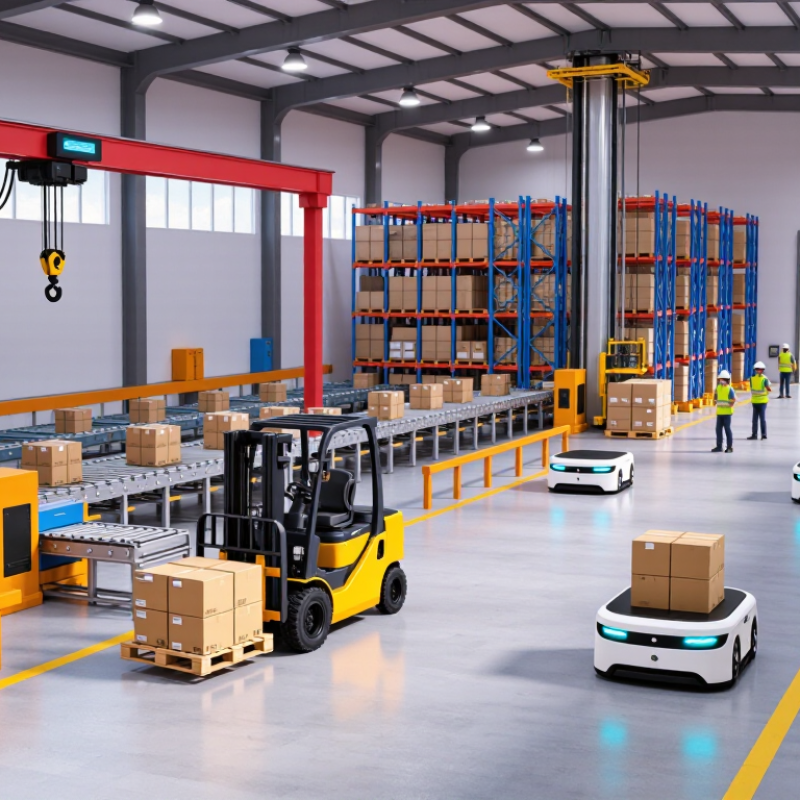
| Industrial Trucks | Horizontal movement, lifting, stacking, and loading of unit loads | - Counterbalance trucks
- Reach trucks
- Order pickers
- Powered pallet trucks
| Warehouses, distribution centers, manufacturing plants, ports, and logistics yards | Load capacity, lift height, turning radius, power source, aisle width, floor conditions, operator visibility, and required safety features | Engineering quality, stability testing, operator ergonomics, battery or fuel-system integration, service coverage, spare-parts availability, and compliance support directly affect safety and uptime. |
| Conveyors | Continuous or controlled movement of cartons, totes, pallets, parcels, and bulk materials | - Belt conveyors
- Roller conveyors
- Chain conveyors
- Screw conveyors
- Flexible conveyors
| Production lines, fulfillment centers, parcel hubs, airports, food facilities, and distribution operations | Load type, throughput, line speed, incline, accumulation requirements, layout flexibility, cleaning needs, noise, and controls integration | Manufacturers determine the quality of system design, guarding, drive reliability, controls compatibility, maintainability, and the ability to scale the installation. |
| Storage and Retrieval Systems | Organized storage, buffering, and retrieval of inventory | - Selective pallet racking
- Drive-in racking
- Carton flow systems
- Automated storage and retrieval systems
- Vertical lift modules
| High-volume warehouses, cold stores, spare-parts centers, retail distribution, and industrial storage areas | Storage density, inventory profile, access frequency, building height, fire protection, load configuration, temperature, and automation requirements | Structural calculations, rack protection, system compatibility, seismic considerations, software integration, installation quality, and inspection support influence long-term performance. |
| Hoists and Cranes | Vertical lifting and overhead transfer of heavy or suspended loads | - Bridge cranes
- Gantry cranes
- Jib cranes
- Electric chain hoists
- Wire-rope hoists
| Steel production, machine shops, construction, shipyards, maintenance areas, and heavy manufacturing | Rated load, span, lift height, duty cycle, travel speed, headroom, environmental conditions, controls, and inspection requirements | Load-path design, mechanical reliability, limit controls, overload protection, installation standards, inspection programs, and operator training are essential to safe lifting. |
| Automated Mobile Equipment | Driverless transport of materials between defined locations | - Automated guided vehicles
- Autonomous mobile robots
- Automated pallet movers
- Tugger vehicles
| Smart warehouses, factories, hospitals, fulfillment centers, and repetitive internal transport routes | Navigation method, payload, route complexity, traffic control, battery charging, fleet size, system integration, and emergency stopping | Reliable navigation, cybersecurity, safety-rated controls, fleet-management software, interoperability, mapping, commissioning, and lifecycle support determine operational value. |
| Sortation Systems | Routing and separating items according to destination, order, size, or product type | - Cross-belt sorters
- Shoe sorters
- Bomb-bay sorters
- Sliding-shoe systems
- Divert conveyors
| Parcel hubs, e-commerce fulfillment, postal operations, airports, and retail distribution centers | Item dimensions, weight range, throughput, destination count, barcode or vision requirements, accuracy, noise, and maintenance access | Mechanical precision, sensor integration, software reliability, fault recovery, throughput validation, and maintenance planning affect sorting accuracy and delivery performance. |
| Loading Dock Equipment | Transfer of goods between vehicles and building floors | - Dock levelers
- Vehicle restraints
- Dock lifts
- Dock shelters
- Loading ramps
| Distribution centers, warehouses, manufacturing facilities, cold-chain sites, and retail backrooms | Vehicle height variation, load weight, weather exposure, dock frequency, trailer safety, energy efficiency, and available pit depth | Correct load ratings, structural durability, interlocks, weather sealing, installation accuracy, and preventive maintenance reduce dock incidents and loading delays. |
| Packaging and Unitizing Equipment | Stabilizing, wrapping, sealing, labeling, and preparing products for handling or shipment | - Stretch wrappers
- Strapping machines
- Case sealers
- Palletizers
- Depalletizers
| Food and beverage, consumer goods, pharmaceuticals, manufacturing, and third-party logistics operations | Product dimensions, package material, line speed, pallet pattern, hygiene requirements, changeover time, and quality control | Equipment consistency, guarding, changeover design, automation controls, material efficiency, integration engineering, and technical service influence product protection and labor productivity. |
| Bulk Material Handling Equipment | Loading, conveying, feeding, storing, and discharging loose materials | - Bucket elevators
- Hoppers
- Feeders
- Stackers and reclaimers
- Pneumatic conveying systems
| Mining, agriculture, cement, chemicals, power generation, food processing, and recycling | Material density, particle size, moisture, abrasiveness, flowability, dust control, corrosion exposure, and required throughput | Material-specific engineering, wear resistance, dust management, containment, explosion-risk assessment, energy efficiency, and maintenance access are critical. |
| Work Platforms and Access Equipment | Safe positioning of people and tools at elevated or difficult-to-reach work areas | - Scissor lifts
- Boom lifts
- Personnel lifts
- Warehouse access platforms
- Mobile work stands
| Warehouses, construction sites, aircraft maintenance, facilities management, and industrial plants | Working height, platform capacity, reach, terrain, indoor or outdoor use, maneuverability, fall protection, and emergency lowering | Stability, control design, guardrails, emergency systems, inspection documentation, operator training, and service programs are central to worker protection. |
| Digital Control and Warehouse Software | Information flow, equipment coordination, inventory visibility, and process control | - Warehouse control systems
- Warehouse management interfaces
- Fleet-management software
- Equipment monitoring platforms
- Industrial control systems
| Automated warehouses, manufacturing plants, distribution networks, and multi-site logistics operations | Data accuracy, integration protocols, response time, cybersecurity, reporting, user permissions, scalability, and system availability | Software interoperability, data security, diagnostics, remote support, upgrade paths, and dependable commissioning determine how effectively equipment operates as one system. |
| Manufacturer Evaluation Factors | Applies across lifting, transport, storage, automation, and control equipment | - Product engineering
- Safety compliance
- Customization capability
- Service and maintenance
- Digital integration
| Relevant to businesses comparing equipment suppliers for new installations, replacements, expansions, or modernization projects | Total cost of ownership, equipment availability, energy use, warranty terms, training, spare parts, response time, documentation, and local support | Manufacturers matter because their design standards, testing processes, production quality, support network, and lifecycle services influence safety, productivity, reliability, compliance, and return on investment. |