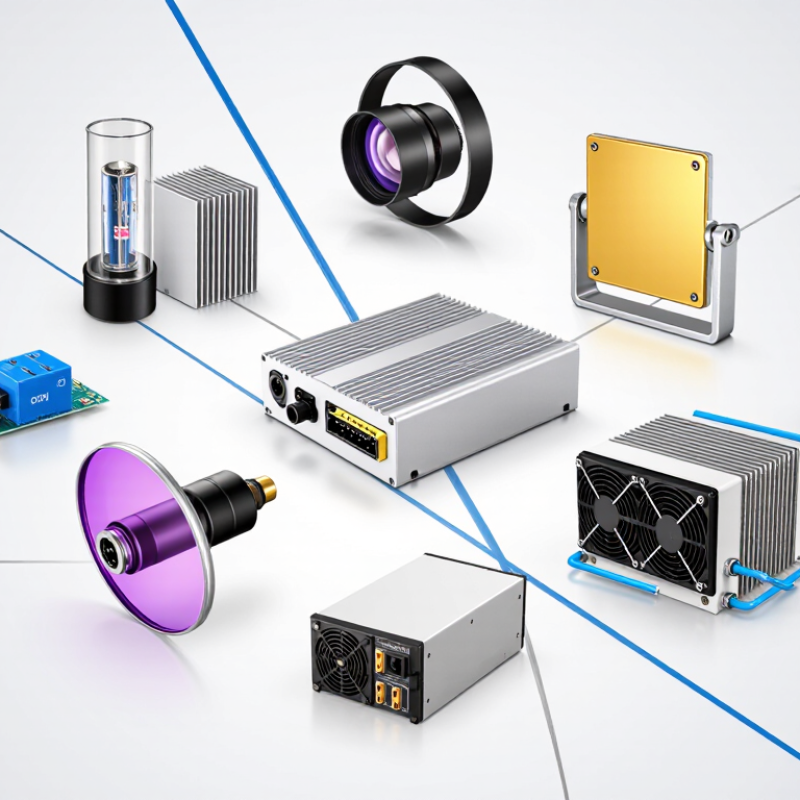
| Control Parts | Laser Diode Driver | Supplies regulated current to a laser diode and helps maintain stable optical output. | Constant-current operation; adjustable current limit; current stability commonly specified in mA or ppm; protection against overcurrent, overvoltage, and overheating. | Laser modules, optical instruments, barcode systems, alignment tools, and laboratory sources. | Match the driver to the diode's operating current, compliance voltage, modulation speed, noise level, and protection requirements. |
| Control Parts | Temperature Controller | Controls the temperature of a laser diode or optical assembly to stabilize wavelength and output power. | Thermoelectric cooler control; thermistor or RTD input; temperature stability often specified in the millikelvin range; programmable heating and cooling limits. | Wavelength-sensitive spectroscopy, interferometry, communications, metrology, and precision measurement. | Check sensor compatibility, cooling capacity, temperature range, loop stability, and heat-sinking requirements. |
| Control Parts | Laser Power Controller | Regulates or maintains laser output power using feedback from a monitor photodiode or external detector. | Closed-loop power control; selectable setpoint; response time from microseconds to milliseconds depending on design; analog or digital control interfaces. | Material processing, imaging, microscopy, optical testing, and automated laser systems. | Evaluate control bandwidth, feedback compatibility, dynamic range, settling time, and behavior during rapid power changes. |
| Control Parts | Laser Modulator or Driver | Varies laser intensity, pulse duration, or output timing for analog or digital operation. | Modulation bandwidth may range from kHz to GHz depending on the device; pulse width, repetition rate, rise time, and impedance matching are important specifications. | Data transmission, fluorescence instruments, laser marking, scanning, and time-resolved measurements. | Confirm modulation format, maximum frequency, voltage or current drive method, signal integrity, and thermal load. |
| Detection Parts | Photodiode | Converts incident optical power into an electrical signal for monitoring or measurement. | Silicon devices commonly cover approximately 400–1100 nm; InGaAs devices commonly cover approximately 900–1700 nm; responsivity is expressed in A/W. | Laser monitoring, optical receivers, power meters, position sensors, and feedback loops. | Select the material and wavelength range first, then compare active area, responsivity, dark current, speed, and saturation level. |
| Detection Parts | Avalanche Photodiode | Provides internal multiplication to improve sensitivity compared with a standard photodiode. | Internal gain is commonly from several times to several tens of times; requires controlled bias voltage and generally has higher noise and temperature sensitivity than a standard photodiode. | Low-light detection, optical communications, ranging, spectroscopy, and precision measurement. | Consider gain stability, excess noise, bias control, wavelength response, temperature compensation, and maximum optical input. |
| Detection Parts | Photodetector Module | Combines a photodetector with amplification, filtering, or signal-conditioning electronics. | May provide transimpedance output, selectable gain, AC or DC coupling, defined bandwidth, and calibrated or monitor-grade output. | Optical laboratories, alignment systems, machine vision, spectroscopy, and automated inspection. | Check output type, bandwidth, gain range, input noise, connector format, power supply, and electromagnetic compatibility. |
| Detection Parts | Power Meter Sensor | Measures average or pulsed optical power over a specified wavelength and power range. | Typically specified by wavelength range, measurable power range, calibration uncertainty, detector aperture, and response time. | Laser calibration, production testing, laboratory measurement, maintenance, and safety verification. | Verify wavelength correction, sensor head range, continuous-wave or pulsed compatibility, aperture size, and calibration requirements. |
| Positioning Parts | Linear Translation Stage | Moves a laser, lens, mirror, sample, or detector along a controlled linear axis. | Important specifications include travel range, minimum incremental motion, accuracy, repeatability, maximum speed, and load capacity. | Beam alignment, microscopy, optical assembly, spectroscopy, and precision manufacturing. | Choose manual or motorized operation and compare axis travel, stiffness, backlash, mounting pattern, and controller compatibility. |
| Positioning Parts | Rotation Stage | Rotates optical components or samples around a defined axis. | Common parameters include angular range, graduations or encoder resolution, wobble, rotational accuracy, load capacity, and manual or motorized drive. | Polarization measurements, crystal orientation, beam steering, optical testing, and sample analysis. | Check clear aperture, angular resolution, axis height, locking method, center-of-rotation accuracy, and payload. |
| Positioning Parts | Kinematic Mirror Mount | Provides fine angular adjustment for directing and aligning a laser beam. | Usually offers two-axis tip and tilt adjustment; specifications may include adjustment sensitivity, angular range, mirror diameter, stability, and optical clear aperture. | Free-space beam alignment, interferometers, optical benches, imaging systems, and laboratory setups. | Match the mount to mirror diameter and thickness; evaluate adjustment resolution, thermal stability, locking behavior, and mounting space. |
| Positioning Parts | Beam Position Sensor | Detects the location of a laser beam on a sensing surface and converts displacement into electrical data. | Common sensor technologies include quadrant photodiodes and position-sensitive detectors; key parameters include active area, position resolution, bandwidth, linearity, and allowable optical power. | Beam stabilization, alignment, optical tracking, vibration measurement, and automated calibration. | Consider wavelength response, spot-size requirements, sensor geometry, calibration method, signal-conditioning electronics, and saturation limits. |
| Positioning Parts | Optical Mount and Holder | Secures lenses, mirrors, filters, laser modules, or detectors while maintaining their designed position. | Typical specifications include compatible optic diameter, clear aperture, adjustment range, material, mounting thread, height, and environmental stability. | Optical benches, laser modules, inspection equipment, research instruments, and production fixtures. | Confirm optic dimensions, optical-axis height, mounting interface, adjustment needs, vibration resistance, and thermal expansion behavior. |