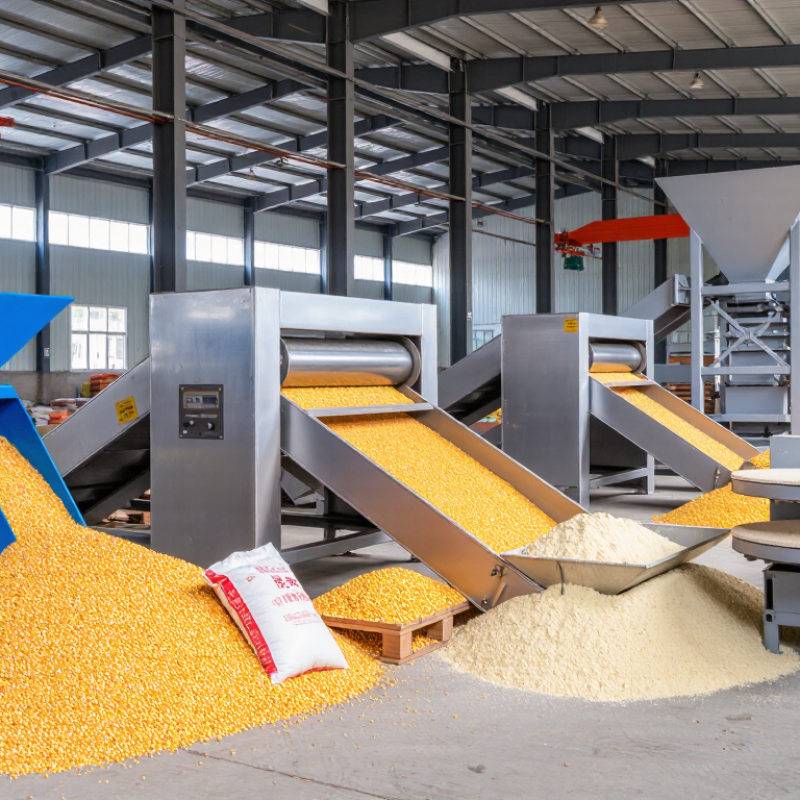
| 1. Grain cleaning | Sieve cleaner, aspirator, magnetic separator | Removes dust, chaff, oversized or undersized material, and ferrous metal from incoming maize. | Cleaner grain ready for further processing. | Cleaning protects downstream equipment and helps improve product quality. The exact cleaning line depends on the condition of the grain. |
| 2. Destoning | Gravity destoner | Separates stones and other dense particles from maize using differences in weight and airflow. | Maize with fewer dense impurities. | Destoning is commonly used where stones or similar contaminants may be present after harvesting and handling. |
| 3. Conditioning or tempering | Water dosing system and tempering bins | Adds a controlled amount of water and allows moisture to distribute through the kernels before milling. | Conditioned grain suited to the chosen milling method. | Moisture targets and resting time vary with the grain and process. Conditioning can help separate kernel components in dry milling. |
| 4. Degermination and dehulling | Degerminator or dehulling machine | Separates some or most of the germ and outer bran from the maize kernel before reduction. | Grits or cleaned endosperm fractions, plus separated germ and bran. | Often used for dry milling intended to produce more uniform grits or refined maize meal. Not every mill includes this step. |
| 5. Roller milling | Roller mill with sifters and, where required, purifiers | Breaks kernels or intermediate pieces between rollers and separates particles by size. | Depending on the setup: maize grits, meal, or flour, with bran and germ fractions when separation is included. | Roller systems can produce several particle sizes and are commonly used in larger dry-milling operations. |
| 6. Hammer milling | Hammer mill with screen | Uses rotating hammers to reduce maize by impact; the screen helps determine the particle size range. | Ground maize meal or flour, often with more of the kernel retained in the product. | A practical option for general-purpose grinding. Particle size depends on the screen, feed rate, and grain characteristics. |
| 7. Plate or disc milling | Plate mill or disc mill | Grinds maize between grooved or textured plates or discs. | Meal or flour, depending on the machine adjustment and screen arrangement. | Used in small-scale and local milling applications. Output and fineness vary by machine design and operating conditions. |
| 8. Stone milling | Stone mill | Crushes and grinds maize between millstones. | Coarse meal through finer flour, depending on the stone gap and feed. | Often chosen for traditional-style products. It generally offers less precise fraction separation than a multi-stage roller system. |
| 9. Wet milling (alternative process) | Steeping tanks, mills, screens, and separation equipment | Steeps maize in water, then mills and separates the kernel components in a wet process. | Starch, germ, fiber, and protein-rich fractions for further processing. | Wet milling is a distinct industrial route, commonly used to recover multiple components; it does not simply produce dry maize flour. |
| 10. Sifting and grading | Plansifter, vibrating sieve, or other grading screen | Separates milled material into particle-size fractions and can return oversize particles for further grinding. | More consistently graded grits, meal, or flour. | Screen openings and the number of sifting stages depend on the desired product specifications. |
| 11. Product handling and packing | Conveyors, storage bins, weighing and bagging equipment | Moves finished product to storage or packaging while limiting exposure to contamination and moisture. | Packaged or bulk maize products ready for distribution or use. | Finished product should be stored in clean, dry conditions. Packaging and storage requirements depend on local food-safety rules and product use. |