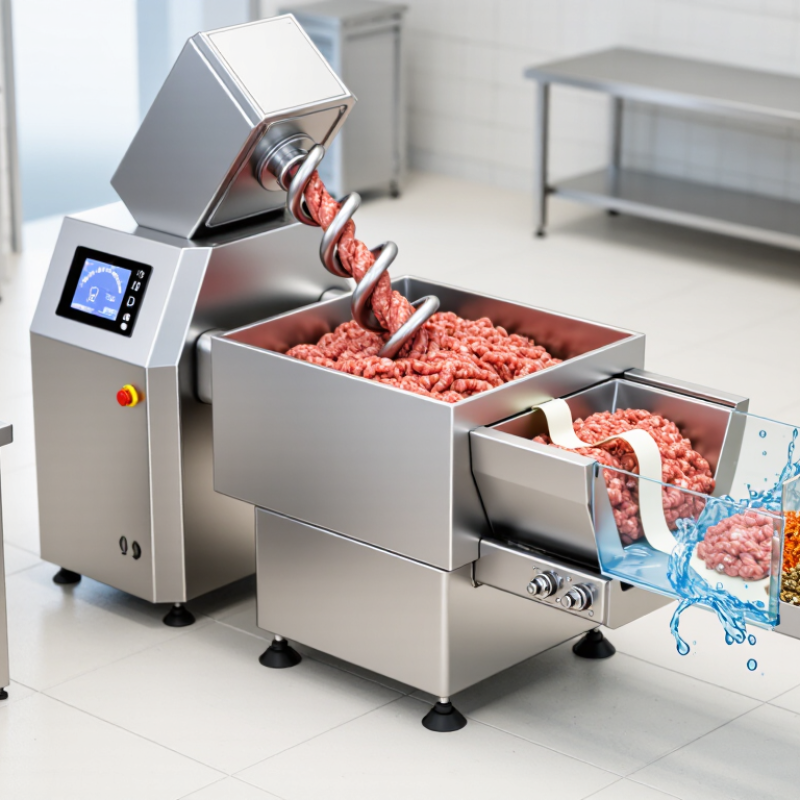
| Primary Function | Uniform blending of meat and ingredients | Rotating paddles, ribbons, or arms move the product through the vessel, combining ingredients and distributing moisture, fat, salt, and seasonings. | The mixer should achieve an even blend without excessive smearing, temperature rise, or mechanical damage to the product. |
| Common Mixer Designs | Horizontal paddle, ribbon, or dual-shaft mixer | Horizontal designs generally move product along a trough, while dual-shaft systems create opposing product flows for more intensive mixing. | The selected design depends on batch size, product texture, ingredient loading, and the required degree of protein extraction. |
| Typical Working Capacity | Approximately 25–80% of vessel volume | The usable batch size is lower than the vessel's total geometric volume because the product needs space to circulate and turn over. | Overfilling can create dead zones and uneven seasoning; underfilling may reduce mixing efficiency and increase product residence time. |
| Loading Sequence: Base Product | Ground or diced meat is usually loaded first | The meat forms the main matrix into which dry seasonings, liquids, binders, and other ingredients are incorporated. | Raw materials should be weighed accurately and kept within the target temperature range specified by the food-safety plan. |
| Loading Sequence: Dry Ingredients | Salt, spices, sugar, curing ingredients, and dry binders | Dry ingredients are added after or during the initial movement of the meat so they can disperse across the product rather than remain concentrated in one area. | Powders should be free-flowing and added in a controlled manner to reduce clumping and localized over-seasoning. |
| Loading Sequence: Liquids and Ice | Water, brine, marinades, or ice may be added gradually | Liquid ingredients are distributed by the moving paddles or arms; ice can help control product temperature while contributing water as it melts. | Gradual addition generally improves absorption and helps prevent pooling at the bottom of the mixer. |
| Initial Mixing Cycle | About 2–5 minutes | A short initial cycle begins distributing seasonings and liquids through the meat before the final blend develops. | Operators commonly inspect the product for dry pockets, liquid accumulation, and uneven ingredient distribution. |
| Main Mixing Cycle | About 5–15 minutes total for many batches | The mixer continues to turn and fold the product until the blend reaches the desired uniformity and texture. | Actual time varies with formulation, batch size, temperature, mixer geometry, paddle speed, and the required protein extraction level. |
| Mixing Speed | Commonly controlled from low speed to moderate speed | Lower speeds provide gentler folding, while higher speeds increase circulation and shear. | Speed should be high enough for complete turnover but low enough to limit smearing, air incorporation, and unnecessary heat generation. |
| Vacuum Mixing Option | Available on some sealed mixer configurations | Air is removed from the vessel during mixing, which can improve product density and reduce visible air pockets. | Vacuum operation requires a sealed lid, suitable product consistency, and correct control of vacuum level and cycle timing. |
| Temperature Control | Product is generally kept cold throughout processing | Mechanical work can increase product temperature, while chilled meat, ice, or refrigerated ingredients help offset that increase. | Temperature limits should follow the facility's validated food-safety procedures and applicable regulations. |
| Mixing End Point | Uniform color, seasoning distribution, and cohesive texture | The batch is considered ready when ingredients are evenly dispersed and the product has reached the formulation's desired bind or tackiness. | Excessive mixing can damage texture, increase temperature, and create a paste-like appearance in products intended to remain coarse. |
| Discharge Method | Bottom, side, or tilting discharge | After mixing, a gate or tilting mechanism moves the finished blend into a hopper, tote, conveyor, stuffer, or forming line. | The discharge path should minimize product retention, contamination risk, and unnecessary handling. |
| Typical Applications | Ground meat, sausage, meatballs, patties, fillings, and seasoned blends | The mixer can combine meat with salt, spices, water, binders, vegetables, or other formulation ingredients. | Ingredient compatibility, particle size, moisture content, and desired final texture determine the appropriate cycle. |
| Cleaning and Sanitation | After each production run or according to the sanitation schedule | Product-contact surfaces are emptied, disassembled where required, washed, rinsed, sanitized, and inspected. | Effective sanitation depends on hygienic equipment design, accessible surfaces, correct chemical concentration, contact time, and documented verification. |
| Key Quality Checks | Appearance, temperature, weight, texture, and ingredient distribution | Operators compare the batch with approved specifications and may sample multiple locations within the vessel. | Consistent weighing, loading, cycle timing, and discharge practices improve repeatability between batches. |