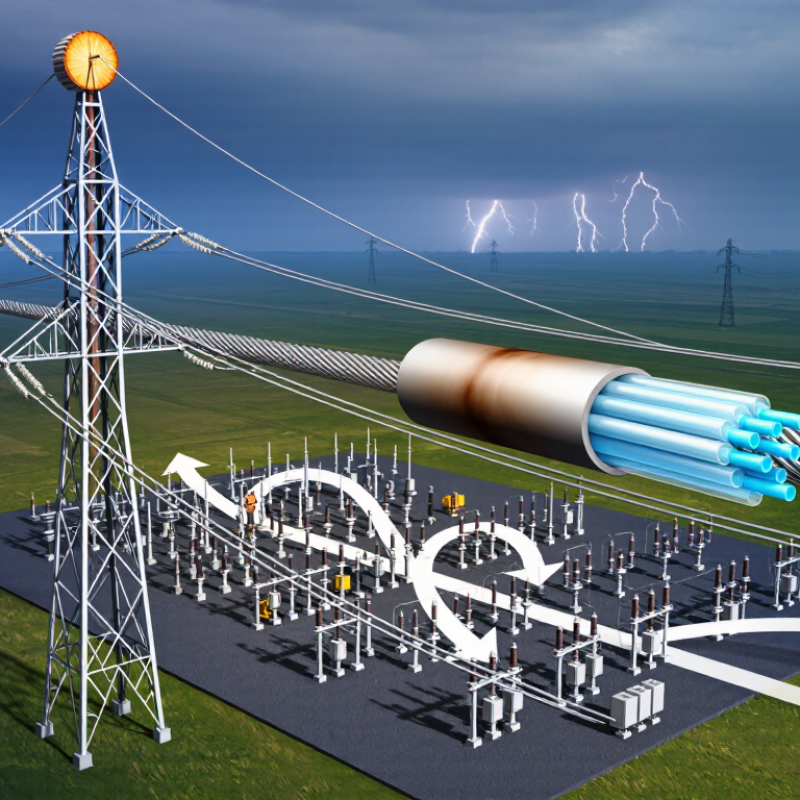
| Product name | Optical Ground Wire (OPGW) | Combines overhead lightning-shielding and fiber-optic communication functions in one conductor. |
| Typical installation position | Mounted at the top of a transmission tower or substation gantry | The elevated position allows the wire to intercept lightning strokes before they reach phase conductors. |
| Optical-fiber capacity | 24–48 optical fibers are common in many transmission-line designs | Provides communication channels for protection, control, voice, data, and remote monitoring systems. |
| Fiber type | Usually single-mode glass fiber, commonly specified for 1310 nm and 1550 nm transmission windows | Supports long-distance, low-loss optical communication along the transmission corridor. |
| Fiber unit protection | Stainless-steel tube or aluminum-covered stainless-steel tube surrounding the fibers | Protects fibers from moisture, mechanical stress, temperature changes, and installation tension. |
| Outer conductive layers | Aluminum alloy wires, aluminum-clad steel wires, or a combination of conductive and strength wires | Provides electrical conductivity, mechanical strength, corrosion resistance, and protection for the optical unit. |
| Mechanical function | Designed to withstand everyday tension, wind, ice, vibration, and installation loads | Maintains required sag and clearance while carrying the optical unit across tower spans. |
| Lightning protection function | Acts as a grounded overhead shield wire | Receives lightning current and routes it through tower grounding systems toward earth. |
| Communication principle | Electrical signals are converted into light pulses and transmitted through the glass fibers | Enables high-speed, electrically isolated data transmission without using the metallic shield-wire path for the signal. |
| Electrical conductivity | Specified by the required DC resistance and short-circuit current rating | Determines how effectively the OPGW carries lightning and fault currents without excessive heating. |
| Outer diameter | Commonly about 8–20 mm, depending on fiber count, strength, current rating, and span requirements | Affects wind loading, ice loading, fittings, sag, and compatibility with existing tower hardware. |
| Unit mass | Often approximately 300–1,000 kg/km, depending on construction and load requirements | Influences tower loading, stringing equipment, transportation, and installation planning. |
| Operating temperature range | Commonly specified around −40°C to +70°C; the exact range depends on the design | Ensures stable mechanical and optical performance under seasonal and fault-current temperature conditions. |
| Short-circuit current rating | Project-specific; commonly rated from several kiloamperes to more than 30 kA for a defined duration | Indicates the short-duration fault current that the metallic OPGW components can withstand thermally. |
| Fiber attenuation | Typically not greater than about 0.35 dB/km at 1310 nm and 0.22 dB/km at 1550 nm for standard single-mode fiber | Lower attenuation permits longer communication distances and fewer optical regeneration points. |
| Common reference standards | IEC 60794-4, IEC 61089, IEEE 1138, and applicable national utility specifications | Standards define requirements for optical performance, mechanical strength, electrical properties, testing, and installation. |
| Main applications | Transmission-line protection, telecommunication, SCADA, substation automation, and grid monitoring | Uses the existing overhead line route to provide reliable utility communications without installing a separate fiber cable. |