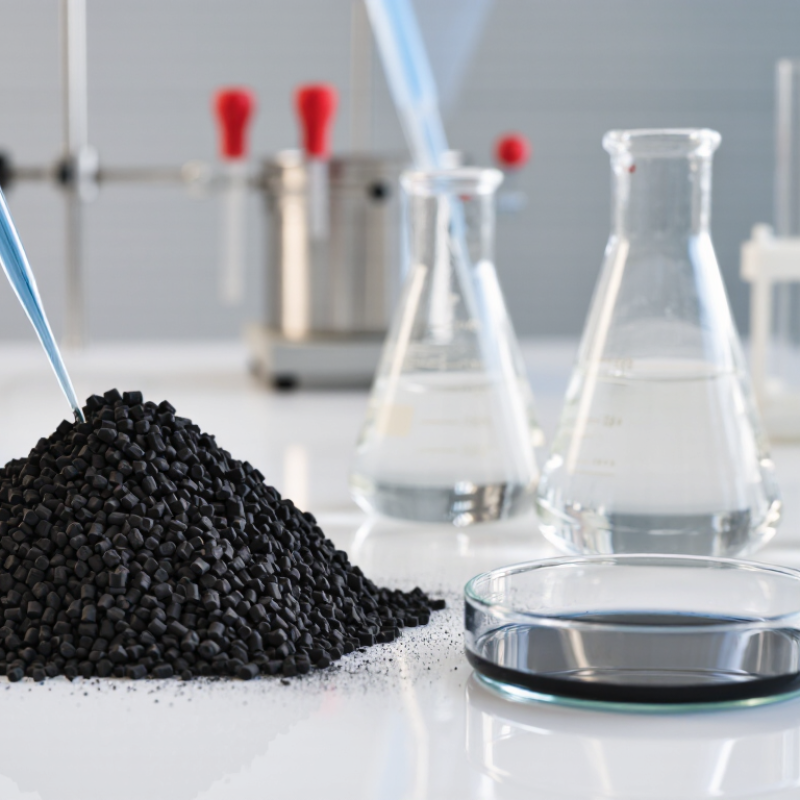
| Material definition | A highly porous form of carbon processed and controlled for use in pharmaceutical, medical, or pharmaceutical-support applications. | Its quality must be suitable for the intended use, with controls for identity, purity, microbial quality, and potentially elemental impurities. | Processing aids, purification steps, oral medicinal products, and pharmaceutical water-treatment systems. |
| Primary function | Adsorption: dissolved molecules attach to the internal surface of the carbon through physical and chemical interactions. | Allows selected impurities, color bodies, odors, and organic contaminants to be removed from liquids or gases. | Decolorization and clarification of process liquids, extracts, and solutions. |
| Specific surface area | Often several hundred to more than 1,000 m²/g, depending on raw material, activation method, and test method. | A larger accessible surface generally provides greater adsorption capacity, although performance also depends on pore structure and the target molecule. | Removal of trace organic substances during pharmaceutical manufacturing and water purification. |
| Pore structure | Contains micropores, mesopores, and sometimes macropores; pore-size distribution varies by grade. | Pore size influences which molecules can enter the carbon and how quickly adsorption occurs. | Selection of a grade for small organic impurities, larger color molecules, or mixed contaminants. |
| Decolorization capacity | Activated carbon can adsorb many colored organic compounds from aqueous and solvent-based process streams. | Supports production of clearer pharmaceutical solutions without chemically changing the active ingredient when properly validated. | Purification of APIs, intermediates, botanical extracts, sugars, and other pharmaceutical ingredients. |
| Organic impurity removal | Adsorbs a broad range of hydrophobic or moderately polar organic compounds, depending on solution conditions. | Can reduce unwanted process impurities, residual color, taste, or odor during a controlled purification step. | Purification of active ingredients, excipients, solvents, and process water. |
| Chemical purity | Quality specifications may address ash, moisture, water-soluble substances, acid-soluble substances, and heavy or elemental impurities. | Limits the risk that the carbon introduces contaminants into a pharmaceutical product or process stream. | Selection and release testing of carbon used as a processing aid or formulation ingredient. |
| Ash content | The inorganic residue remaining after combustion; the acceptable limit depends on the applicable specification and intended use. | Lower and controlled ash helps reduce inorganic residues and possible metal contamination. | Used as a quality-control parameter for pharmaceutical-grade carbon. |
| Moisture content | Carbon may contain adsorbed water; the measured value depends on storage, particle size, and test conditions. | Affects net active content, weighing accuracy, handling, and adsorption performance. | Batch release, formulation calculations, and process-dose control. |
| Microbial quality | May be controlled through microbial limits, bioburden testing, and manufacturing or sterilization practices appropriate to the application. | Important when carbon contacts pharmaceutical preparations, purified water, or other controlled process materials. | Manufacturing-process purification and selected medicinal formulations. |
| Particle size and form | Available as powder, granular material, or other engineered forms; particle size affects contact area, filtration, pressure drop, and dust generation. | The form must match the process equipment and be removable from the treated product when required. | Powdered carbon for batch treatment and granular carbon for fixed-bed water or air systems. |
| Oral medicinal use | Activated charcoal can adsorb certain substances in the gastrointestinal tract because it remains largely unabsorbed. | Used in specific clinical situations under professional guidance; it is not effective for every poison or ingestion. | Selected emergency toxicology applications and some gastrointestinal products. |
| Process filtration | After adsorption, carbon is commonly removed by filtration, centrifugation, or another validated separation method. | Prevents carbon particles from remaining in the final pharmaceutical solution. | Batch purification of liquids and clarification before downstream processing. |
| Compatibility and selectivity | Adsorption is affected by pH, temperature, solvent, contact time, concentration, and the molecular properties of the target substance. | Process studies are needed to avoid unwanted loss of active ingredients, preservatives, or other valuable components. | Grade selection, dosage optimization, validation, and in-process control. |
| Regulatory and specification control | Requirements depend on the pharmacopoeia, jurisdiction, dosage form, and intended use; no single specification applies to every product. | Users should verify applicable monographs, certificates, analytical methods, and supplier qualification requirements. | Raw-material approval, vendor qualification, incoming inspection, and batch release. |