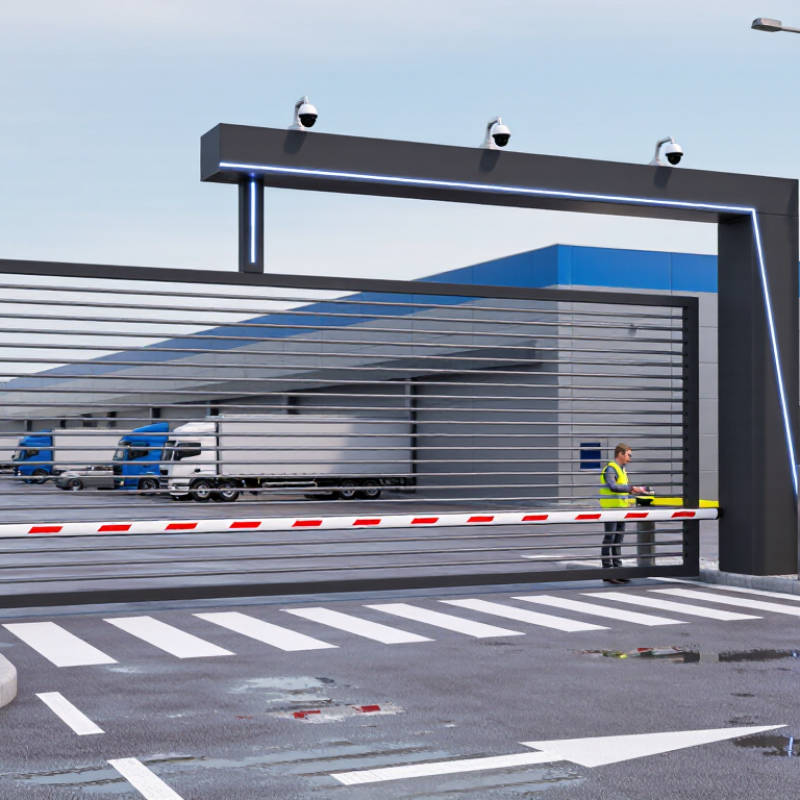
| 1. Match the gate to the site | Moves parallel to the fence; needs clear runback space beside the opening. | Needs room for one or two leaves to swing; check driveway slope and nearby paths. | Rises vertically; requires suitable overhead clearance and supporting structure. | Uses little lateral space and suits vehicle lanes where stopping is expected. | Choose controls based on who needs entry: handheld transmitters for regular users, keypads or credentials for shared access. |
| 2. Check wind and exposure | A solid infill can catch wind; consider local wind loads and a suitably engineered gate and foundation. | Solid leaves can impose substantial wind loads on hinges and posts; open infill can reduce wind exposure. | Design and structural support must account for the gate’s weight and site-specific wind conditions. | Wind load is generally lower than for a full-height gate, but the arm and mounting still need appropriate ratings. | For outdoor readers, keypads, and enclosures, verify the stated temperature range and ingress-protection rating for the installation environment. |
| 3. Assess traffic and opening speed | Often suitable for frequent vehicle use when the operator and gate are rated for the duty cycle. | Can work well for residential or lower-traffic entrances; leaf size, weight, and cycle frequency affect operator selection. | Can suit sites that need vertical movement, but installation and maintenance requirements are site-specific. | Commonly used for controlled vehicle lanes with frequent passage; it regulates traffic but does not provide a full-height barrier. | Check reader response, credential capacity, and whether entry records or scheduled access are needed. |
| 4. Plan safety protection | Use suitable entrapment protection, such as monitored photoelectric sensors or edges, as required by the design and local rules. | Protect the swing path and hinge-side hazards; arrange sensors and safety edges for the actual layout. | Use the manufacturer-specified safety devices and safeguards for the lifting mechanism and access area. | Provide appropriate vehicle and pedestrian detection; use a breakaway or other specified safety feature where required. | Remote access does not replace physical safety devices. Confirm applicable local codes and have the complete system assessed by a qualified installer. |
| 5. Compare access methods | Compatible control depends on the operator and its control inputs; confirm interoperability before purchase. | Confirm that the selected operator supports the planned control devices and any required interface. | Check control-system compatibility with the lift mechanism and site access equipment. | Verify that the controller supports the intended lane controls and vehicle-detection equipment. | Options include radio transmitters, PIN keypads, RFID or other credential readers, intercoms, and smartphone access. Verify protocol, receiver compatibility, and credential management. |
| 6. Prepare for power or network outages | Ask about manual release, battery backup availability, and whether backup operation meets the site’s needs. | Confirm how the gate can be released safely if power fails, including any two-leaf operating requirements. | Review emergency release procedures and backup-power options for the specific lift design. | Determine how the arm will be raised or secured during an outage and whether a backup supply is appropriate. | Battery backup may keep some operators running, but internet-dependent features can still be unavailable without a connection. Ask which functions work offline. |
| 7. Budget for installation and upkeep | Allow for a level track or a suitable trackless design, foundations, drainage, and periodic inspection of moving parts. | Budget for strong posts and hinges, correct alignment, and inspection of the leaves and operator. | Include structural work, specialist installation, and service access for the lifting equipment. | Plan for arm and mechanism inspections, vehicle-loop or sensor checks, and replacement of wear items. | Compare the total cost of readers, credentials, wiring, network connectivity, software, and support—not just the gate operator. |