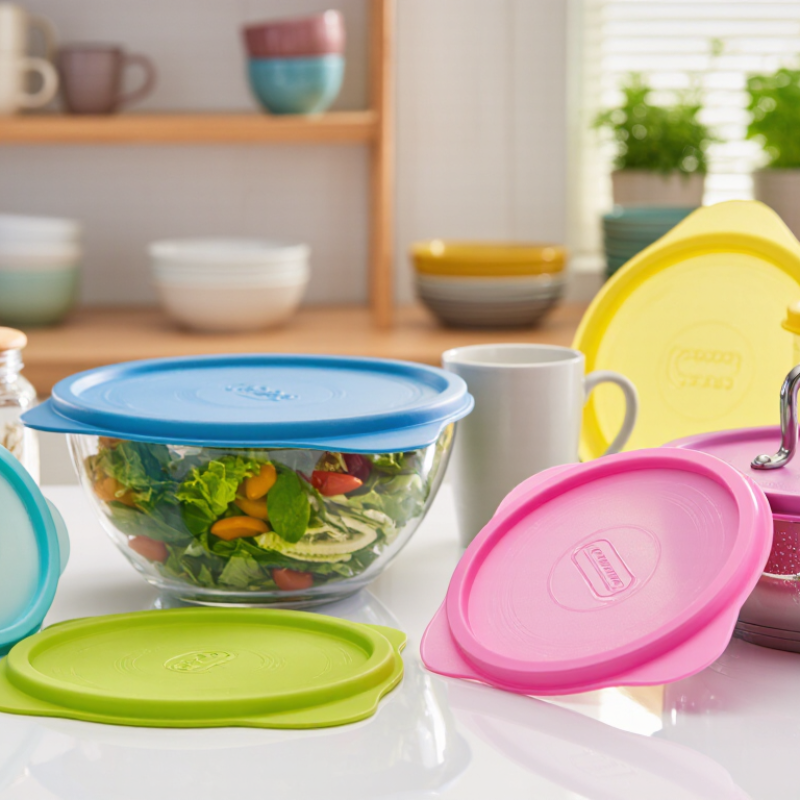
| Primary Material | Food-grade silicone rubber, generally made from silicone polymers with approved pigments or additives. | Silicone provides flexibility, resilience, and a non-porous surface that can form a seal against many smooth container rims. | Choose a lid identified as food-contact safe and free from unwanted fillers or strong chemical odors. |
| Temperature Resistance | Many food-grade silicone products are designed for approximately -40°C to 200°C, but the exact limit depends on the product construction. | The material remains flexible across a broad temperature range, allowing use with chilled foods and many hot foods. | Always follow the lid's stated limits. Temperature resistance does not automatically mean suitability for direct flame, ovens, or broilers. |
| Stretch and Elasticity | The flexible sheet can stretch around container openings that are slightly larger or smaller than the lid's relaxed diameter. | Elastic tension helps the lid conform to the rim and maintain contact when the surface is smooth and clean. | Stretching capacity is limited. Excessive tension may reduce sealing performance or shorten service life. |
| Universal Size Adaptability | A single round lid commonly fits several container diameters within a stated range, such as about 15–25 cm. | The lid adapts through elastic deformation rather than using a rigid, fixed-size locking mechanism. | Measure the outside diameter and rim shape of the container before selecting a size range. |
| Sealing Mechanism | A flexible perimeter, sometimes combined with a raised center or pull tab, creates a close contact seal. | Pressing the lid onto the opening removes some air and allows the silicone edge to grip the rim. | The seal is usually splash-resistant or airtight only when the rim is smooth, dry, and free from crumbs or grease. |
| Container Compatibility | Bowls Cups Pots Containers | The flexible material can cover glass, ceramic, metal, and many rigid food-safe plastic containers. | Best results occur on flat, continuous rims. Containers with sharp edges, deep curves, or damaged lips may not seal well. |
| Surface and Texture | Usually smooth, non-porous, and slightly tacky, with a flexible edge that may include ribs or concentric rings. | The surface helps resist liquid absorption, while edge texture can improve handling and contact with the container. | A smooth surface is easier to clean, but it can attract lint or dust when stored without drying. |
| Air and Liquid Control | Designed to cover food and reduce exposure to air, spills, and household odors; performance varies by fit. | Close contact limits air exchange and helps contain liquids during normal stationary storage. | A universal lid is not necessarily leak-proof during shaking, transport, or pressure changes unless it has a dedicated locking design. |
| Transparency | Many silicone lids are translucent or semi-transparent, while some are opaque due to pigmentation. | Translucency allows users to identify the covered food without fully removing the lid. | Color and transparency do not determine sealing quality; edge contact and correct sizing are more important. |
| Cleaning Method | Typically washable by hand and often suitable for dishwashers when permitted by the product instructions. | The non-porous material generally releases food residue more easily than absorbent materials. | Wash after oily foods, allow the lid to dry fully, and inspect the edge for cuts, tears, or permanent deformation. |
| Reusable Life | Intended for repeated use; service life depends on heat exposure, stretching, cleaning, storage, and physical damage. | Silicone can repeatedly flex and recover its shape, reducing the need for disposable plastic wrap. | Replace the lid if it becomes sticky, cracked, permanently stretched, brittle, or unable to maintain contact. |
| Key Limitations | Not suitable for every container shape or every cooking application. | The lid relies on surface contact and cannot compensate for rough, porous, sharply angled, or heavily irregular rims. | Do not use as a pressure-cooker seal, a substitute for a canning closure, or directly over an open flame unless specifically designed for that purpose. |