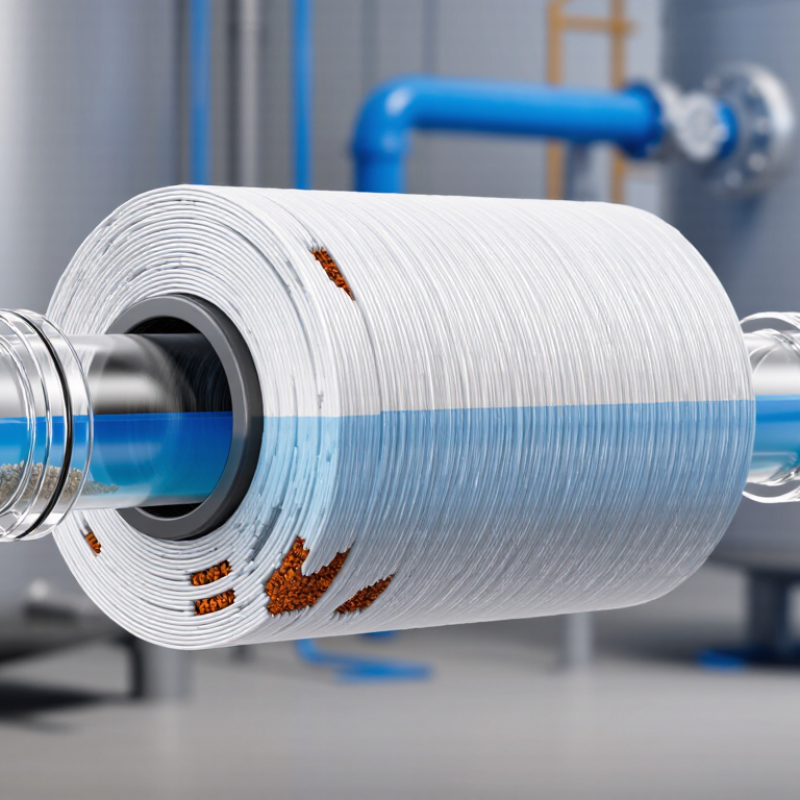
| Primary Function | Depth filtration of suspended solids, sediment, rust, dirt, sand, and other particulate matter in liquid streams. | The wound layers provide a three-dimensional filtration path that can retain particles throughout the cartridge depth rather than only at the surface. |
| Common Applications | Pre-filtration for drinking-water systems, process water, industrial liquids, cooling water, irrigation water, and reverse-osmosis systems. | String wound cartridges are commonly used where reducing visible sediment and protecting downstream equipment are important. |
| Typical Contaminants Removed | Sand, silt, rust particles, scale fragments, pipe debris, and other non-dissolved solids. | They are designed mainly for particulate reduction and generally do not remove dissolved salts, most dissolved chemicals, or microorganisms unless combined with another treatment method. |
| Filter Media | Common winding materials include polypropylene, cotton, polyester, and other compatible fibers. | The fiber material should be selected according to liquid compatibility, temperature, chemical exposure, and regulatory requirements. |
| Core Material | Usually a rigid plastic or other structural support core. | The core helps maintain cartridge shape and provides mechanical support as pressure builds during service. |
| Typical Nominal Ratings | Many commercially available cartridges are offered in ratings from approximately 1 to 100 micrometres, depending on construction and manufacturer specifications. | A lower nominal rating generally indicates finer particle capture, but the actual performance depends on fiber, winding density, fluid conditions, and test method. |
| Filtration Mechanism | Liquid flows through channels formed by the wound fibers while particles are trapped by interception, entrapment, and depth loading. | Progressively tighter passages toward the inner layers can improve particle retention and distribute contaminant loading through the cartridge. |
| Flow Direction | In many standard housings, liquid flows from the outside of the cartridge toward the inner core, although the required direction depends on the housing and cartridge design. | Correct flow direction helps use the intended filtration structure and prevents poor sealing or premature cartridge damage. |
| Pressure Drop | Pressure drop increases as trapped solids accumulate inside the cartridge. | Monitoring differential pressure helps identify loading and determine when cartridge replacement is needed. |
| Operating Temperature | Temperature limits vary according to the fiber, core, end-cap materials, and liquid being filtered. | The cartridge must be operated within its specified temperature range to avoid softening, deformation, media degradation, or loss of filtration integrity. |
| Chemical Compatibility | Compatibility depends on the media and construction materials. Polypropylene is often selected for broad compatibility with many aqueous applications, while natural fibers may have more limited resistance. | Material compatibility should be verified before use with solvents, oxidizing agents, acids, alkalis, oils, or other aggressive liquids. |
| Main Advantages | Large dirt-holding capacity, simple construction, broad availability, flexible micron options, and relatively low operating cost. | The depth-loading design can extend service life in applications with moderate or high particulate concentrations. |
| Main Limitations | Not normally intended for dissolved contaminants, gases, or complete microbial control; heavily loaded cartridges require replacement. | Additional treatment technologies may be needed for dissolved solids, taste and odor compounds, oil removal, or disinfection. |
| Replacement Indicators | Excessive differential pressure, reduced flow rate, visible cartridge fouling, or deterioration in downstream water quality. | Replacement intervals depend on feed-water quality, flow rate, contaminant concentration, cartridge size, and the selected filtration rating. |
| Best Selection Factors | Required particle size reduction, liquid compatibility, operating temperature, flow rate, pressure limits, housing dimensions, and expected contaminant load. | Choosing a cartridge based only on micron rating may lead to premature clogging or inadequate protection of downstream equipment. |