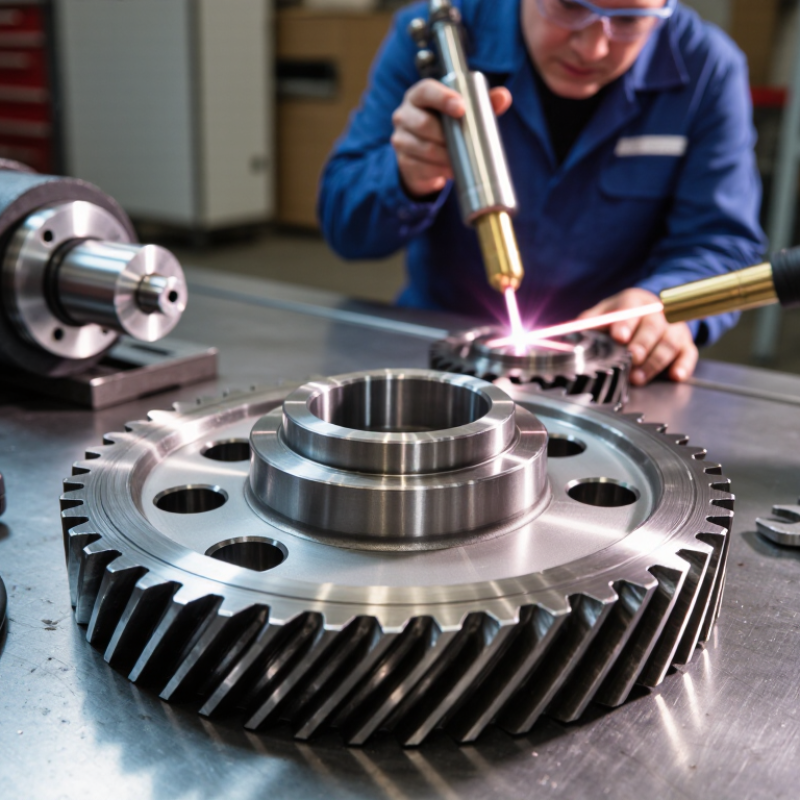
| Nitriding | Nitrogen diffuses into the surface of a suitable steel, usually through a controlled gas, plasma, or salt-bath process. | Creates a hardened surface layer while leaving most of the component’s core properties largely unchanged. | Improve wear resistance and resistance to surface fatigue. | Gears, crankshafts, and other steel components subject to repeated contact. | Material composition and process conditions affect the resulting layer; the process is mainly used for suitable steels. |
| Physical Vapor Deposition (PVD) | Material is vaporized in a vacuum and condenses as a thin coating on the component. | Adds a thin functional film without changing the component’s bulk material. | Reduce friction and improve resistance to wear or surface damage. | Cutting tools, forming tools, and precision components. | Coating adhesion depends on surface preparation, coating selection, and process control. |
| Chemical Vapor Deposition (CVD) | Reactive gases form a solid coating through chemical reactions at or near a heated component surface. | Deposits a coating that can provide wear, chemical, or thermal protection. | Protect surfaces in demanding wear or high-temperature environments. | Hard-coated tooling and components requiring protective films. | Many CVD processes use elevated temperatures, which may affect the substrate or its prior heat treatment. |
| Anodizing | An electrochemical process thickens the naturally occurring oxide layer on metals such as aluminum. | Forms an oxide surface that can improve corrosion resistance and provide a base for coloring or sealing. | Protect against corrosion and, depending on the process, improve surface wear performance. | Aluminum housings, panels, and components exposed to the environment. | The outcome depends on alloy, process conditions, and sealing; anodizing is not a coating suitable for every metal. |
| Thermal Spraying | Powder or wire feedstock is heated and propelled onto a prepared surface, where particles build up as a coating. | Adds a comparatively thick coating that can restore dimensions or provide a functional surface. | Improve wear, corrosion, or heat resistance, depending on the coating material. | Turbine components, industrial rollers, and worn parts requiring surface restoration. | Coating quality depends on surface preparation, deposition conditions, and the selected feedstock. |
| Electroless Nickel Plating | A chemical reaction deposits a nickel-based layer without using an external electrical current. | Creates a coating that can provide corrosion and wear protection, with coverage on complex shapes. | Protect components and help achieve consistent coverage on intricate surfaces. | Valves, pumps, and components with recessed or complex geometry. | Coating properties vary with bath chemistry and treatment; the component must be compatible with the process. |