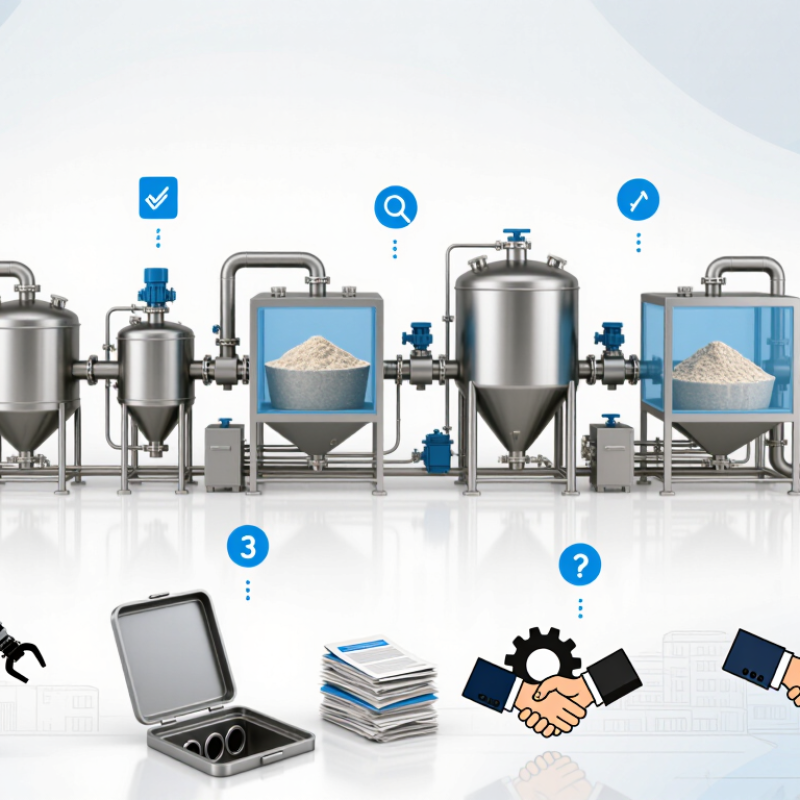
| 1. Define the containment objective | Compare sealed transfer connections, enclosure design, dust extraction interfaces, and provisions for safe disconnection. A closed configuration can reduce operator exposure, but it does not by itself guarantee a particular containment level. | Map every powder-transfer step, including charging, discharge, sampling, and equipment changeover, to identify where the process could be exposed to the room. | Ask for containment test methods and results for the intended material and operating conditions. Confirm how routine interventions and maintenance are handled. |
| 2. Match the granulation method to the formulation | Compare high-shear wet granulation, fluid-bed granulation, and dry granulation designs. They differ in mixing action, liquid addition, drying needs, and suitability for different material properties. | Check how the chosen method connects to dispensing, drying, milling, and final blending, and whether the process flow supports the intended batch sequence. | Review development or scale-up data for the formulation, including granule properties, yield, and the effects of process variables such as liquid addition and mixing time. |
| 3. Compare transfer and connection design | Assess sealed product paths, transfer containers or valves, docking arrangements, and the number of manual handling steps between equipment items. | Confirm that connection sizes, elevations, discharge points, and transfer routes align with upstream and downstream equipment. | Request a process-flow diagram and equipment layout. Check for trapped product, difficult-to-access connections, and practical ways to verify correct docking. |
| 4. Evaluate cleaning and changeover | Compare clean-in-place capability, removable product-contact parts, drainability, access for inspection, and the design of seals and dead spaces. | Determine whether cleaning utilities, wash steps, drying, and inspection can be coordinated across the full line rather than equipment by equipment. | Review cleaning procedures and validation approach for the actual product-contact surfaces. Confirm how cleaning status is documented before the next batch. |
| 5. Check utilities and environmental controls | Compare requirements for electrical power, compressed air, process air, vacuum, water, and exhaust. For fluid-bed systems, airflow and filtration are especially important design considerations. | Verify that facility capacity, utility quality, room conditions, and exhaust arrangements support simultaneous operation of connected equipment. | Request a utility load list and identify temperature, humidity, pressure, and filtration requirements. Confirm how filter inspection and replacement are managed. |
| 6. Assess automation and data handling | Compare recipe control, sensor coverage, alarms, interlocks, and the ability to control and record critical process parameters. | Check whether equipment controls can exchange the necessary batch, status, and alarm information with the facility control system and adjacent process steps. | Review the control-system boundary, data records, user access, and alarm handling. Confirm that recorded parameters match the process-control strategy. |
| 7. Plan capacity, flexibility, and lifecycle support | Compare working-volume range, allowable batch sizes, change parts, wear components, maintenance access, and the ability to accommodate future formulations. | Assess bottlenecks across the entire line, including transfer, drying, cleaning, and material staging—not just the nominal capacity of the granulator. | Use representative batch-cycle estimates and maintenance plans. Verify spare-part availability, operator training needs, and access for inspection and servicing. |