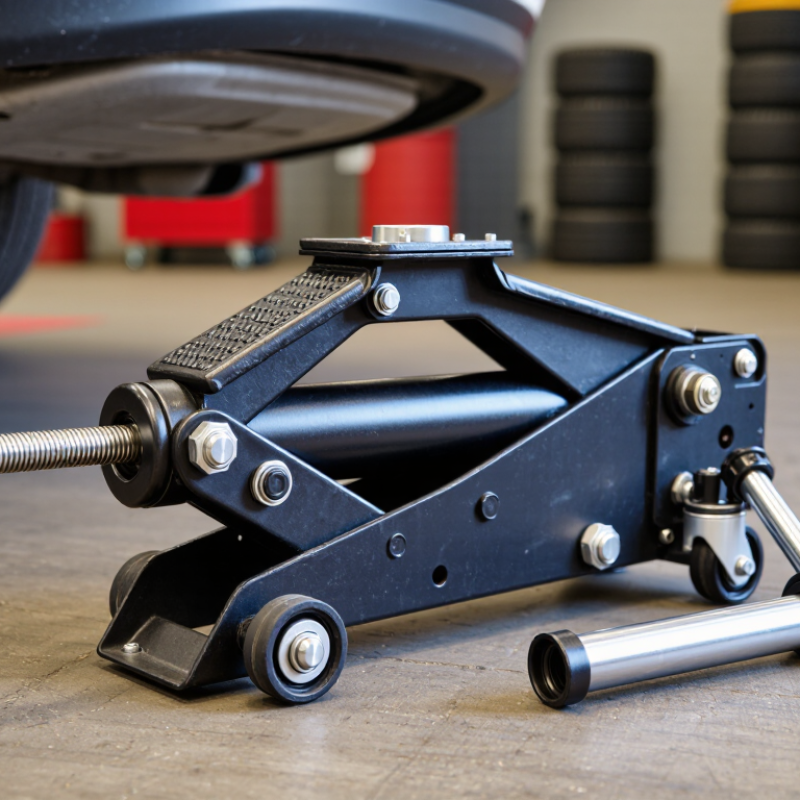
| 1 | Choose the Correct Lifting Capacity | Common short hydraulic jacks are available in approximately 2–20 tonnes. Select a rated capacity at least 25% higher than the intended lifting load. | A suitable safety margin reduces overload risk and helps the jack operate with less hydraulic stress. | Check the equipment weight, axle load, or manufacturer specification. Never rely on the total vehicle weight alone. |
| 2 | Match the Minimum and Maximum Height | Typical minimum saddle heights are about 75–125 mm, with lifting ranges commonly around 40–100 mm for compact models. | A short jack must fit beneath the lowest lifting point while still reaching a stable contact position. | Measure the clearance at the approved lifting point when the load is resting normally. Compare it with the jack's closed height. |
| 3 | Assess Build Quality and Stability | Prefer a welded steel body, a machined or hardened saddle, a wide base, protected hydraulic components, and a smooth, aligned ram. | Rigid construction helps maintain alignment and reduces tipping, deformation, and premature wear. | Inspect welds, base flatness, saddle condition, ram finish, oil seals, and handle sockets. Avoid visible cracks, dents, or oil residue. |
| 4 | Verify Safety Features | Look for an overload protection system, controlled lowering, a non-slip saddle, clear capacity markings, and instructions for safe operation. | Safety controls help limit excessive pressure and sudden descent during normal use. | Review the manual and product test documentation. Confirm that the jack is intended for lifting only and use approved support stands afterward. |
| 5 | Compare Operating Performance | A practical compact model should lift smoothly without binding, hold the rated load without noticeable drift, and lower in a controlled manner. | Smooth movement indicates proper hydraulic sealing, correct alignment, and adequate manufacturing quality. | If possible, perform a no-load and controlled-load test. Check for abnormal noise, jerky movement, leakage, or rapid pressure loss. |
| 6 | Evaluate Total Purchase Cost | Typical retail pricing is approximately USD 30–80 for basic 2–4 tonne units, USD 80–200 for heavier-duty compact models, and higher for specialized designs. | The lowest purchase price may lead to higher replacement, maintenance, or downtime costs. | Compare capacity, dimensions, included handle, shipping, replacement seals, service availability, and expected duty cycle—not price alone. |
| 7 | Review Warranty and After-Sales Support | A written warranty of 12–36 months is commonly offered, but coverage, exclusions, and service response times vary by seller and region. | Clear warranty terms protect against manufacturing defects and make long-term ownership costs easier to estimate. | Confirm the warranty period, covered parts, claim process, proof-of-purchase requirements, spare-part access, and technical support contact. |