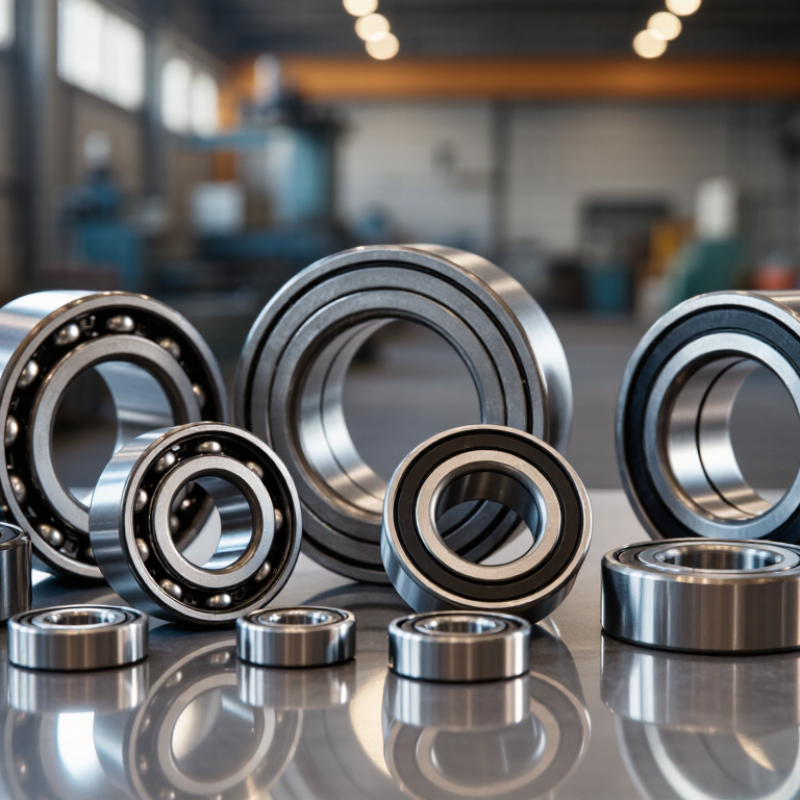
| Main bearing components |
| Component | Inner ring | Hardened ring with one or more precision-ground raceways; may be integrated with a hub in unitized assemblies. | Provides a running track for the rolling elements and transfers load to the axle or hub interface. | Fit and geometry depend on the bearing arrangement and the vehicle’s mounting design. |
| Component | Outer ring | Hardened ring with raceway surfaces, fitted into or incorporated into the wheel-end assembly. | Provides the opposing raceway and transfers load to the steering knuckle or housing. | In many wheel-end designs, the outer ring is stationary relative to the vehicle structure. |
| Component | Rolling elements | Precision-made balls or rollers positioned between the raceways. | Carry load while enabling relative rotation between the rings. | Element shape and raceway geometry influence load capacity, speed capability, and friction. |
| Component | Cage or separator | Component that spaces and guides the rolling elements; designs and materials vary. | Helps maintain rolling-element spacing and reduces contact between adjacent elements. | May be made from steel, polymer, or other materials selected for operating conditions. |
| Component | Seals and lubricant | Sealing elements protect the bearing interior; grease is commonly retained inside sealed wheel-bearing units. | Help retain lubricant and limit the entry of water and contaminants. | Sealing performance and lubricant selection are important for service life and operating conditions. |
| Common bearing types and wheel-end arrangements |
| Bearing type | Deep-groove ball bearing | Ball elements run in relatively deep, continuous grooves in the inner and outer rings. | Supports radial loads and can also accommodate axial loads in both directions within design limits. | Used in various rotating applications; suitability for a wheel end depends on the required load, stiffness, and packaging. |
| Bearing type | Angular-contact ball bearing | Raceways are arranged so that the contact angle supports combined radial and axial loading. | Carries radial load and axial load; paired arrangements can support axial loads in both directions. | Preload and paired configuration affect rigidity and operating behavior. |
| Bearing type | Tapered-roller bearing | Conical rollers run between matching tapered raceways. | Designed for combined radial and axial loads; axial-load capacity depends on orientation and arrangement. | Opposed pairs are commonly used where the wheel end requires support for axial loads from either direction. |
| Bearing type | Cylindrical-roller bearing | Cylindrical rollers run between cylindrical raceways; internal design determines axial guidance. | Generally well suited to high radial loads; axial-load capability varies by design. | Used where radial-load capacity is important and the arrangement accommodates the required axial movement or guidance. |
| Bearing type | Spherical-roller bearing | Barrel-shaped rollers run on a spherical outer-ring raceway. | Supports substantial radial loads and, depending on design, axial loads while accommodating limited misalignment. | More common in heavy-duty industrial and machinery applications than in passenger-car wheel hubs. |
| Wheel-end arrangement | Unitized hub bearing assembly | Preassembled wheel-end unit that may integrate bearing rows, hub flanges, seals, and, in some designs, a sensor encoder. | Supports the wheel and transfers vehicle loads while reducing the need for separate bearing adjustment during installation. | Configurations vary; features such as mounting flanges and wheel-speed sensing are application-specific. |