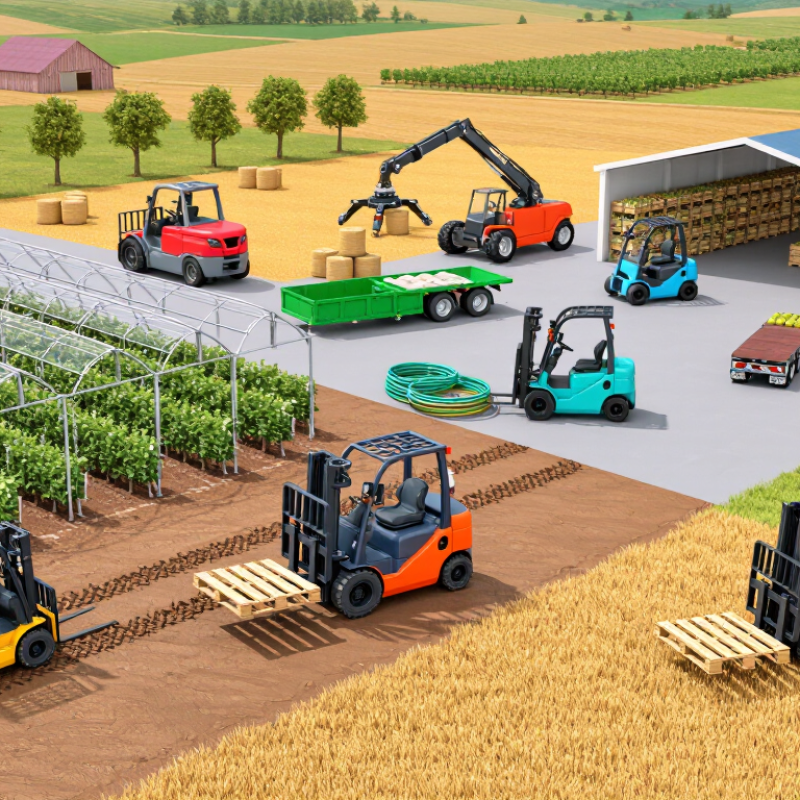
Agricultural forklifts are not classified by lifting capacity alone. Global buyers should examine terrain, crop conditions, workload, and attachment needs. A compact warehouse-style forklift may suit a flat packing shed. It can struggle badly in wet soil.
Terrain changes everything. Rough-terrain forklifts use larger tires, higher ground clearance, and stronger frames. Four-wheel drive improves traction near orchards, barns, and uneven storage yards. For narrow aisles, buyers often choose compact models with tighter turning radii. However, smaller dimensions can reduce stability when loads rise.
Capacity is another practical category. Light-duty forklifts handle bags, cartons, and short daily cycles. Heavy-duty machines move bulk feed, fertilizer, timber, or palletized produce. Buyers should compare rated capacity at the actual lifting height. A machine rated for three tonnes at low height may lift much less near its maximum reach. That detail is often overlooked.
Power systems create another classification. Diesel units suit outdoor work and long operating hours, while electric units fit enclosed facilities and noise-sensitive areas. Gas-powered options may offer flexibility, but ventilation remains important. Telescopic handlers extend the classification further by combining lifting height with forward reach. They can place materials onto high platforms, although reach affects balance quickly. Attachments also matter: forks, bale clamps, buckets, and platform accessories change the machine’s working purpose. In my experience, buyers sometimes classify equipment by appearance. That is convenient, but not always accurate. Check local certification, operator requirements, emissions rules, and service support before comparing specifications.