| China Airport Market Indicators |
| Passenger throughput | 1.459 billion passenger trips | Indicates the scale and intensity of passenger movement through China’s civil transport airport system. | Prioritize suppliers able to support high-frequency operation, rapid dispatch, documented quality control, and replacement-part availability. | Civil Aviation Administration of China, 2024 civil aviation industry statistics |
| Domestic passenger trips | Approximately 1.304 billion
Year-on-year growth: 14.3% | Domestic terminals create substantial demand for wear parts exposed to continuous daily traffic. | Assess service coverage, standard-part interchangeability, production capacity, and delivery performance within China. | Civil Aviation Administration of China, 2024 civil aviation industry statistics |
| International passenger trips | Approximately 155.17 million
Year-on-year growth: 70.0% | International traffic recovery increases operating hours and maintenance requirements at major gateway airports. | Look for multilingual technical documentation, export packaging, traceability, and support for international compliance requirements. | Civil Aviation Administration of China, 2024 civil aviation industry statistics |
| Transport airports | 262 airports
Reported at the end of 2024 | A large installed airport network supports recurring demand for escalator wear parts, safety devices, and electrical components. | Evaluate regional warehousing, emergency supply capability, spare-part catalog coverage, and documentation for different escalator configurations. | Civil Aviation Administration of China, 2024 statistical bulletin |
| Air cargo and mail throughput | Approximately 19.99 million tonnes
Year-on-year growth: 22.1% | Cargo-terminal escalators and moving walks may operate in demanding environments with higher exposure to dust, luggage, and service traffic. | Check sealing, corrosion resistance, load suitability, lubrication requirements, and maintenance intervals. | Civil Aviation Administration of China, 2024 civil aviation industry statistics |
| Airport Escalator Spare Parts Procurement Matrix |
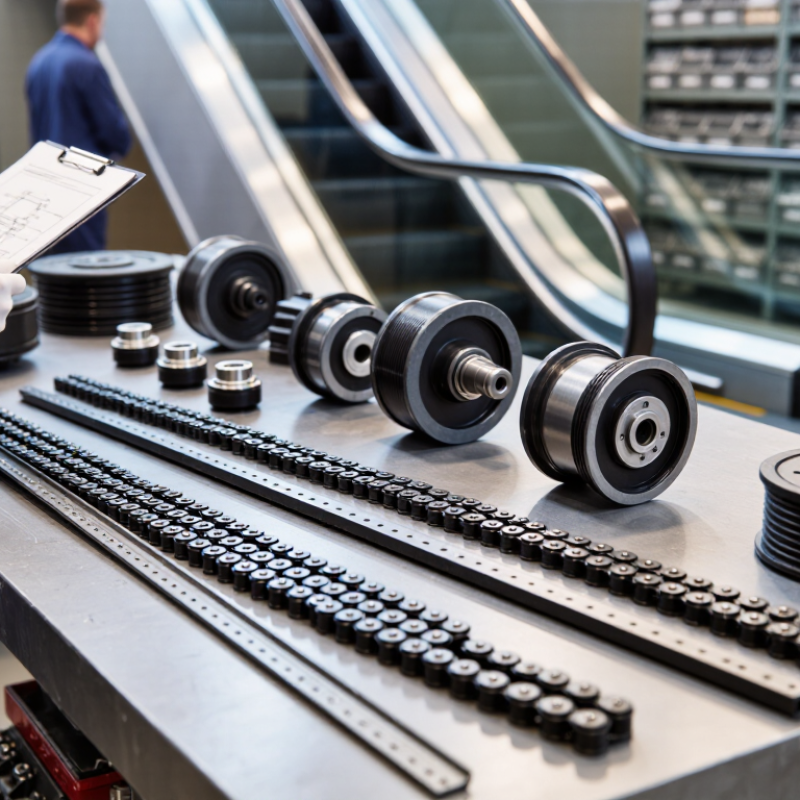
| Step assemblies and step rollers | High-wear component
Common materials include cast aluminum alloy, steel, polyurethane, and engineered plastics, depending on the design. | Step surfaces and rollers experience repeated loading, vibration, and contamination from luggage and passenger traffic. | Verify step dimensions, axle geometry, roller hardness, bearing specification, load rating, surface finish, and dimensional inspection records. | Equipment-specific drawings; GB 16899-2011 maintenance and safety requirements |
| Handrails and handrail drive components | Safety-critical interface
Common handrail materials include synthetic rubber or elastomeric constructions with embedded reinforcement. | Handrails require stable speed, correct tension, low friction, and resistance to abrasion and cleaning chemicals. | Confirm profile dimensions, tensile and elongation properties, joining method, color consistency, temperature range, and compatibility with the handrail drive system. | Equipment-specific specifications; GB 16899-2011 |
| Drive chains, step chains, sprockets, and shafts | Mechanical transmission
Typically supplied as matched components or according to the original equipment drawing. | Transmission wear can cause noise, uneven movement, vibration, and unplanned downtime. | Check pitch, roller diameter, tensile strength, heat treatment, sprocket tooth profile, alignment tolerance, lubrication requirements, and batch traceability. | Equipment-specific engineering drawings and maintenance records |
| Comb plates and comb segments | Passenger safety part
Usually manufactured from aluminum alloy or other approved structural materials. | Comb assemblies protect the transition between the moving steps and the fixed landing area. | Verify tooth geometry, gap dimensions, mounting-hole position, fracture resistance, surface finish, and compatibility with the step design. | GB 16899-2011; equipment-specific drawings |
| Balustrade panels, decks, and skirting parts | Structural and passenger-contact area
Common materials include tempered glass, stainless steel, aluminum, and coated sheet metal. | These parts are exposed to impact, cleaning chemicals, passenger contact, and visual-quality requirements. | Assess thickness, edge treatment, flatness, corrosion resistance, glass safety certification where applicable, and packing protection during transport. | GB 16899-2011; material and equipment specifications |
| Safety switches and monitoring devices | Safety-critical electrical part
Typical devices include emergency-stop switches, comb-plate switches, skirt obstruction switches, overspeed monitoring, and handrail-entry protection. | Safety devices initiate warnings or shutdowns when abnormal conditions are detected. | Confirm contact configuration, rated voltage and current, ingress protection, switching repeatability, reset method, wiring arrangement, and functional-test documentation. | GB 16899-2011; applicable electrical safety specifications |
| Controller, inverter, sensors, and relays | Control-system component
Specifications vary by escalator control architecture and motor system. | Control components affect starting, stopping, speed monitoring, fault diagnosis, energy use, and communication with building-management systems. | Verify voltage, current, frequency, input/output signals, software or parameter compatibility, electromagnetic compatibility, heat dissipation, and replacement commissioning requirements. | Equipment-specific electrical schematics; applicable GB and IEC requirements |
| Bearings, guide rollers, and return rollers | Routine maintenance part
Selection depends on load, speed, temperature, sealing, and mounting geometry. | Worn bearings and rollers can increase noise, friction, vibration, and energy consumption. | Check bearing designation, radial and axial load capacity, sealing type, operating temperature, lubrication, concentricity, and measured running noise. | Equipment-specific drawings; manufacturer maintenance specifications |
| Lubrication and cleaning components | Maintenance consumable
Includes lubricators, tubing, brushes, approved lubricants, and cleaning accessories. | Correct lubrication reduces friction and wear while unsuitable chemicals may damage elastomers, coatings, or electrical insulation. | Require material compatibility data, operating-temperature range, safety data sheets, dosing accuracy, shelf life, and clear maintenance instructions. | Equipment maintenance manuals; lubricant technical data sheets |
| Supplier Qualification and Purchasing Controls |
| Dimensional interchangeability | Must be verified against the equipment drawing | Escalator parts that appear similar may differ in profile, pitch, mounting position, electrical connection, or safety function. | Request inspection reports, dimensional drawings, sample approval, first-article inspection, and a controlled change-notification process. | Good engineering and maintenance practice |
| Quality and traceability | Batch-level traceability recommended | Traceability supports root-cause analysis, warranty management, and airport maintenance audits. | Review quality-management certification, material certificates, test records, serial or batch numbers, nonconformance procedures, and warranty terms. | Procurement quality-control practice |
| Delivery and after-sales support | Critical for 24/7 airport operations | Long downtime can disrupt passenger flow and terminal operations, especially at high-traffic locations. | Compare standard lead time, emergency response, local inventory, technical hotline coverage, installation guidance, return policy, and replacement availability. | Airport maintenance and service-planning practice |
| Applicable compliance framework | GB 16899-2011
Safety rules for the construction and installation of escalators and moving walks | The standard provides a key Chinese reference for escalator safety design, protective measures, and relevant components. | Ask suppliers to identify applicable clauses, provide conformity evidence where relevant, and confirm that replacement parts do not reduce the original safety level. | Chinese national standard GB 16899-2011 |