| Maximum service temperature | Graphite can operate above 2,000°C in vacuum or inert atmospheres. In oxidizing air, oxidation becomes significant at much lower temperatures, commonly around 400–600°C depending on grade, surface condition, and exposure time. | Vacuum furnaces, inert-gas heat treatment, high-temperature sintering, crystal growth, and thermal-processing equipment. | Specify atmosphere, pressure, heating cycle, dwell time, and whether the rod will be shielded from oxygen. |
| Material structure | Common rod materials include isotropic graphite, extruded graphite, molded graphite, and fine-grain graphite. Performance depends on grain size, porosity, strength, and manufacturing direction. | Heating elements, furnace fixtures, electrodes, support rods, susceptors, and high-temperature tooling. | Match the grade to mechanical load, thermal shock, electrical demand, and dimensional stability requirements. |
| Electrical resistivity | Typical industrial graphite grades may have room-temperature resistivity approximately in the range of 5–15 μΩ·m, with the exact value depending on grade, density, orientation, and test method. | Resistance heating, electrical contacts, electrodes, and conductive furnace components. | Request a certified resistivity range and define the measurement direction for anisotropic or extruded material. |
| Bulk density | Many dense industrial graphite products fall approximately within 1.6–1.9 g/cm³. Higher density generally reduces open porosity, although the optimum value depends on the application. | Vacuum furnace components, semiconductor processing parts, molds, crucibles, and precision fixtures. | Confirm density together with open porosity, permeability, flexural strength, and thermal conductivity rather than using density alone. |
| Thermal expansion | Graphite has relatively low thermal expansion compared with many metals, but expansion is anisotropic and varies with grade, orientation, temperature, and manufacturing process. | High-temperature fixtures, furnace supports, molds, and components exposed to repeated heating and cooling. | Request the coefficient of thermal expansion over the actual operating temperature range and identify the axial and radial directions. |
| Thermal shock resistance | Graphite generally provides good thermal-shock resistance because of its low thermal expansion and useful thermal conductivity; rapid temperature changes can still cause cracking in thin, notched, or poorly supported parts. | Batch furnaces, laboratory heating systems, rapid-cycle thermal processing, and removable furnace tooling. | Review wall thickness, edge radii, support points, heating rate, cooling rate, and handling procedures. |
| Chemical compatibility | Graphite is compatible with many high-temperature environments but can react with oxygen and certain metals, carbides, halogens, or process chemicals at elevated temperatures. | Inert-atmosphere furnaces, molten-material handling, laboratory equipment, and high-temperature reaction systems. | Provide the complete gas composition, contaminants, vapor species, contact materials, and expected exposure duration before selecting a grade. |
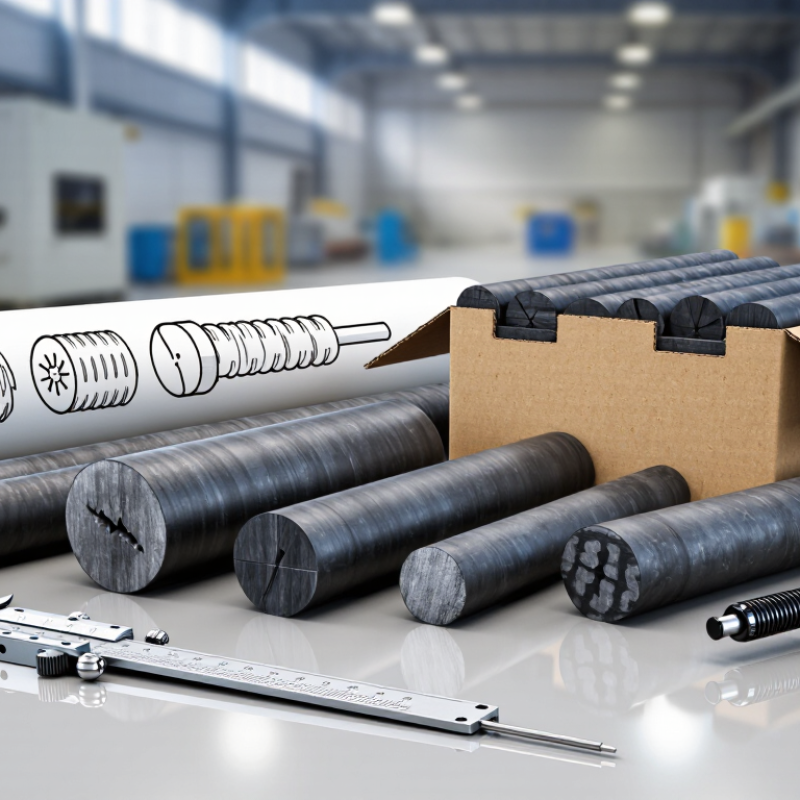
| Common rod profiles | Round rods, square rods, rectangular bars, stepped shafts, slotted rods, threaded rods, and rods with drilled or tapped holes can be produced according to drawing requirements. | Heating supports, electrodes, spacers, guide components, fixtures, and custom furnace assemblies. | Submit a 2D drawing or 3D model showing dimensions, tolerances, chamfers, threads, holes, datum references, and surface-finish requirements. |
| Custom size range | Small laboratory rods may be machined from millimeter-scale stock, while industrial rods can be supplied in larger diameters and lengths. Feasible dimensions depend on raw-material blocks, equipment capacity, grain structure, and machining limits. | Prototype components, replacement parts, pilot furnaces, production furnaces, and engineered thermal systems. | Confirm maximum blank size, finished length, diameter, straightness, concentricity, and allowable machining allowance before ordering. |
| Machining and tolerance | Graphite is relatively easy to machine but is brittle and generates fine dust. Tight tolerances may require additional grinding, inspection, and protective packaging. | Precision furnace assemblies, alignment components, electrical fixtures, and replacement parts. | Define tolerance by feature; avoid unnecessary precision on non-functional surfaces to control cost and reduce breakage risk. |
| Purity and ash content | Standard industrial graphite grades vary in purity. High-purity grades are commonly specified for contamination-sensitive applications, with the required ash or trace-element limit defined by the process. | Semiconductor processing, specialty ceramics, analytical equipment, and high-purity vacuum furnaces. | State the required purity basis, test method, restricted elements, cleaning procedure, and certificate requirements. |
| Coating options | Depending on the process, graphite may be supplied uncoated or protected with coatings such as silicon carbide, pyrolytic carbon, or other application-specific barrier layers. | Contamination-controlled furnaces, semiconductor equipment, crystal growth, and applications requiring improved oxidation or chemical resistance. | Specify coating thickness, allowable temperature, adhesion, dimensional impact, surface roughness, and compatibility with the process atmosphere. |
| Quality documentation | Typical documentation may include material grade, density, resistivity, flexural strength, ash content, dimensional inspection, surface inspection, and batch traceability. | Regulated manufacturing, repeat production, laboratory validation, and qualification of furnace components. | Request a sample inspection report, certificate of analysis, dimensional report, packaging specification, and nonconformance procedure. |
| Packaging and shipping | Graphite rods should be protected from impact, bending loads, moisture, contamination, and abrasion during handling and transport. | Domestic and international shipment of fragile custom-machined components. | Specify individual wrapping, end protection, rigid crates, orientation marks, moisture control, labeling, and spare-quantity requirements. |
| RFQ information checklist | A complete inquiry should include drawing, quantity, material grade, purity, dimensions, tolerances, operating temperature, atmosphere, electrical load, coating, inspection, and delivery requirements. | One-time prototypes, recurring production orders, replacement parts, and furnace retrofit projects. | Comparing quotations is more reliable when all suppliers receive identical technical specifications and acceptance criteria. |