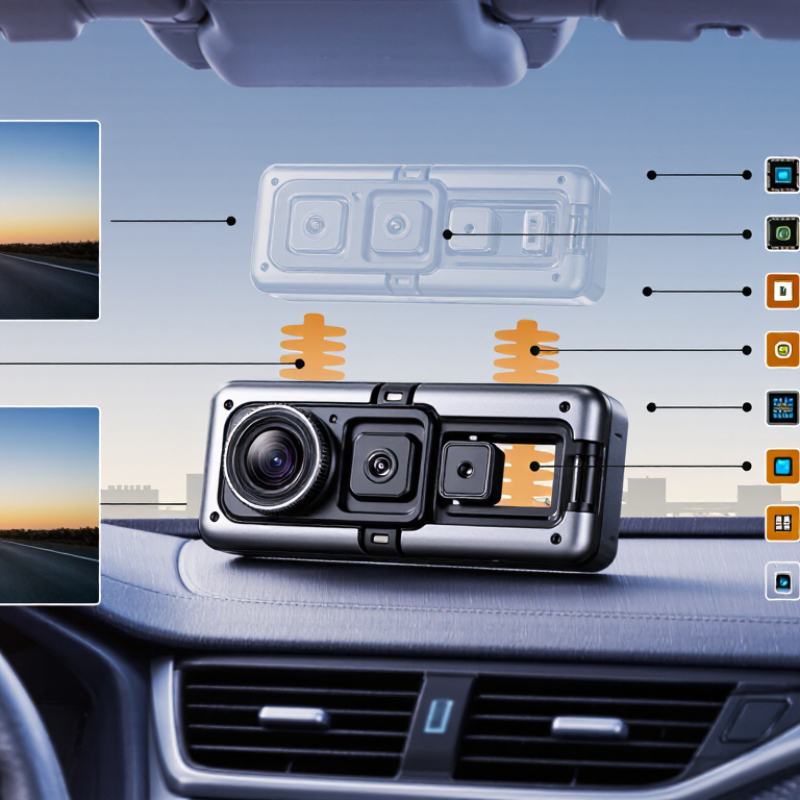
| Image sensor | A semiconductor sensor that converts incoming light into electrical signals. | Pixels capture light through the lens; the sensor reads and outputs image data for processing. Resolution, pixel size, readout mode, and low-light performance affect the result. | Confirm supported resolution and frame rates, image format, rolling- or global-shutter requirements, low-light test conditions, and whether the sensor is available for the required product life cycle. |
| Lens and optical assembly | The lens, lens holder, and related parts that focus a scene onto the image sensor. | Lens elements direct light onto the sensor. Focal length and field of view influence scene coverage, while focus, distortion, and optical alignment affect image clarity. | Check the stated field of view and how it is measured, focus range, distortion, aperture, infrared-filter configuration, alignment method, and performance across operating temperatures. |
| Image signal processor (ISP) | A processing unit, often integrated into a system-on-chip (SoC), that converts sensor data into viewable video. | The ISP can perform operations such as demosaicing, exposure adjustment, white balance, noise reduction, and color processing. Available functions depend on the chip and its software. | Request sample footage in daylight, low light, and high-contrast scenes. Verify supported sensor modes, image-processing controls, firmware access, and the video formats required by the final product. |
| Video encoder and processor | Hardware and software that prepare video streams for storage or transmission. | Video encoding compresses image data into a format such as H.264 or H.265, when supported. The processor may also coordinate recording, menus, event handling, and multiple camera inputs. | Confirm codec and profile support, resolution and frame-rate combinations, number of simultaneous streams, and sustained recording performance under the intended workload. |
| Memory and storage interface | Working memory and an interface for removable or built-in storage. | RAM supports active processing, while storage holds recorded video. Many dash cameras use a microSD card; card capacity, write speed, file system, and card compatibility affect reliable recording. | Check supported card types and capacities, minimum write-speed requirements, loop-recording behavior, file recovery after power loss, and endurance testing with the intended card specification. |
| Power management | Power-conversion and protection circuitry for the module and connected camera system. | Vehicle electrical systems commonly use nominal 12 V or 24 V supplies. A power stage converts the input to the lower voltages needed by the sensor, processor, and memory; protection design helps address electrical disturbances. | Verify the actual input-voltage range, power consumption, startup behavior, reverse-polarity and transient protection requirements, and the vehicle-specific power design. Do not connect a low-voltage module directly to vehicle power unless designed for it. |
| PCB, connectors, and interfaces | The circuit board and electrical connections linking the sensor, processor, storage, and external equipment. | Board traces carry power and data. Depending on the design, interfaces may include MIPI CSI-2 between sensor and processor, USB for data or service, or other board-level and external connections. | Review interface versions, pin assignments, connector retention, cable length limits, signal-integrity needs, board dimensions, and the availability of schematics or integration documentation. |
| Thermal design and enclosure | Mechanical parts and heat-management features that protect and position the module. | The enclosure holds the optical assembly in alignment and shields electronics. Heat flows from components through the PCB and housing; temperature can affect image quality, reliability, and component life. | Assess operating and storage temperature ratings for the complete assembly, heat dissipation, vibration resistance, mounting method, ingress protection if specified, and focus stability after thermal cycling. |
| Firmware and image tuning | Embedded software and calibration settings that control recording and image behavior. | Firmware configures sensor operation, exposure, encoding, recording, and supported features. Image tuning adjusts processing for the lens, sensor, and intended scene conditions. | Clarify firmware ownership and update method, customization scope, language and regional requirements, configuration tools, defect-fix process, and validation using production-equivalent hardware. |
| Supplier validation and production control | Processes used to check that modules meet agreed requirements consistently. | Engineering samples, pilot builds, and production inspections help identify design and manufacturing variation. Test coverage may include image performance, electrical behavior, mechanical fit, and environmental reliability. | Request a written specification, sample test reports, change-control procedure, traceability details, quality-system information, production capacity evidence, and a clear process for handling nonconforming units. |