01
Legal Business Verification | Supplier provides a consistent registered company name, business address, legal representative information, and active business license. | Business license copy, official registration details, company bank-account information, and matching names across quotation, contract, invoice, and shipping documents. | Confirms that the buyer is dealing with a traceable legal entity rather than an unverifiable trading contact. |
02
Product Range and Material Consistency | Can clearly specify granite variety, color, finish, thickness, tolerances, edge profile, and acceptable natural variation. | Current product catalog, high-resolution slab or tile photographs, physical samples, technical specifications, and written approval samples. | Granite is a natural stone, so color, veining, mineral distribution, and background tone can vary between batches. |
03
Dimensional Accuracy | Uses documented production tolerances and checks thickness, length, width, squareness, and flatness before packing. | Inspection checklist, measurement records, approved drawings, and pre-shipment inspection photographs showing calibrated measuring tools. | Accurate dimensions reduce installation problems, joint inconsistencies, material waste, and replacement claims. |
04
Physical Performance Data | Provides test data appropriate to the intended application, such as water absorption, density, compressive strength, and flexural strength. | Recent laboratory reports linked to the supplied material, test methods, sample identification, and testing dates. | Performance requirements differ for façades, flooring, countertops, stairs, paving, and other applications. |
05
Quality Management | Maintains documented incoming-material, in-process, and final-inspection procedures with defined acceptance criteria. | Quality-control process, inspection forms, nonconformity records, corrective-action procedure, and production photographs or video. | A repeatable quality system is more dependable than a one-time visual inspection or informal assurance. |
06
Sample-to-Production Control | Agrees in writing how the approved sample will be compared with mass production and how natural variation will be handled. | Signed sample approval, batch photographs, slab layout images, color-range confirmation, and a clear rejection or replacement procedure. | Prevents disputes caused by differences between sample pieces and delivered production batches. |
07
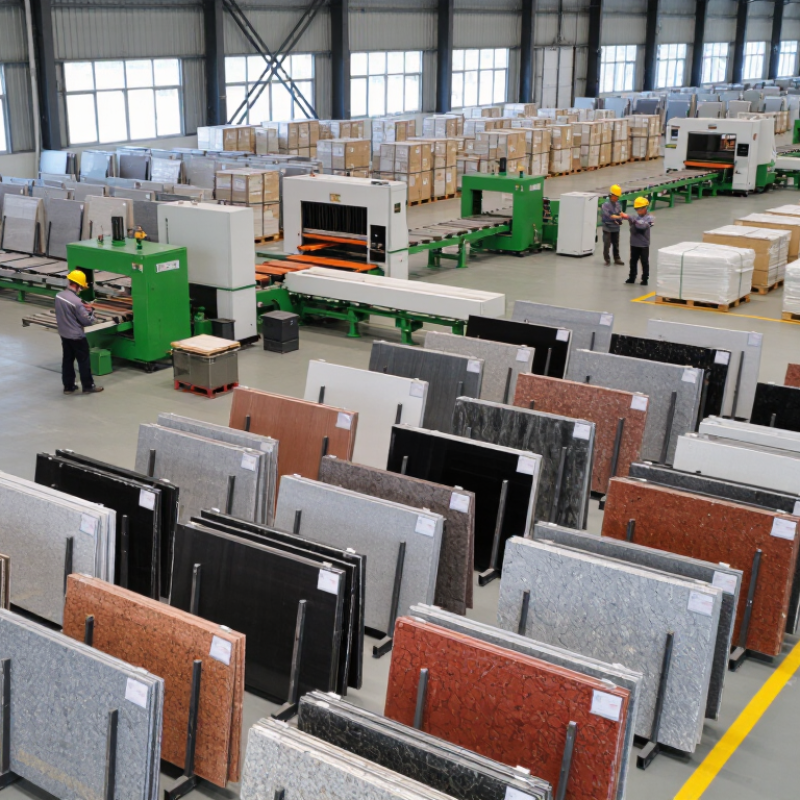
Processing Capability | Can support the required combination of sawing, polishing, honing, flamed or brushed finishing, CNC cutting, drilling, and edge processing. | Machine list, processing-area photographs, technical drawings, shop drawings, and examples of comparable completed work. | Complex fabrication requires stronger process control than standard cut-to-size products. |
08
Packaging and Loading | Uses packaging suited to stone weight, surface finish, transport distance, moisture exposure, and handling conditions. | Packing specifications, crate photographs, loading plans, gross and net weight details, and container-loading records. | Proper bracing and separation help prevent corner damage, scratches, breakage, and shifting during transport. |
09
Export Documentation | Can prepare consistent commercial and shipping documents, including commercial invoice, packing list, bill of lading, and origin documents when required. | Redacted sample documents, harmonized-system classification confirmation, shipping terms, and document-submission timeline. | Correct documentation supports customs clearance, payment processing, insurance claims, and import compliance. |
10
Trade Terms and Cost Transparency | Separates stone, processing, packaging, inland transport, port charges, documentation, and freight-related costs in the quotation. | Itemized quotation under an agreed Incoterm, validity period, minimum order quantity, payment schedule, and list of exclusions. | A low unit price may exclude important costs or reflect differences in thickness, finish, quality, or packaging. |
11
Production Lead Time | Provides a realistic schedule covering sample approval, material preparation, fabrication, inspection, packing, and dispatch. | Written production timeline, capacity confirmation, order milestones, and procedures for reporting delays. | Clear milestones help buyers coordinate construction schedules, installation teams, and inventory planning. |
12
Communication and Technical Support | Responds with specific technical information, confirms drawings and measurements, and identifies ambiguities before production. | Written quotation, drawing-confirmation workflow, named project contact, response-time expectations, and records of technical approvals. | Good communication reduces errors in dimensions, quantities, finishes, labeling, and installation requirements. |
13
Inspection and Acceptance | Accepts reasonable pre-shipment inspection based on agreed specifications, approved samples, quantity, finish, and packaging standards. | Inspection scope, inspection timing, defect classification, tolerance table, photo records, and written acceptance procedure. | Independent or buyer-authorized inspection creates objective evidence before the goods leave the factory. |
14
After-Sales and Claims Handling | Defines how shortages, breakage, dimensional defects, finish problems, and specification deviations will be investigated and resolved. | Written claims policy, required evidence, response deadline, replacement or credit terms, and responsibility for confirmed defects. | Clear remedies protect the buyer when problems are discovered after delivery or installation preparation. |
15
Responsible Sourcing and Compliance | Can explain the origin and supply chain of the stone and provide relevant environmental, labor, or project-specific compliance information. | Quarry or source disclosure where available, material-origin statement, compliance declarations, and project-required certifications. | Public, commercial, and green-building projects may require traceability and documented responsible-sourcing practices. |