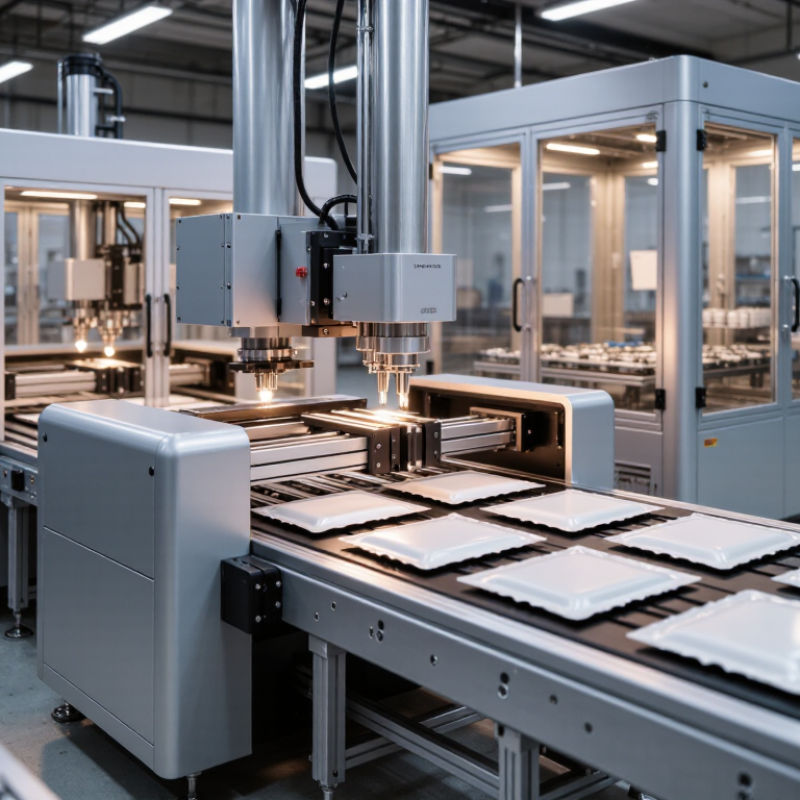
| Machine Function | Primary trimming purpose | Removes excess aluminum-plastic laminate film and shapes the pouch edge after cell forming. | Creates a consistent perimeter for sealing, folding, tab protection, insulation, and subsequent assembly. | Integrated trimming, edge folding, inspection, and production-data collection in one automated line. |
| Cell Formats | Compatible pouch-cell designs | Flat pouch cells with different length, width, thickness, tab positions, and forming depths. | Used for consumer electronics, battery energy storage, electric vehicles, and specialty mobility batteries. | Modular tooling and recipe-based changeover to support multiple cell models on the same line. |
| Cutting Method | Mechanical trimming process | Uses precision dies, blades, or servo-driven cutting assemblies selected for laminate structure and edge geometry. | Supports repeatable edge dimensions while limiting burrs, film delamination, and damage to the formed pouch. | Higher-precision servo control, tool-life monitoring, and automated die-condition alerts. |
| Typical Accuracy | Dimensional repeatability | Precision requirements are commonly specified in tenths-of-a-millimeter ranges, depending on cell design, tooling, and quality standards. | Stable edge dimensions help maintain sealing allowances and consistent module or pack integration. | Closed-loop vision correction and statistical process control for continuous dimensional optimization. |
| Production Mode | Automation level | Available configurations range from operator-loaded semi-automatic equipment to fully automatic inline systems. | Semi-automatic systems suit pilot lines and low-volume production; inline systems suit high-volume manufacturing. | Robotic loading, automatic alignment, recipe management, and unmanned material handling. |
| Inspection | Quality-control checkpoints | Common checks include edge position, cut completeness, wrinkles, foreign particles, surface damage, and pouch deformation. | Early detection reduces the risk of sealing defects, electrolyte leakage, and downstream assembly rejection. | Inline machine vision combined with defect classification, traceability, and automatic reject handling. |
| Material Compatibility | Pouch-film considerations | Pouch packaging generally combines aluminum foil with polymer layers; cutting conditions must account for layer adhesion and thickness. | Correct tooling and pressure help prevent torn polymer layers, exposed foil, and contamination at the sealing zone. | Adaptive cutting parameters based on material recipes and real-time force or displacement feedback. |
| Key Applications | Consumer electronics | Small and thin pouch cells are widely used where low weight and flexible product geometry are important. | Smartphones, tablets, notebooks, wearables, and other compact electronic devices. | Faster changeover and finer edge control for increasingly compact, customized battery shapes. |
| Key Applications | Electric vehicles | Large-format pouch cells provide high packaging efficiency and flexible module design when properly protected and assembled. | Passenger vehicles, buses, commercial vehicles, and hybrid-electric platforms. | High-throughput lines with automated handling, stronger traceability, and integration with module and pack assembly. |
| Key Applications | Energy storage systems | Pouch cells can be used in stationary storage when supported by suitable compression, thermal management, and enclosure design. | Renewable-energy storage, backup power, telecommunications, and commercial storage installations. | Long-life production, low-maintenance tooling, and digital quality records for safety-critical applications. |
| Operational Efficiency | Changeover and maintenance | Quick tooling replacement, accessible maintenance points, spare-part availability, and operator training affect total equipment effectiveness. | Shorter setup times reduce production interruptions when manufacturers produce multiple pouch-cell models. | Predictive maintenance using vibration, motor current, force, and cycle-count data. |
| Sustainability | Material utilization and scrap | Trimming inevitably generates laminate offcuts; accurate nesting, optimized edge allowances, and controlled scrap collection can reduce waste. | Lower scrap improves material efficiency and supports safer, cleaner production areas. | Automated scrap separation, recycling-compatible collection, and production analytics for waste reduction. |
| Industry Trend | Digital manufacturing | Modern battery lines increasingly use PLC control, industrial networks, recipe storage, alarms, and production traceability. | Enables consistent process records and faster root-cause analysis across multiple production shifts. | MES connectivity, digital twins, remote diagnostics, and artificial-intelligence-assisted defect analysis. |
| Supplier Evaluation | Selection criteria for Chinese manufacturers | Relevant criteria include process validation, customization capability, safety design, acceptance testing, service response, documentation, and spare-parts support. | A complete evaluation helps match machine capability with cell dimensions, production volume, quality targets, and factory automation standards. | More standardized validation data, remote commissioning, lifecycle service agreements, and globally compatible control systems. |