Top 5 CNC Router Machines for Your Business Needs?
In today's competitive manufacturing landscape, choosing the right CNC Router can significantly impact your business success. According to a recent report by MarketsandMarkets, the global CNC Router market is projected to reach $2.75 billion by 2026, growing at a CAGR of 5.6%. This growth highlights the increasing demand for precision and efficiency in fabricating materials.
Expert Tom Richards, a prominent figure in CNC technology, once stated, "Investing in a high-quality CNC Router can streamline production and enhance product quality." As industries continuously evolve, the need for advanced machining solutions becomes crucial. CNC Routers allow businesses to cut, carve, and engrave various materials with remarkable accuracy.
However, selecting a CNC Router isn't always straightforward. Companies must consider factors like budget, operational capabilities, and specific project requirements. While many options exist, not all routers meet the diverse needs of every business. It's vital to investigate and reflect on the functionalities each router provides. This careful analysis can lead to better decisions and improved outcomes.
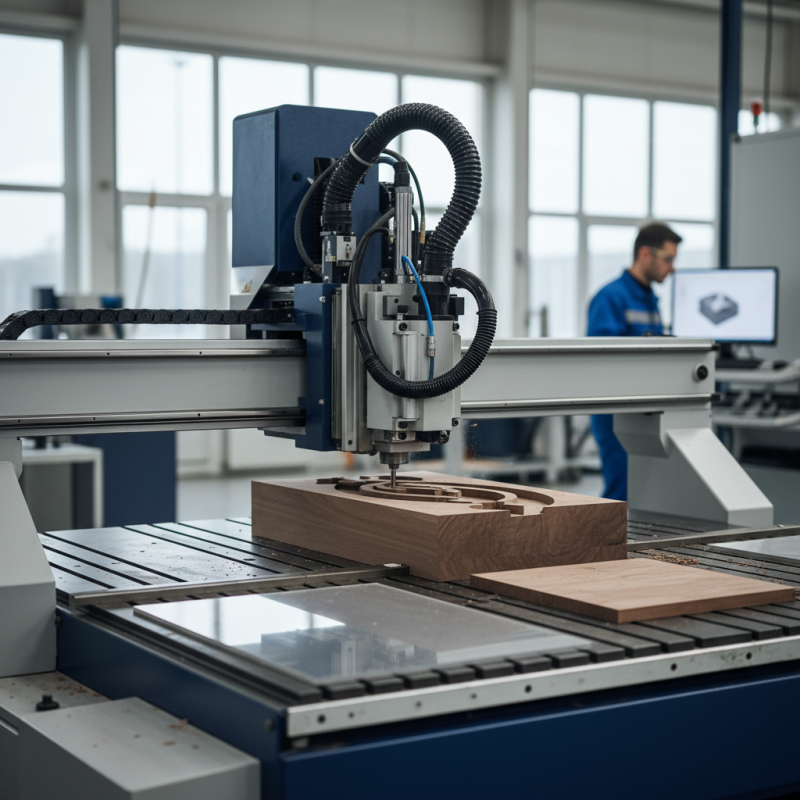
Top Features to Consider When Selecting CNC Routers for Businesses
When considering CNC routers for business needs, there are crucial features to evaluate. One key aspect is the machine's precision. Accurate cuts result in better product quality. Look for routers with reliable positioning systems. This ensures that every piece is consistent. A minor error can lead to significant material waste.
The size of the work area is another essential feature. Depending on your projects, you may need a larger workspace. A compact machine may limit your capabilities. Additionally, the router's milling speed impacts productivity. Faster machining means more output over time. Balance between speed and quality is vital.
Automation features are worth attention. CNC routers with auto-tool changers can save time. Streamlined processes reduce manual labor. However, consider your budget. Advanced features often come at higher costs. Evaluating your specific needs is crucial. Not every business requires the same functionalities. Taking time to assess these aspects will lead to smarter investment decisions.
Market Trends: Growth and Demand for CNC Router Machines in 2023
In 2023, the demand for CNC router machines is experiencing significant growth. This surge is driven by various industries seeking efficiency and precision. Businesses are investing in automation to improve production rates. Many companies report enhanced productivity since adopting CNC technology. The shift toward more advanced machinery has elevated operational standards.
Market trends reveal a strong inclination towards customization. Industries like woodworking and metal fabrication are responding to unique customer needs. The ability to create personalized designs helps businesses differentiate themselves. However, not all companies are adapting smoothly. Some face challenges integrating new technology into existing workflows. These obstacles highlight the importance of training and support.
User feedback often points to a learning curve associated with CNC machines. Understanding software and programming can be daunting for new operators. While technical skills improve over time, initial hurdles can be frustrating. Businesses need to acknowledge these issues and provide adequate solutions. Embracing both the benefits and challenges of CNC technology will ultimately enhance overall performance.
Comparison of Machining Precision: CNC Routers vs. Traditional Methods
CNC routers have revolutionized machining precision in various industries. Compared to traditional methods, their accuracy is hard to match. These machines can achieve tolerances within a few microns, thanks to computer-controlled movements. Traditional machining often relies on manual adjustments, which can introduce human error. In contrast, CNC routers consistently produce identical parts, enhancing production efficiency.
However, not all CNC routers are created equal. Factors like software capabilities, bit quality, and machine calibration impact outcome. A poorly calibrated CNC router can lead to subpar results. Traditional methods may be slower, but skilled artisans can produce intricate designs with a personal touch. It’s a balance between speed and craftsmanship. Each approach has strengths and weaknesses.
Adopting CNC technology requires ongoing learning and skill development. Operators must understand machine maintenance and software updates. Mistakes can occur during setup, affecting precision. The transition from traditional to CNC can be challenging. Yet, the benefits in precision often outweigh these initial hurdles. A thoughtful approach to integrating CNC routers can transform business practices.
Cost Analysis: Budgeting for Your CNC Router Investment and ROI
Investing in a CNC router is a significant decision for any business. Proper budgeting is essential. The initial cost can vary widely based on features and capabilities. Businesses must consider not just the purchase price but also ongoing operational costs. Maintenance, software updates, and consumables can add to the financial commitment.
Calculating return on investment (ROI) is equally crucial. A well-chosen CNC router can improve efficiency and productivity. However, not all models yield the same results. Each business needs to analyze its production needs. Consider how often the machine will be used. Understand the payback period for your router investment. This is often overlooked but vital for financial planning.
Investing without complete information can lead to regrets. Many companies find themselves needing more capability than their machine provides. This can hinder growth and lead to additional expenses. On the flip side, overspending on high-end features may not yield a proportional increase in returns. Balancing cost with capability requires thorough research and reflection.
Top 5 CNC Router Machines Cost Analysis
This chart illustrates the cost analysis of the top 5 CNC router machines, providing insights for budgeting and investment planning. The costs range from $3000 to $6000, which can help businesses assess potential return on investment (ROI).
Applications of CNC Routers: Industries that Benefit Most from Their Use
CNC routers are revolutionizing various industries by enhancing precision and efficiency. These machines are widely used in woodworking, metal fabrication, sign making, and even electronics. According to a report by Markets and Markets, the global CNC router market is expected to reach $8.7 billion by 2025, driven by increasing demand for intricate designs and customized solutions.
In woodworking, CNC routers allow for detailed carvings and complex cuts that traditional methods struggle to achieve. This has made them essential for furniture makers and cabinet producers. The furniture industry, for instance, saw a 16% increase in production efficiency with the help of CNC technology. In sign making, the ability to quickly produce high-quality signage has improved services and customer satisfaction.
However, challenges remain. The initial investment for CNC routers can be substantial. Many small businesses hesitate to adopt this technology due to high setup costs. Additionally, training skilled operators is crucial. Operators must understand both design software and machine operation. This complexity can create a barrier to entry, even as the benefits become clearer. Nonetheless, as industries evolve, the adaptability of CNC routers may lead to broader acceptance and use.
Top 5 CNC Router Machines for Your Business Needs
| CNC Router Model | Maximum Cutting Area (mm) | Spindle Power (kW) | Material Compatibility | Typical Applications |
| Model A | 3000 x 1500 | 3.5 | Wood, Plastic, Composite | Furniture Making, Signage |
| Model B | 2500 x 1250 | 2.2 | MDF, Acrylic, Soft Metals | Prototype Making, Arts and Crafts |
| Model C | 4000 x 2000 | 5.5 | Wood, Stone, Glass | Architectural Models, Art Installations |
| Model D | 2000 x 1000 | 1.5 | Plastic, Foam, Wood | Model Making, Educational Projects |
| Model E | 1500 x 1500 | 2.0 | Aluminum, Wood, Plastic | Small Parts Manufacturing, DIY Projects |