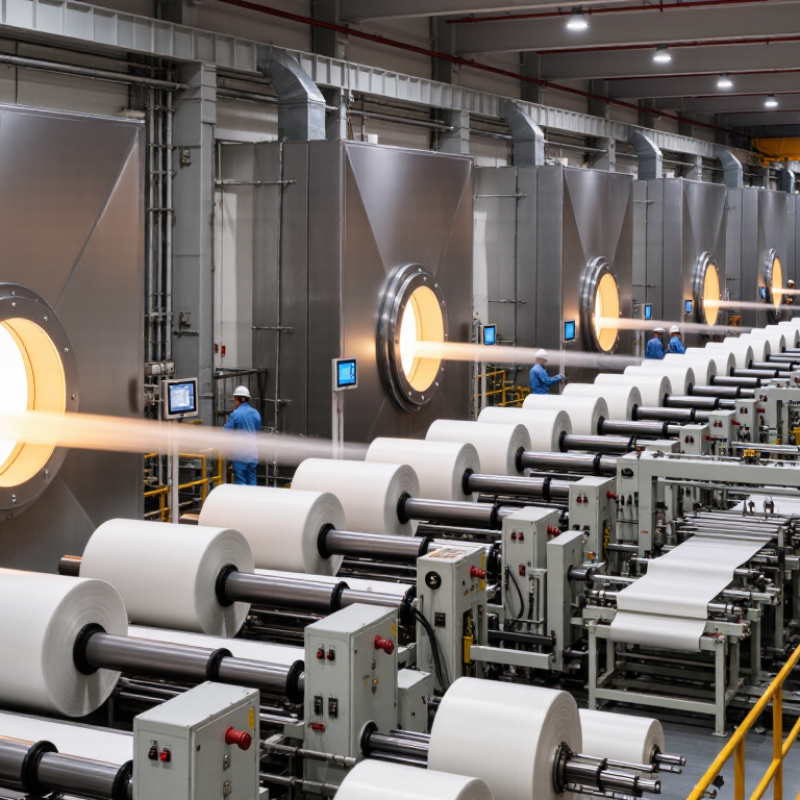
| Precursor Tow Handling | Creel frames, tow guides, tension-control units, and automatic break detection | 12K to 50K precursor tow positions per line section | Standard industrial-grade carbon fiber and high-throughput conversion lines | Stable tow tension, low fuzz generation, accurate alignment, and expandable creel capacity | The required creel layout depends on tow size and the number of parallel production lanes. |
| Oxidation and Stabilization | Multi-zone hot-air oxidation ovens with independent temperature and airflow control | Typically about 180–300°C, arranged across several controlled zones | PAN-based precursor conversion before carbonization | Uniform airflow, residence-time control, heat recovery, and reliable exhaust treatment | Temperature uniformity is essential for consistent stabilization and reduced filament breakage. |
| Low-Temperature Carbonization | Inert-gas tubular or multi-chamber furnace with sealed entry and exit sections | Approximately 300–900°C under nitrogen or another suitable inert atmosphere | General-purpose carbon fiber grades requiring controlled conversion of stabilized PAN | Oxygen exclusion, furnace sealing, gas-flow balance, thermal uniformity, and line-speed stability | Nitrogen purity and leakage control directly affect surface quality and process safety. |
| High-Temperature Carbonization | Graphite-lined or high-temperature furnace with controlled inert-gas circulation | Usually about 1,000–1,600°C, depending on the target grade | Higher-modulus or higher-strength carbon fiber products | Maximum operating temperature, hot-zone length, power efficiency, and graphite-component life | Not every line requires a high-temperature stage; the specification should match the final fiber grade. |
| Surface Treatment | Electrochemical oxidation bath, controlled-current system, rinsing section, and conductivity monitoring | Adjustable treatment intensity based on fiber type and resin system | Fibers intended for improved adhesion with epoxy, thermoplastic, or other polymer matrices | Bath uniformity, current-density control, water quality, chemical management, and drying performance | Surface treatment must be matched to the intended sizing chemistry and downstream composite process. |
| Sizing Application | Metered sizing applicator, immersion or kiss-roll system, squeeze rollers, and drying oven | Common sizing add-on levels are approximately 0.5–2.0% by fiber mass | Structural prepreg, filament winding, pultrusion, weaving, and thermoplastic compounding | Accurate add-on control, emulsion stability, drying temperature, and compatibility with the customer’s resin | Sizing selection is application-specific and should be validated through interfacial and processing tests. |
| Drying and Moisture Control | Hot-air drying oven with humidity monitoring and closed-loop temperature control | Common operating zones are roughly 80–180°C | Continuous lines requiring consistent sizing distribution and package quality | Residence time, air velocity, moisture removal, energy consumption, and prevention of fiber sticking | Excessive drying can damage sizing performance, while insufficient drying can cause package defects. |
| Take-Up and Winding | Precision godet rollers, traversing winder, tension feedback, and programmable package build | Line speed commonly ranges from several meters per minute to more than 20 m/min | Small trial packages through continuous industrial production | Winding tension, package density, traverse accuracy, spool changeover, and fiber spreading control | Actual speed is limited by precursor type, furnace residence time, target properties, and package requirements. |
| Process Control System | PLC-based control with HMI, recipe management, data logging, alarms, and remote diagnostics | Independent monitoring of temperature, tension, speed, gas flow, pressure, and current | Laboratory, pilot, and high-volume continuous production lines | Control-loop response, historian functions, cybersecurity, sensor redundancy, and ease of recipe transfer | Traceable process data supports quality investigations, qualification, and repeatable scale-up. |
| Environmental and Safety Systems | Exhaust treatment, nitrogen monitoring, interlocked furnace doors, fire protection, and cooling-water systems | Designed according to local emissions, pressure, fire, and occupational-safety requirements | All continuous carbon fiber production configurations | Exhaust capacity, oxygen detection, emergency shutdown, heat shielding, and maintenance access | Safety equipment should be engineered with the furnace atmosphere, solvent or sizing chemistry, and plant layout. |
| Quality Inspection | Online tension monitoring, filament-break detection, appearance inspection, and laboratory testing equipment | Typical tests include tensile strength, tensile modulus, elongation, sizing content, and linear density | Qualification batches, process validation, and routine production control | Measurement repeatability, calibration procedures, sampling frequency, and compliance with applicable test standards | Mechanical properties should be verified using recognized carbon-fiber test methods and documented sampling plans. |
| Line Scale and Output Planning | Laboratory-scale, pilot-scale, or multi-lane industrial line architecture | Output depends on tow count, line speed, fiber yield, denier, and operating hours | Process development, customer qualification, commercial production, and capacity expansion | Available floor space, utility demand, future lane expansion, maintenance access, and total cost of ownership | Suppliers should provide a mass-balance calculation rather than relying only on nominal machine speed. |