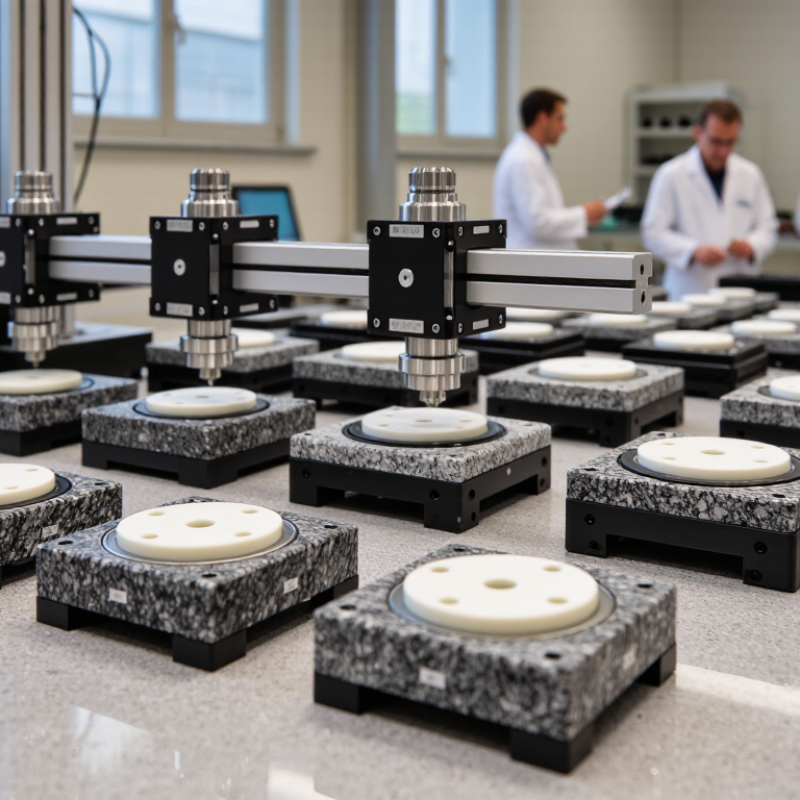
Granite air bearings support precise motion by separating two flat surfaces with a thin air film.
Typical air gaps measure between 5 and 20 micrometres. At this scale, the carriage appears to float above the granite guide.
Small gap. Serious control.
The air film removes most solid contact, reducing friction, wear, and particle generation. It also helps maintain smooth movement during measurement, inspection, and semiconductor equipment operation.
In practical testing, alignment matters as much as the bearing itself. A granite surface with poor flatness can disturb the air gap and create unwanted motion.
Clean, dry air is essential. Pressure stability matters too.
Global buyers should ask suppliers for gap tolerance, load capacity, flatness data, airflow requirements, and installation procedures. They should also confirm inspection methods and after-sales technical support.
A capable supplier can explain how the bearing performs under changing loads, temperatures, and travel speeds. Specifications may look perfect on paper, but installation errors still cause problems.
That is an uncomfortable lesson.
Preloading, mounting torque, and surface cleanliness deserve careful checks. Buyers should request test records from comparable applications, not only general performance claims.
Proper maintenance remains simple, but ignoring it can slowly reduce precision.