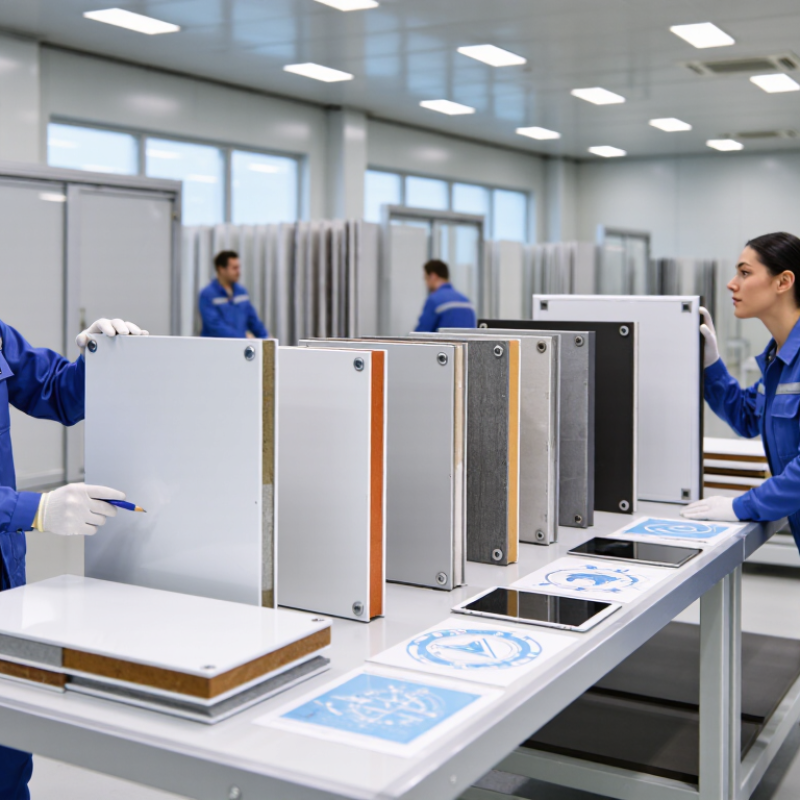
| Rockwool core | Mineral wool; commonly about 0.036–0.045 W/(m·K), depending on product density and test method. | 50–150 mm | Non-combustible core options are available; useful where fire performance and acoustic insulation are priorities. | Request the tested fire classification for the complete panel assembly, not just the core. Check edge sealing, moisture protection, density, and joint details. | Projects prioritizing fire performance, including many industrial and technical areas. |
| PIR core | Polyisocyanurate foam; commonly about 0.020–0.026 W/(m·K), subject to formulation and test conditions. | 50–150 mm | Good insulation performance at relatively low thickness; typically lighter than mineral-wool panels of comparable size. | Confirm fire-test documentation, smoke-related requirements, joint construction, and whether the declared thermal value applies to the core or the complete panel. | Temperature-controlled clean areas where insulation and lower panel weight are important. |
| PU core | Polyurethane foam; commonly about 0.022–0.028 W/(m·K), depending on formulation and measurement method. | 50–150 mm | Efficient thermal insulation and a comparatively light panel construction. | Compare the documented fire performance of the complete assembly, foam formulation, dimensional stability, and compatibility with the project’s fire code. | Insulated cleanroom envelopes and temperature-controlled spaces, subject to project fire requirements. |
| EPS core | Expanded polystyrene; commonly about 0.034–0.040 W/(m·K), depending on density and grade. | 50–150 mm | Often a cost-conscious, lightweight option with straightforward fabrication. | Check fire classification and code acceptance carefully. Verify panel strength, skin bonding, joint sealing, and suitability for the intended cleanroom conditions. | Applications where budget and basic insulation are priorities and the fire strategy permits this construction. |
| Aluminum honeycomb core | Cellular aluminum core; thermal performance varies significantly with cell geometry, skins, and construction. | Typically 50–100 mm; confirm available sizes with the supplier. | Can provide a rigid, lightweight panel with a flat surface when correctly manufactured. | Request panel-specific load, deflection, impact, joint, and fire-test data. Check edge reinforcement and fixing details. | Areas needing a rigid, smooth partition system or where panel weight and surface flatness matter. |
| Paper honeycomb core | Cellular paper core; thermal performance is product-specific and is generally not the primary selection criterion. | Typically 50–100 mm; confirm available sizes with the supplier. | Lightweight construction that can be suitable for interior partitions in controlled environments. | Verify moisture resistance, fire classification, impact resistance, edge sealing, and whether the intended cleaning regime is suitable. | Interior partitions with controlled exposure and project requirements that accept the tested construction. |