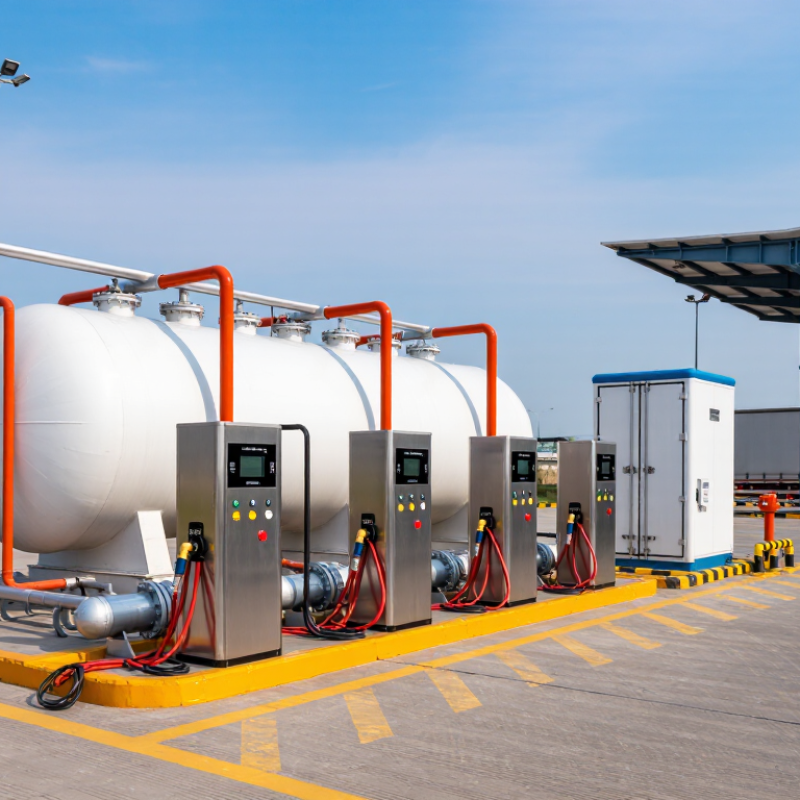
| Vacuum-insulated LNG storage tank | Storage | Stores LNG at cryogenic temperature before dispensing. | Capacity and allowable working pressure are selected for station demand and supply logistics. Insulation limits heat ingress; pressure-relief devices protect against overpressure. |
| LNG unloading and transfer assembly | Delivery connection | Transfers LNG from a delivery vehicle into station storage. | Typically includes compatible cryogenic connections, isolation valves, pressure and temperature instrumentation, and provisions for controlled hose connection and disconnection. |
| Cryogenic LNG pump | Liquid transfer and dispensing line | Raises LNG pressure and moves liquid toward the dispenser when the station layout requires pumped delivery. | Pump type and capacity depend on required flow, pressure, operating cycle, and system configuration. Equipment must be designed for cryogenic service. |
| Pressure-building circuit or vaporizer | Tank pressure management | Uses a controlled portion of LNG, warmed in a vaporizer, to help build storage-tank pressure where required. | May be integrated with the tank or installed as a separate circuit. Its control strategy must match the tank design and station operating procedure. |
| LNG dispenser and fueling hose | Vehicle fueling bay | Connects the station supply to the vehicle and controls the fueling transaction. | Includes cryogenic-rated hoses, couplings, valves, and operator controls. Connection design and fueling procedure must be compatible with the vehicle’s LNG receptacle. |
| Mass-flow measurement and transaction system | Dispenser | Measures dispensed fuel and supports transaction records and dispenser control. | Coriolis mass-flow meters are commonly used for LNG service. Metering equipment must be suitable for the fluid conditions and applicable local measurement requirements. |
| Ambient-air vaporizer | Pressure and gas-handling systems | Transfers heat from ambient air to vaporize LNG in systems that require gaseous natural gas. | Sizing depends on required gas flow, inlet conditions, climate, and duty cycle. Frost formation can reduce heat transfer and should be considered in operating plans. |
| Vapor return and boil-off gas piping | Storage, unloading, and fueling connections | Routes vapor according to the station’s transfer and pressure-management design. | Routing, isolation, and pressure control must be engineered for cryogenic or low-temperature gas service, as applicable to each section of the system. |
| Emergency shutdown (ESD) system | Across the station | Initiates a controlled shutdown and isolates designated equipment during an emergency. | May include manual shutdown stations, automatic inputs, and remotely or automatically operated isolation valves. Design and testing should follow applicable codes and risk assessments. |
| Gas detection, alarms, and fire protection | Fueling and equipment areas | Detects specified hazards and alerts personnel or initiates protective actions. | Detector type, placement, alarm set points, and fire-protection provisions depend on the site hazard assessment, ventilation, layout, and local regulations. |
| Instrumentation and control system | Control and monitoring | Monitors operating conditions and coordinates pumps, valves, alarms, and fueling sequences. | Common measurements include pressure, temperature, level, and flow. Control logic, interlocks, and records should be designed for the station’s operating concept and safety requirements. |