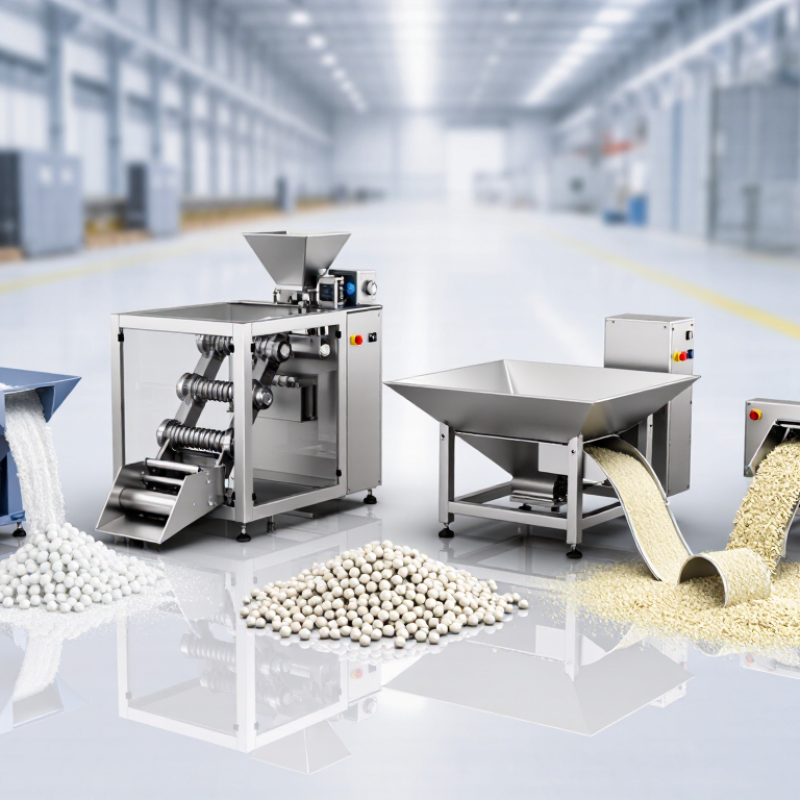
| Single-screw feeder | Free-flowing powders, granules, pellets, and many bulk solids | A rotating screw moves material from a hopper through an outlet. | Load cells track the decreasing weight of the feeder and hopper. The controller calculates the rate of weight loss over time and adjusts screw speed to maintain the target mass flow. | A widely used general-purpose option. Performance depends on screw design, material consistency, hopper flow, and correct feeder sizing. |
| Twin-screw feeder | Cohesive, sticky, difficult-to-flow, or flood-prone powders; some pellets and flakes | Two screws convey material together, helping maintain a more consistent discharge for challenging solids. | Hopper weight loss provides the mass-flow feedback signal. The controller changes screw speed to correct the measured rate toward the setpoint. | Often selected when a single screw has difficulty feeding consistently. Screw geometry and agitation should be matched to the material. |
| Vibratory feeder | Fragile granules, crystals, flakes, and other solids that can be conveyed in a shallow stream | Controlled vibration moves material along a tray or trough. | A load-cell-supported supply hopper measures weight loss. A controller adjusts vibration intensity or frequency, where supported by the design, to regulate discharge. | Can provide gentle handling and avoid a rotating screw. Flow may be affected by material characteristics, tray loading, and vibration settings. |
| Belt feeder | Granules, pellets, flakes, and other solids suited to belt transport | A moving belt carries material from the supply hopper to the discharge point. | The feeder assembly is weighed on load cells; the controller uses the rate of weight decrease and adjusts belt speed to maintain the requested mass flow. | Useful for materials that are not well suited to screw conveying. Belt design, material distribution, and sealing are important considerations. |
| Liquid loss-in-weight system | Liquids, pastes, and some viscous ingredients supplied from a weighed vessel | A pump, valve, or other discharge device withdraws material from a tank or vessel. | Load cells measure the vessel’s weight decrease over time. The control system adjusts the pump or valve to keep the mass-flow rate near its setpoint. | Provides gravimetric dosing without relying solely on liquid volume. Vessel, piping, and pump arrangement must accommodate the fluid’s properties. |
| How loss-in-weight control works: The feeder assembly is weighed by load cells, and the controller determines mass flow from the change in measured weight over time. It adjusts the metering device to correct deviations from the target rate. During hopper refill, the weight signal is affected by the added material, so systems typically use a designed refill sequence and may temporarily rely on a calculated or volumetric feed rate until gravimetric measurement is stable again. |
| Selection note: These are common loss-in-weight feeder configurations, not a ranked performance list. The appropriate type depends on material flow properties, required feed rate, accuracy needs, process conditions, and refill requirements. Actual performance is application-specific. |