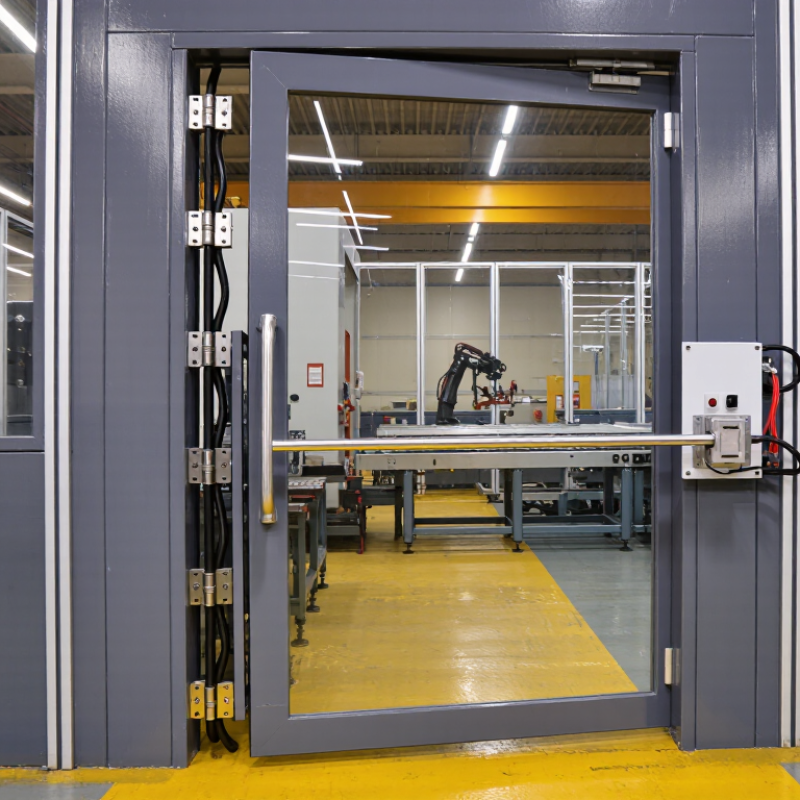
| Hinged access door | Swings outward or inward on hinges. | Enclosures around presses, machining centers, conveyors, and production cells where there is room for a swinging door. | Simple access for inspection, cleaning, and maintenance; can provide a rigid physical barrier. | Allow adequate swing clearance. Where hazardous motion may continue after opening, use an appropriately selected and installed interlocking device. |
| Sliding access door | Moves horizontally along a track or guide. | Machine enclosures and work cells with limited space in front of the opening, including areas with frequent operator access. | Does not need a wide swing area and can cover a broad access opening. | Keep tracks clear and maintain suitable overlap or coverage so the opening cannot expose a hazard when the door is closed. |
| Vertical-lift door | Moves upward, often guided by rails or a counterbalanced mechanism. | Large machine openings, loading stations, and areas where floor space beside the opening is restricted. | Provides a large access opening without occupying much floor area when raised. | Assess the risk of falling or unexpected movement. Use suitable guides, supports, and interlocking where required by the risk assessment. |
| Roll-up door | Rolls into a compact overhead coil or housing. | Large industrial openings, automated production areas, and locations where a conventional hinged door is impractical. | Compact when open and suitable for wide openings or frequent passage. | Verify that the door construction provides the necessary guarding performance; a flexible curtain may not be adequate against every machine hazard. |
| Interlocked access door | May be hinged, sliding, or another door style; an interlocking device monitors its position. | Access points to machines where opening the guard must initiate a defined safety response. | Can help prevent access during hazardous operation when properly integrated into the machine’s safety-related control system. | Select the interlocking method based on the risk assessment. Consider guard locking if hazards do not stop before a person can reach them. |
| Removable guard panel | Is detached from its mounting points rather than opened on hinges or tracks. | Infrequently accessed areas, setup tasks, or maintenance access where routine entry is not needed. | Can provide a sturdy enclosure and discourage casual access to hazardous areas. | Secure the panel against unintended removal. If frequent access is necessary, a door with suitable interlocking may be more appropriate. |
| Mesh or perforated-panel door | Typically hinged or sliding, with a mesh or perforated infill. | Robot cells, conveyors, and machinery where visibility and ventilation are useful. | Allows visual monitoring and airflow while maintaining a physical barrier. | Opening size and distance from the hazard must be considered to prevent reaching through or around the guard. |