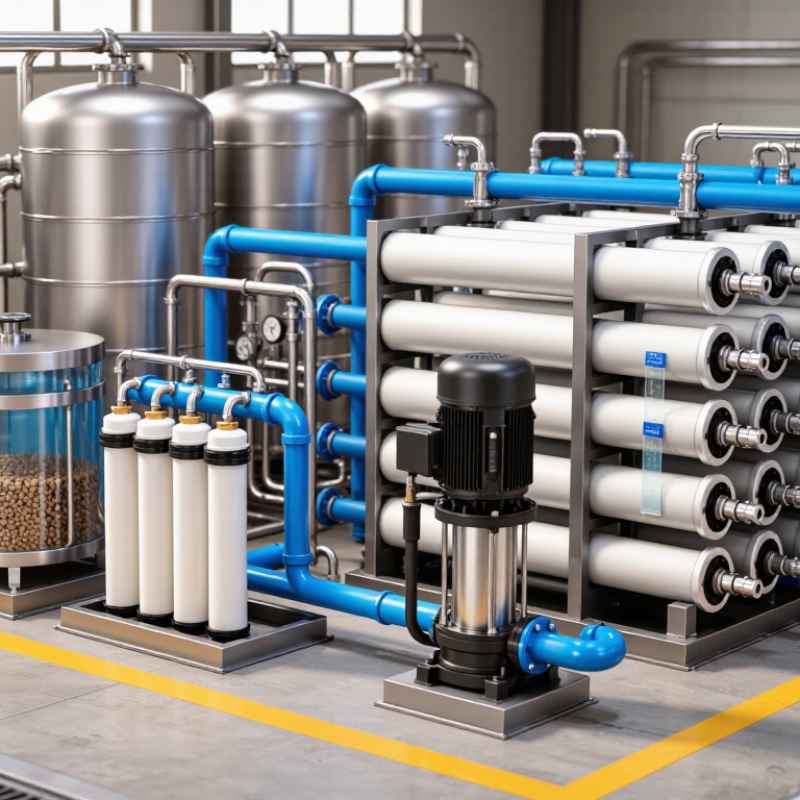
| System definition | Membrane-based wastewater treatment process | A wastewater reverse osmosis system uses pressure to force water through a semipermeable membrane while retaining many dissolved salts, metals, organic compounds, microorganisms, and suspended contaminants. | Pretreatment is essential because RO membranes are sensitive to suspended solids, scaling compounds, oil, and oxidizing chemicals. |
| Main process streams | Feed water, permeate, and concentrate | Feed water enters the membrane system. Permeate is the treated water that passes through the membrane. Concentrate, also called reject or brine, contains a higher concentration of retained contaminants. | Both permeate quality and concentrate disposal must be managed to keep the system compliant and reliable. |
| Typical treatment sequence | Screening → clarification or filtration → cartridge filtration → chemical conditioning → RO → post-treatment | The sequence removes larger particles and protects the RO membrane before high-pressure separation. | The exact configuration depends on wastewater composition, required water quality, temperature, and discharge requirements. |
| Operating pressure | Approximately 10–30 bar for many brackish or industrial wastewater applications | Pressure supplies the driving force needed to overcome osmotic pressure and move water through the membrane. | The required pressure varies with salinity, temperature, recovery, membrane type, and fouling level. Excessive pressure can increase energy use and membrane stress. |
| Water recovery | Commonly about 50–85% per pass, depending on feed quality | Recovery is the percentage of feed water converted into permeate: Recovery = permeate flow ÷ feed flow × 100%. | Higher recovery reduces liquid waste but increases the risk of scaling and concentration polarization. |
| Salt and dissolved solids rejection | Often approximately 95–99% for many dissolved salts under suitable conditions | Rejection indicates how effectively the membrane retains a dissolved constituent: Rejection = (feed concentration − permeate concentration) ÷ feed concentration × 100%. | Actual rejection differs by contaminant, membrane condition, pH, temperature, pressure, and operating age. |
| Feed turbidity | Preferably below 1 NTU after pretreatment | Turbidity reflects light-scattering particles that can contribute to membrane fouling. | Monitor the pretreatment outlet and investigate sudden increases before they reach the RO vessels. |
| Silt Density Index | An SDI15 value below 3 is generally desirable; values below 5 are commonly used as an upper design limit | SDI estimates the fouling potential of fine suspended particles in the feed water. | High SDI may require better clarification, media filtration, ultrafiltration, or improved cartridge filtration. |
| Cartridge filter rating | Commonly 1–5 micrometres nominal or absolute, depending on design | Cartridge filters protect high-pressure pumps and membrane elements from larger particles. | Replace filters when the differential pressure reaches the supplier’s limit or when flow and pressure indicate blockage. |
| pH operating window | Often approximately pH 5–9 during operation; membrane-specific limits apply | pH affects membrane performance, scaling potential, chemical compatibility, and contaminant rejection. | Maintain the pH within the membrane manufacturer’s approved range and verify chemical dosing with regular testing. |
| Temperature effect | Permeate flow generally increases as water temperature rises | Water viscosity decreases at higher temperatures, allowing more water to pass through the membrane. Salt passage may also change. | Compare performance using temperature-corrected data rather than raw flow alone. |
| Common scaling compounds | Calcium carbonate, calcium sulfate, barium sulfate, silica, and metal hydroxides | Scaling occurs when dissolved minerals exceed their solubility and precipitate on membrane surfaces. | Use pretreatment, pH adjustment, antiscalant where appropriate, controlled recovery, and periodic cleaning. |
| Common fouling sources | Suspended solids, microorganisms, oils, natural organic matter, iron, manganese, and colloids | Fouling forms a layer on the membrane surface and reduces water production or increases pressure demand. | Use source control, effective pretreatment, suitable biocide practices, and cleaning based on normalized performance trends. |
| Chlorine control | Free chlorine is typically removed before polyamide RO membranes | Oxidants can chemically damage many thin-film composite membranes and reduce salt rejection. | Use dechlorination or another approved protection method, and verify residual oxidant at the RO inlet. |
| Key performance indicators | Normalized permeate flow, normalized salt passage, feed pressure, concentrate pressure, differential pressure, conductivity, and recovery | These measurements reveal fouling, scaling, membrane damage, instrumentation problems, and hydraulic restrictions. | Record data consistently and compare it with baseline values corrected for temperature and operating conditions. |
| Cleaning trigger | Often considered when normalized permeate flow decreases by about 10–15%, salt passage rises by about 5–10%, or differential pressure increases significantly | A performance decline indicates that contaminants may be accumulating on or inside the membrane elements. | Use site-specific limits and diagnostic testing; cleaning too late can make fouling more difficult to remove. |
| Cleaning frequency | Highly variable; commonly several times per year in challenging wastewater service | Frequency depends on feed quality, pretreatment, recovery, operating hours, and contaminant loading. | Performance-based cleaning is generally more effective than relying only on a fixed calendar interval. |
| Cleaning chemistry | Acid cleaners for many mineral scales; alkaline cleaners for many organic and biological deposits | Different deposits require different cleaning conditions, concentrations, contact times, and temperatures. | Use only membrane-compatible chemicals, follow safety procedures, and flush thoroughly after cleaning. |
| Routine inspection interval | Critical readings: each operating shift or daily; laboratory and mechanical checks: weekly to monthly | Frequent monitoring helps identify changes before they cause membrane damage or unplanned shutdowns. | The final schedule should reflect system size, automation level, wastewater variability, and regulatory requirements. |
| Permeate quality monitoring | Conductivity or total dissolved solids, pH, turbidity, and application-specific contaminants | Permeate quality confirms whether the treated water is suitable for reuse, process water, or discharge. | A sudden conductivity increase may indicate membrane damage, sealing problems, incorrect flow conditions, or instrument error. |
| Industrial reuse applications | Cooling tower makeup, boiler feed pretreatment, rinsing, washing, process water, and wastewater volume reduction | RO can produce a lower-dissolved-solids water stream suitable for many non-potable industrial uses. | Additional treatment may be needed for high-purity applications, microbial control, or specific trace contaminants. |
| Municipal and commercial applications | Tertiary water reuse, high-strength wastewater treatment, landfill leachate treatment, and desalting of reclaimed water | RO is used when biological treatment and conventional filtration do not provide sufficient dissolved-contaminant removal. | Feed equalization, advanced pretreatment, concentrate management, and online monitoring are often required. |
| Concentrate management | Discharge to an approved sewer or outfall, further concentration, evaporation, beneficial recovery, or permitted disposal | RO does not destroy dissolved contaminants; it transfers much of the contaminant load into a smaller concentrate stream. | The disposal method must meet local environmental, sewer, and water-quality requirements. |
| Main advantages | High dissolved-contaminant removal, modular design, and water reuse potential | RO can reduce total dissolved solids and many ionic contaminants without phase-change heating. | Benefits must be evaluated against energy consumption, pretreatment needs, membrane replacement, and concentrate handling. |
| Main limitations | Fouling, scaling, pressure demand, concentrate production, and sensitivity to feed variability | RO is a separation process rather than a complete destruction or stabilization process for all wastewater contaminants. | A properly designed pretreatment and monitoring program is necessary for stable long-term operation. |