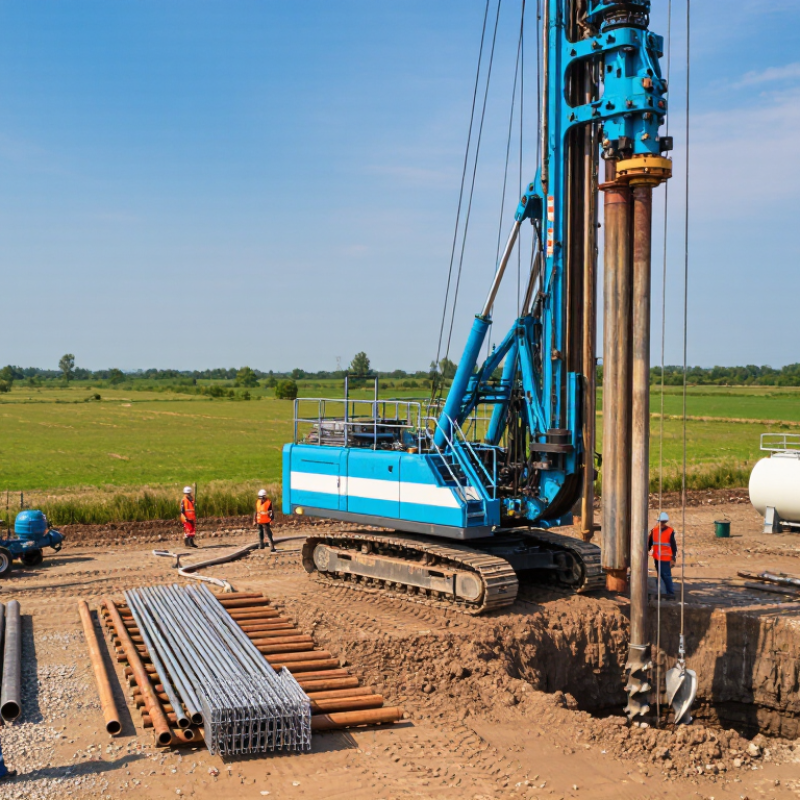
| Drilling rig | Supports and powers the drilling operation, turning the drill string and applying force to the bit. | Used throughout drilling; rig design depends on the drilling method, site access, and required well depth. | Creates a borehole that can reach a water-bearing formation underground. |
| Drill bit | Breaks and cuts rock, sediment, or other material at the bottom of the borehole. | Attached to the bottom of the drill string and replaced or selected according to ground conditions. | Advances the borehole through layers of soil and rock toward a suitable aquifer. |
| Drill pipe and drill string | Connect the rig to the drill bit and transmit rotation and force. | Extended section by section as drilling progresses. | Allow the bit to work below ground while providing a route for drilling fluid or compressed air in applicable methods. |
| Drilling fluid or compressed air | In rotary drilling, drilling fluid can carry cuttings upward and help stabilize the borehole; air is used in some air-rotary methods to lift cuttings. | Circulated through or alongside the drill string, depending on the drilling system. | Helps remove drilled material so the hole can be advanced and prepared for completion. |
| Mud pump and circulation equipment | Move drilling fluid through the drill string and back to the surface in fluid-based rotary drilling. | Operate during drilling when the selected method uses circulating drilling fluid. | Support cuttings removal and fluid circulation; not every drilling method uses a mud pump. |
| Casing | Lines part of the borehole with pipe to help keep it from collapsing and to isolate selected formations. | Installed in the borehole during or after drilling, according to the well design and local requirements. | Provides a stable pathway for water and helps protect the well from unwanted material entering from surrounding formations. |
| Well screen | Allows groundwater to enter the well while helping retain surrounding formation material. | Placed across the water-producing interval in many wells completed in unconsolidated sediments. | Helps bring water into the well while limiting sand and sediment movement. |
| Gravel pack | In suitable screened wells, graded gravel is placed around the screen to support the formation and improve water entry. | Installed in the annular space around the screen when specified by the well design. | Can help reduce the movement of fine formation particles into the well. |
| Submersible pump | Lifts water from below the water level in the well to the surface. | Installed inside the completed well and connected to a rising main and power supply. | Moves groundwater into a home or into a distribution or storage system for community use. |
| Pressure tank and controls | Manage pump operation and help maintain water pressure in a pressurized supply system. | Usually installed at the surface as part of the well’s water-delivery system. | Help provide usable water flow to household plumbing or connected facilities; larger systems may use different storage and control arrangements. |
| Well development and testing equipment | Remove fine material from the well and measure performance, such as water level and pumping rate. | Used after construction and during commissioning or maintenance. | Helps assess whether the well is producing water as intended; water-quality testing is also important before drinking use. |