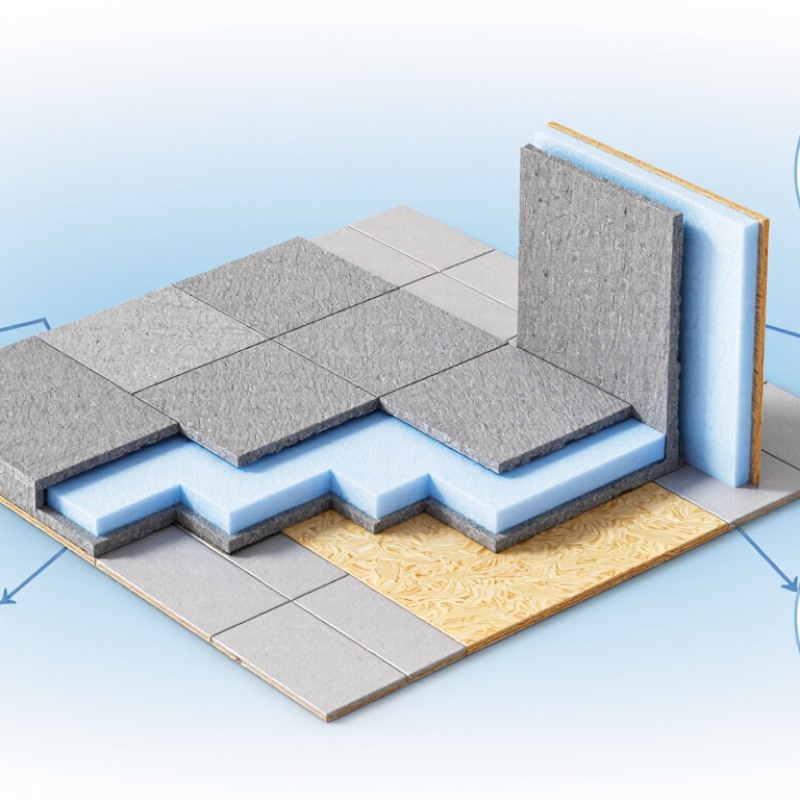
| Decorative tile or finish layer | Ceramic tile, porcelain tile, stone, or resilient flooring | 6–20 mm | Approximately 1.0–2.5 | Provides the visible, wear-resistant walking surface | Tile hardness, slip resistance, moisture absorption, and surface flatness affect performance |
| Rigid foam insulation core | Extruded polystyrene (XPS), expanded polystyrene (EPS), or polyisocyanurate | 20–100 mm | Approximately 0.022–0.038 | Reduces heat transfer through the floor and improves thermal comfort | Actual conductivity depends on density, temperature, moisture, and aging |
| Cementitious tile backer board | Cement-bonded mineral board, often reinforced with glass fiber | 6–12 mm | Approximately 0.35–0.60 | Creates a rigid, tile-compatible substrate and distributes loads | Adds stiffness and moisture tolerance but contributes less insulation than foam |
| Fiber-reinforced facing layer | Glass-fiber mesh, polymer-modified cement, or reinforced laminate | 1–5 mm | Approximately 0.20–0.50 | Improves tensile strength, dimensional stability, and impact resistance | Reinforcement helps limit cracking caused by movement or point loads |
| Tongue-and-groove or interlocking edge | Milled foam edge, composite profile, or mechanical joint | Integrated into the panel perimeter | Not normally rated separately | Reduces thermal bridging and helps align adjacent panels | Joints should be tightly fitted and detailed according to the installation method |
| Hydronic underfloor-heating channel | Grooved insulation board with aluminum or metal heat-spreading plates | 15–40 mm above or within the insulation layer | Foam core approximately 0.025–0.035 | Directs heat from water pipes toward the floor surface | Requires compatible pipe spacing, floor coverings, controls, and load design |
| Electric floor-heating system | Resistance cable, heating mesh, or electrically conductive film | Approximately 3–8 mm for the heating element | Depends mainly on the surrounding insulation | Generates radiant heat beneath the tile finish | Electrical protection, sensor placement, and maximum floor temperature must be considered |
| Vapor or moisture-control layer | Polyethylene sheet, coated membrane, or cement-based waterproofing layer | Less than 1–3 mm | Not generally used as the main insulation layer | Limits moisture migration and protects moisture-sensitive components | Selection depends on ground moisture, indoor humidity, and local construction requirements |
| Typical complete panel assembly | Tile or finish, reinforced substrate, insulation core, and optional heating components | Approximately 30–120 mm | Overall performance is expressed as thermal resistance rather than one λ value | Combines surface durability, structural support, insulation, and optional heating | Verify compressive strength, point-load resistance, fire classification, moisture behavior, and compatibility with the subfloor |