| 1. Steel wire rod selection | Steel wire rod is selected according to the required strength, ductility, chemistry, and final wire application. | The rod is the starting material. Its composition and condition influence how readily it can be drawn and what properties the finished wire can achieve. | Material documentation, rod diameter, surface condition, and, where required, chemical composition. |
| 2. Descaling and surface preparation | Mill scale and other surface contaminants are removed, commonly by mechanical descaling, chemical pickling, or a combination of methods. | A clean surface helps prevent defects during drawing and supports proper wetting by molten zinc during hot-dip galvanizing. | Visible cleanliness, residual scale, and surface defects. |
| 3. Wire drawing | The rod is pulled through a series of progressively smaller dies to reduce its diameter and form wire. | Drawing reduces cross-section and increases strength through work hardening. Intermediate annealing may be used when a softer or more ductile wire is required. | Diameter, surface condition, tensile properties, and any specified ductility test. |
| 4. Final cleaning and fluxing | Before hot-dip coating, the wire is cleaned and may be treated with a flux to limit re-oxidation and help molten zinc contact the steel surface. | Cleaning and fluxing are process-dependent steps used to support a continuous coating. Actual line arrangements differ among manufacturers. | Cleanliness, treatment conditions, and coating continuity on trial or production samples. |
| 5. Hot-dip galvanizing | The prepared wire passes through molten zinc, which forms a zinc coating on the steel. Industrial zinc baths are commonly maintained near 450°C, with the precise operating temperature set by the process. | Zinc provides a barrier against the environment and can also offer sacrificial protection to exposed steel. Coating thickness depends on the product specification and process controls. | Bath condition, line speed, coating appearance, and specified zinc coating mass or thickness. |
| 6. Coating control and cooling | Excess zinc may be controlled as the wire exits the bath; the coated wire is then cooled and handled to avoid damaging the surface. | Air wiping or other control methods can help regulate coating pickup. The method and cooling arrangement depend on the production line and product requirements. | Coating uniformity, bare spots, lumps, adhesion, and surface damage. |
| 7. Inspection and testing | Samples are checked against the applicable product specification and order requirements before release. | Coating can be specified by mass per unit area or by thickness. For zinc, 1 μm of uniform coating is approximately 7.14 g/m²; this is a conversion, not a universal product requirement. | Wire diameter, tensile properties, coating mass or thickness, coating adherence, and visual condition, as required. |
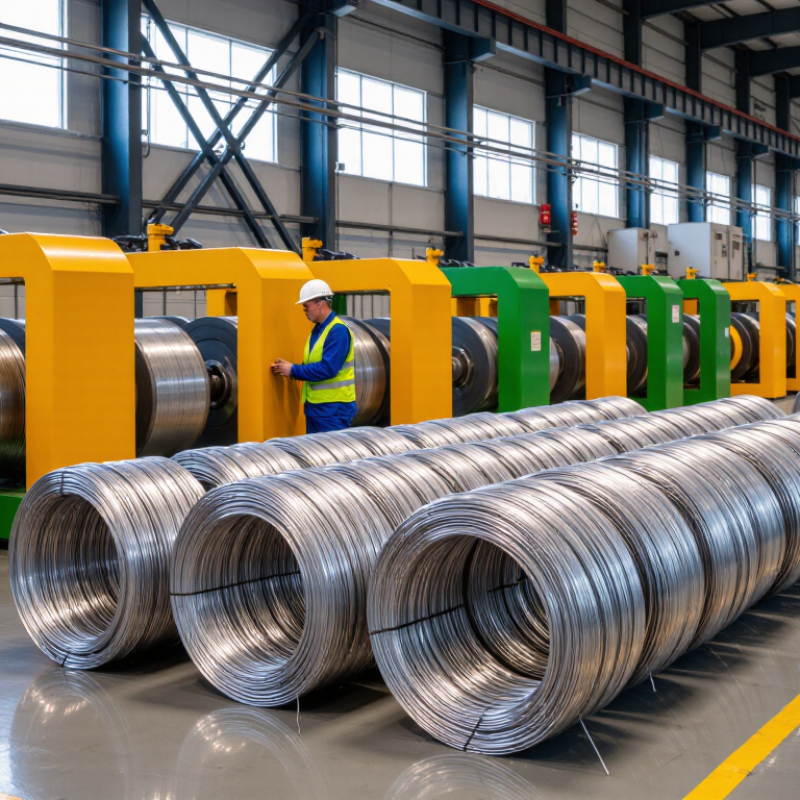
| 8. Coiling, identification, and packaging | Accepted wire is wound into coils or supplied in another agreed format, then protected and identified for shipment. | Packaging helps limit handling damage and contamination. Coil size, weight, and packaging are set by the order and handling needs. | Coil integrity, product identification, quantity, and packaging condition. |