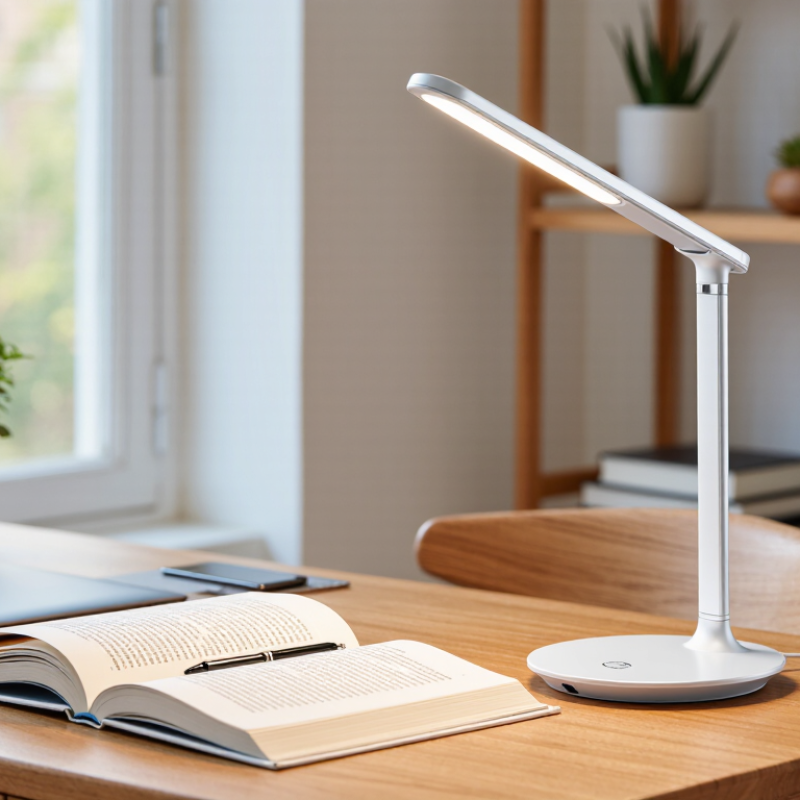
| Definition | A cordless LED desk light is a portable table lamp that uses LED light sources and an internal rechargeable battery instead of requiring continuous connection to a wall outlet. | It can be placed on a desk, bedside table, shelf, or other surface without a power cable restricting its position. |
| Common Battery Chemistry | Rechargeable lithium-ion or lithium-polymer batteries are the most common types. | These batteries provide a relatively high amount of energy in a compact and lightweight package. |
| Typical Battery Capacity | Approximately 1,000–5,000 mAh, commonly at a nominal battery voltage of about 3.7 V. | Battery capacity varies by lamp size, brightness level, and whether additional functions such as USB output are included. |
| Approximate Stored Energy | Roughly 3.7–18.5 Wh, calculated from a 3.7 V nominal battery voltage. | Watt-hours provide a more useful comparison of battery energy than milliamp-hours alone because voltage is also considered. |
| Charging Port | USB-C is increasingly common; some lights use Micro-USB or a proprietary magnetic connector. | USB-C generally offers easier cable replacement and can support convenient charging from adapters, computers, power banks, or vehicle outlets. |
| Typical Charging Input | Usually 5 V USB charging, with input current commonly ranging from about 1 A to 2 A. | A suitable power adapter and cable are required. The lamp's own charging circuit determines how much power it actually accepts. |
| Typical Full-Charge Time | Approximately 2–5 hours from empty, depending on battery capacity, charging current, and the lamp's charging circuitry. | Actual charging time may be longer near full capacity because many lithium batteries charge more slowly during the final stage. |
| Typical Runtime at Low Brightness | Approximately 20–80 hours. | Low brightness uses less energy and is suitable for ambient lighting, nighttime use, or occasional task lighting. |
| Typical Runtime at Medium Brightness | Approximately 8–30 hours. | This range is often suitable for reading, writing, studying, or general desk work. |
| Typical Runtime at Maximum Brightness | Approximately 3–12 hours. | Maximum output provides the most illumination but drains the battery substantially faster than lower settings. |
| Runtime Calculation | Estimated runtime in hours ≈ usable battery energy in watt-hours ÷ lamp power consumption in watts. | For example, a 7.4 Wh battery powering a 1.5 W LED system could theoretically operate for about 4.9 hours before accounting for conversion losses and battery protection limits. |
| Brightness Control | Many models provide two to five brightness levels or continuous dimming. | Lower settings extend runtime, while higher settings provide more light for detailed work. |
| Light Output | Compact cordless desk lights commonly produce approximately 100–500 lumens, although some larger models provide more. | Lumens indicate total visible light output. The useful brightness on a desk also depends on beam direction, diffuser design, and lamp height. |
| Color Temperature | Common options include warm white around 2,700–3,000 K, neutral white around 3,500–4,100 K, and cool white around 5,000–6,500 K. | Warm light feels more relaxed, neutral light is versatile for everyday tasks, and cool light can appear more alert and vivid. |
| Charging While in Use | Many cordless lamps can operate while connected to a charger, but this depends on the product's charging and power-management design. | When supported, the lamp can function like a conventional plugged-in desk light while replenishing its battery. |
| Power Bank Compatibility | Lights using standard USB input can generally be charged from a compatible USB power bank. | This is useful during travel, power interruptions, outdoor work, or locations without a nearby wall outlet. |
| Battery Service Life | Rechargeable lithium batteries gradually lose capacity. Many retain approximately 70–80% of their original capacity after several hundred full-equivalent charge cycles, depending on conditions and design. | Frequent operation at high temperature, complete discharges, and prolonged storage at full charge can accelerate capacity loss. |
| Best Practices for Longer Runtime | Use the lowest comfortable brightness, keep the lamp's air vents unobstructed, and charge it with a suitable USB power source. | Reducing brightness is usually the simplest way to extend operating time between charges. |
| Best Practices for Battery Longevity | Avoid excessive heat, physical damage, unsuitable chargers, and long-term storage at either completely empty or completely full. | Store the lamp in a cool, dry location and follow the charging and safety instructions supplied with the product. |