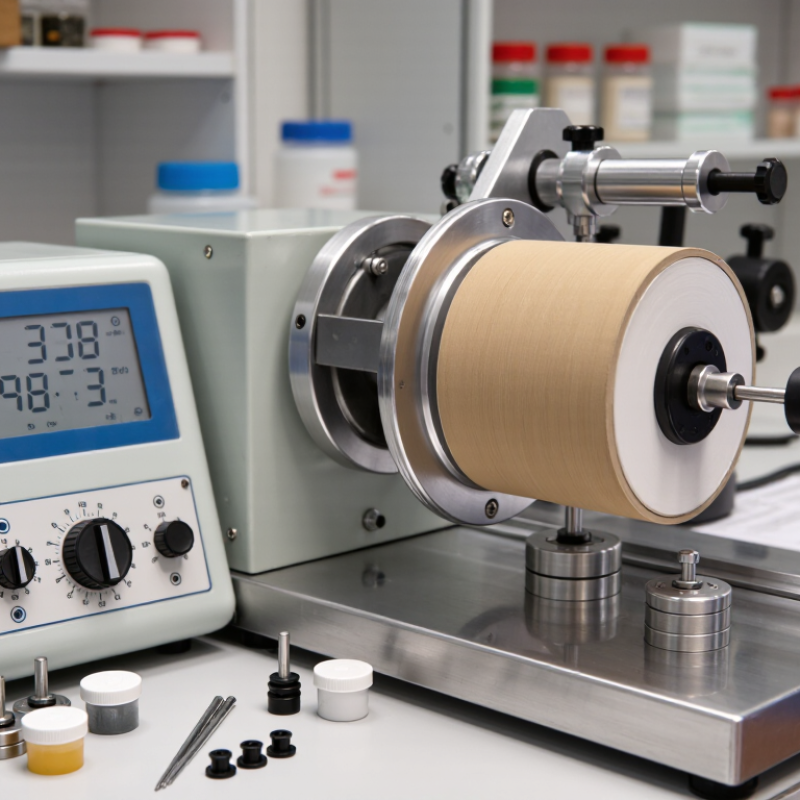
| DIN Abrasion Test Basis |
| Reference method | DIN 53516 abrasion test | Standardized rubber abrasion method | Determines material volume loss after rubbing a cylindrical specimen against abrasive paper mounted on a rotating drum. |
| Standard reporting distance | Sliding distance | 40 m | The DIN method traditionally reports abrasion as volume loss in mm³ after a 40 m sliding distance. |
| Specimen geometry | Cylindrical test piece | 16 mm diameter × 6 mm minimum height | The specimen is held under a controlled load while its end face contacts the abrasive surface. |
| Applied test force | Normal force on specimen | 10 N | A controlled force is used to make results comparable between specimens and laboratories. |
| Abrasive surface | Corundum abrasive paper | Commonly specified as P60 grit | Abrasive-paper condition, backing, age, and replacement frequency can significantly affect the result. |
| Drum geometry | Approximate drum diameter | 150 mm | At this diameter, a 40 m sliding distance corresponds to approximately 84.9 drum revolutions. |
| Cycle definition used here | One cycle | One complete drum revolution | Because DIN 53516 is distance-based rather than cycle-based, values per 1,000 cycles must state how a cycle is defined. |
| Calculated Volume-Loss Results |
| Low abrasion example | DIN volume loss | 80 mm³ per 40 m
≈ 0.94 cm³ per 1,000 cycles | Indicates relatively low material removal under the stated test conditions; useful for comparing wear-resistant compounds. |
| Moderate abrasion example | DIN volume loss | 160 mm³ per 40 m
≈ 1.89 cm³ per 1,000 cycles | Represents an intermediate abrasion level for comparative screening of elastomer formulations. |
| High abrasion example | DIN volume loss | 240 mm³ per 40 m
≈ 2.83 cm³ per 1,000 cycles | Shows greater material removal and may indicate a need for compound, filler, curing, or surface-contact improvements. |
| Very high abrasion example | DIN volume loss | 400 mm³ per 40 m
≈ 4.71 cm³ per 1,000 cycles | Suitable for identifying materials that may require additional wear protection in severe rubbing applications. |
| Calculation and Applications |
| Normalization formula | Conversion to cm³ per 1,000 cycles | V₁₀₀₀ = V₄₀m ÷ 84.9 | V₄₀m is the DIN result in mm³ per 40 m. The division by 1,000 to convert mm³ to cm³ and multiplication by 1,000 cycles cancel numerically. |
| Footwear soles | Comparative wear screening | Lower volume loss preferred | Used to compare outsole compounds, tread formulations, and production batches before field validation. |
| Conveyor and drive components | Belts, rollers, and wheels | Lower and more stable loss preferred | Supports material selection where repeated sliding or rolling contact can remove surface material. |
| Seals and gaskets | Material screening | Result interpreted with compression and chemical tests | Abrasion data alone is not sufficient for service-life prediction because sealing performance also depends on temperature, pressure, fluid exposure, and geometry. |
| Quality control | Batch-to-batch comparison | Use a defined internal limit | Acceptance limits should be established from validated product specifications rather than applying a universal abrasion threshold. |