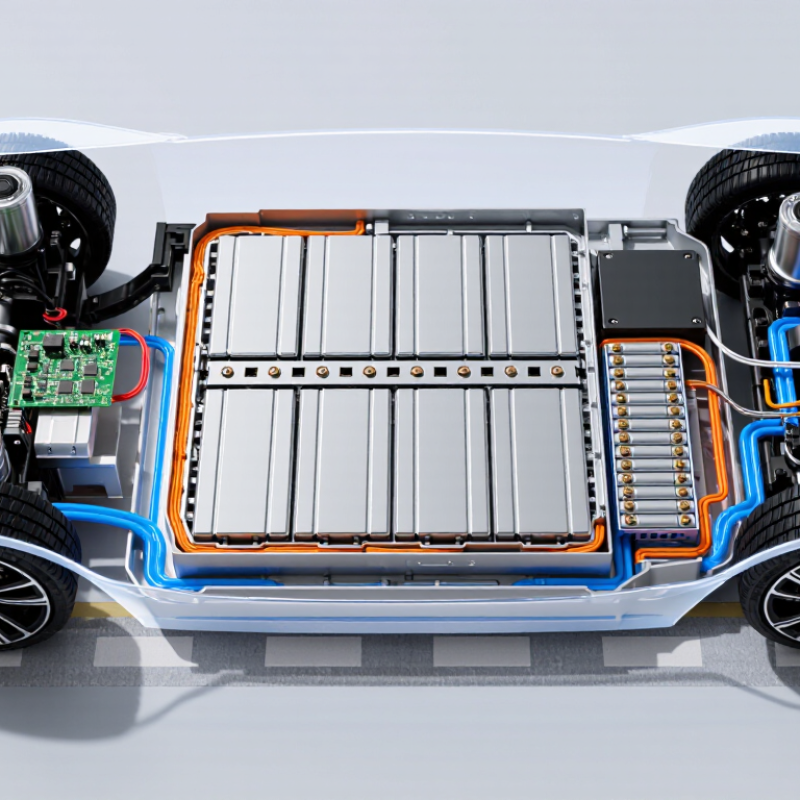
| Battery cells | Individual electrochemical units containing positive and negative electrodes, an electrolyte, and a separator. | During charging and discharging, lithium ions move between the electrodes through the electrolyte; electrons travel through the external circuit to provide useful electrical power. | Common cell formats include cylindrical, prismatic, and pouch cells. |
| Cell chemistry | The materials used for the electrodes and electrolyte. | Chemistry affects cell voltage, energy density, operating limits, service life, and thermal behavior. | Lithium iron phosphate (LFP) and nickel-manganese-cobalt (NMC) are examples of lithium-ion chemistries. |
| Series configuration | Cells connected positive-to-negative in a sequence. | Series-connected cell voltages add together, increasing the pack’s nominal voltage. | A pack’s voltage depends on its cell chemistry and the number of cells connected in series. |
| Parallel configuration | Cells connected together at matching positive and negative terminals. | Parallel-connected cells increase the available capacity and current capability while keeping voltage approximately the same. | A pack described as 4S2P has four cell groups in series and two cells or cell groups in parallel at each series position. |
| Nominal voltage | A representative voltage used to describe a cell or pack during normal operation. | It helps define the electrical system the pack can supply; actual voltage changes with charge level, load, temperature, and chemistry. | Many conventional lithium-ion cells have a nominal voltage around 3.6–3.7 V; LFP cells are commonly around 3.2–3.3 V. Values vary by cell design. |
| Capacity | The amount of electric charge a battery can deliver, usually stated in ampere-hours (Ah). | Capacity indicates how much charge is available, but does not by itself describe total energy without considering voltage. | A 20 Ah pack can theoretically deliver 20 A for one hour under specified conditions; real performance depends on operating limits and conditions. |
| Energy | The amount of electrical work the pack can provide, commonly stated in watt-hours (Wh) or kilowatt-hours (kWh). | A useful nominal estimate is energy (Wh) = nominal voltage (V) × capacity (Ah). | A 48 V, 20 Ah pack has a nominal energy estimate of 960 Wh (48 × 20). Usable energy may differ. |
| Battery management system (BMS) | Electronic circuitry that monitors and helps control the cells or cell groups. | A BMS may monitor voltage, current, and temperature; protect against conditions outside specified limits; and balance cell-group voltages. | Protection features and balancing methods vary by pack design. A BMS does not change the underlying cell chemistry. |
| Thermal management | Design features that help control cell temperature during use and charging. | Keeping cells within their specified temperature range supports performance, durability, and safe operation. | Depending on the application, a pack may use passive heat transfer, airflow, or a liquid-based cooling system. |
| Enclosure and electrical connections | The housing, wiring, terminals, and connectors that protect and connect the cells and pack electronics. | These components provide mechanical support and a path for current to flow between the pack and the equipment. | Enclosure materials, sealing, connector type, and protection against vibration or moisture depend on the application. |
| Charging and discharging | Charging stores energy in the cells; discharging supplies electrical energy to an external load. | A compatible charger controls charging according to the pack’s specifications. During discharge, current flows to the connected device or system. | Charge voltage, current limits, temperature limits, and cutoff thresholds are specific to the pack design and chemistry. |