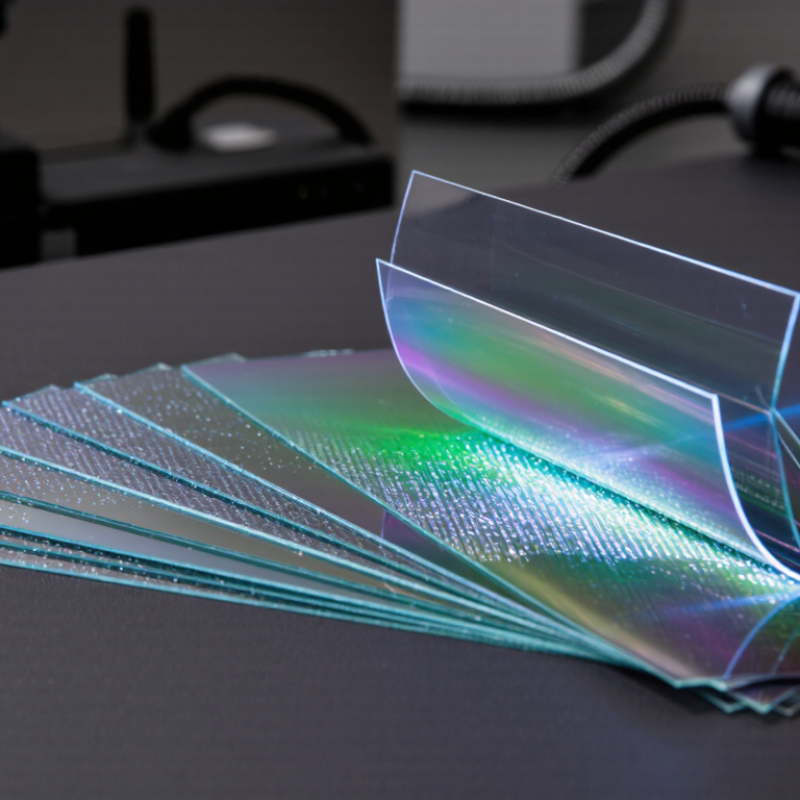
| Definition | Laser film is a thin functional film designed to interact with laser light, either by transmitting, reflecting, filtering, converting, or responding to the beam. | Its optical layer or surface structure changes how laser energy travels through or interacts with the film. | The exact meaning depends on the product type, such as optical film, laser-markable film, holographic film, or protective film. |
| Basic Structure | A typical construction may include a polymer substrate, optical or active coating, adhesive layer, and protective liner or hard coat. | Each layer contributes to flexibility, optical performance, surface protection, bonding, or laser response. | Layer selection must match the laser wavelength, power level, operating temperature, and intended surface. |
| Common Substrate Materials | Polyester (PET), polycarbonate (PC), polyethylene (PE), polypropylene (PP), and polyimide are frequently used film substrates. | The substrate provides mechanical support and influences clarity, dimensional stability, heat resistance, and flexibility. | Polyimide generally offers higher temperature resistance, while PET is widely used for dimensional stability and optical clarity. |
| Laser Wavelength | Performance is wavelength-dependent. Common industrial laser regions include ultraviolet near 355 nm, visible light around 532 nm, and infrared near 1,064 nm. | Absorption, transmission, and reflection vary with wavelength, so the film must be selected for the specific laser source. | A film optimized for one wavelength may absorb too much or too little energy at another wavelength. |
| Optical Interaction | The film may transmit, absorb, reflect, scatter, diffract, or convert incident laser energy. | Coatings, pigments, dyes, nanoparticles, or microstructured surfaces control the interaction with the beam. | Excessive absorption can cause discoloration, deformation, melting, or thermal damage. |
| Laser Marking Mechanism | In laser-markable films, focused laser energy creates a visible contrast through color change, carbonization, foaming, ablation, or removal of a surface layer. | The laser selectively modifies the film according to programmed position, pulse energy, speed, and focus. | Results depend on power density, pulse duration, scan speed, focus, and the film's absorption characteristics. |
| Thickness Range | Flexible films commonly range from several micrometres to a few hundred micrometres, depending on construction and use. | Thickness affects handling, flexibility, heat dissipation, optical path length, and resistance to tearing. | Exact thickness should be specified with tolerance because small variations can affect optical and processing consistency. |
| Key Optical Properties | Important properties include transmittance, reflectance, haze, refractive index, optical density, and polarization response. | These values determine how much laser energy passes through, returns from, or is dispersed by the film. | Testing should be performed at the intended wavelength and angle of incidence. |
| Thermal Performance | Thermal behavior is influenced by melting point, glass-transition temperature, heat-shrinkage rate, and thermal conductivity. | Laser energy can produce localized heating, so the film must tolerate the process without unwanted warping or degradation. | Cooling time, pulse control, ventilation, and substrate compatibility may be necessary for stable processing. |
| Surface Characteristics | Surfaces may be glossy, matte, transparent, colored, textured, coated, or hard-coated. | Surface texture and coating affect beam reflection, focus stability, mark contrast, scratch resistance, and cleanability. | Contamination, fingerprints, and uneven surfaces can reduce marking quality or optical uniformity. |
| Typical Applications | Applications include optical filtering, beam protection, security graphics, product identification, decorative effects, sensors, and flexible electronic components. | The film provides a lightweight, conformable alternative to rigid optical or marking components in selected designs. | Application suitability depends on required durability, optical precision, environmental exposure, and regulatory conditions. |
| Main Advantages | Laser films can be lightweight, flexible, fast to process, customizable, and suitable for high-resolution patterns or markings. | Digital laser processing can reduce the need for physical dies, screens, inks, or mechanical contact. | Benefits vary by film design and may require careful process calibration. |
| Main Limitations | Potential limitations include heat sensitivity, limited wavelength compatibility, surface damage, edge deformation, and variable contrast. | The laser-film combination must be optimized to balance processing speed, mark quality, and material protection. | Small-scale trials are recommended before full production. |
| Safety Requirements | Laser processing requires wavelength-appropriate eye protection, beam enclosure or controlled access, ventilation, and material-specific hazard assessment. | Direct or reflected laser radiation can injure eyes and skin, while heated films may release fumes or particles. | Use documented laser-safety procedures and verify the film's safety data before processing. |