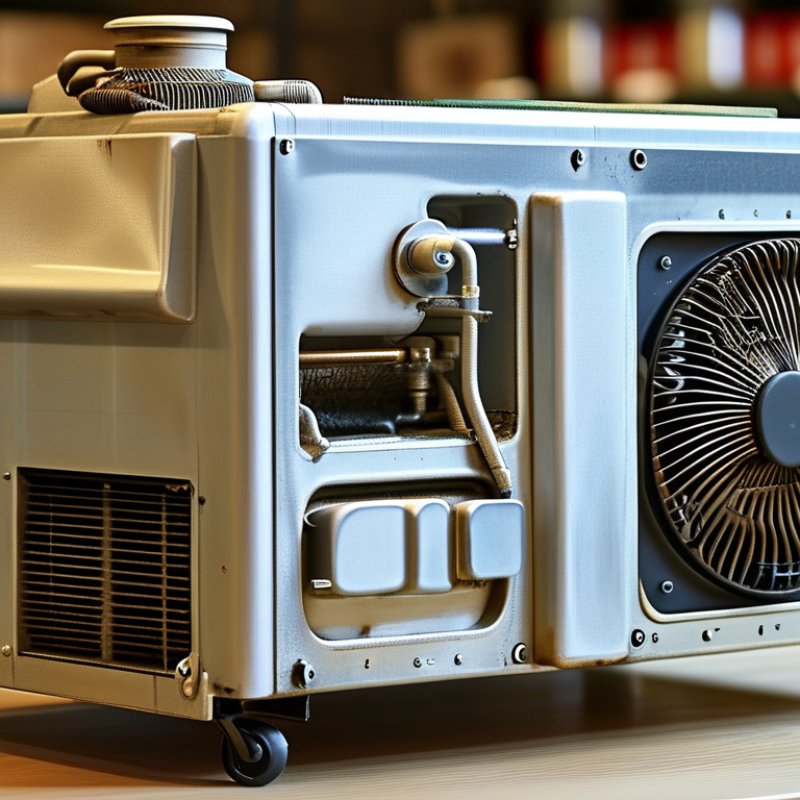
| Basic Definition | Refrigeration unit | A mechanical system that removes heat from a controlled space, product, or process and rejects that heat to a warmer surrounding environment. | Transfers heat; it does not create cold. |
| Core Purpose | Temperature control | Maintains a target temperature to preserve food, protect equipment, support manufacturing processes, or provide conditioned air. | Target temperature depends on the application. |
| Heat-Absorbing Component | Evaporator | The refrigerant absorbs heat from the refrigerated space while evaporating at a low pressure and low temperature. | Located inside or near the cooled space. |
| Pressure-Raising Component | Compressor | Draws in low-pressure refrigerant vapor, compresses it, and delivers high-pressure, high-temperature vapor to the condenser. | Requires electrical or mechanical energy. |
| Heat-Rejecting Component | Condenser | Releases heat from the refrigerant to air or water, causing the high-pressure vapor to condense into a high-pressure liquid. | May be air-cooled or water-cooled. |
| Pressure-Reducing Component | Expansion device | Reduces the pressure of the liquid refrigerant and meters its flow into the evaporator. | Common forms include thermostatic expansion valves and electronic expansion valves. |
| Operating Cycle | Vapor-compression cycle | The refrigerant repeatedly evaporates, is compressed, condenses, and expands to move heat from the cold side to the warm side. | The cycle is continuous while cooling is required. |
| Refrigerant | Working fluid | A fluid selected for its pressure-temperature characteristics so it can absorb and reject heat efficiently through phase changes. | Selection depends on safety, efficiency, operating range, and environmental requirements. |
| Typical Temperature Range | Medium- and low-temperature applications | Medium-temperature systems commonly maintain chilled spaces near 0–5°C, while frozen-storage systems are often designed around −18°C or lower. | Actual settings vary by product, load, humidity, and design. |
| Control System | Thermostat and sensors | Monitors temperature and controls compressor operation, fan operation, defrost cycles, and safety functions. | Helps maintain stable conditions and reduce unnecessary energy use. |
| Heat Rejection | Air or water discharge | The unit rejects the heat absorbed from the refrigerated space plus the compressor’s input energy. | The condenser must have adequate airflow or water flow. |
| Common Applications | Cold rooms, display cases, transport, and process cooling | Used wherever products, spaces, or industrial processes must remain below ambient temperature. | Examples include food storage, laboratories, data equipment, and manufacturing. |
| Energy Performance | Coefficient of Performance (COP) | COP compares the useful cooling capacity to the energy input. A higher COP generally indicates greater cooling efficiency under the tested conditions. | Performance changes with outdoor temperature, load, set point, and maintenance. |