Why Choose a Carbon Fiber Tube for Your Project?
A carbon fiber tube can make sense when a project needs stiffness and strength without carrying unnecessary weight. The U.S. Department of Energy’s Vehicle Technologies Office reports that a 10% reduction in vehicle weight can improve fuel economy by roughly 6–8%. That is a useful benchmark, not a promise: a tube’s real contribution depends on its dimensions, layup, joints, and operating loads.
There is precedent at scale. Boeing’s published 787 materials breakdown lists composite materials as about 50% of the aircraft’s structural weight. That figure describes an entire aircraft, not a tube, but it shows why engineers consider composites for demanding structures. For a small frame or robotic arm, the practical gains may be easier to see: less mass at the end of a moving member, or a slimmer support that still resists bending. Details matter.
A carbon fiber tube is not automatically the right choice. Impact damage can be hard to spot, and drilling or clamping may create stress concentrations. I would check load direction, tube diameter, wall thickness, end fittings, and inspection needs before comparing prices. Carbon fiber also conducts electricity, a detail that can matter near exposed wiring. The material has limits. Still, when weight and stiffness both matter, a carefully specified tube can be a strong option—not a shortcut around sound design.
What Is a Carbon Fiber Tube and How Is It Made?
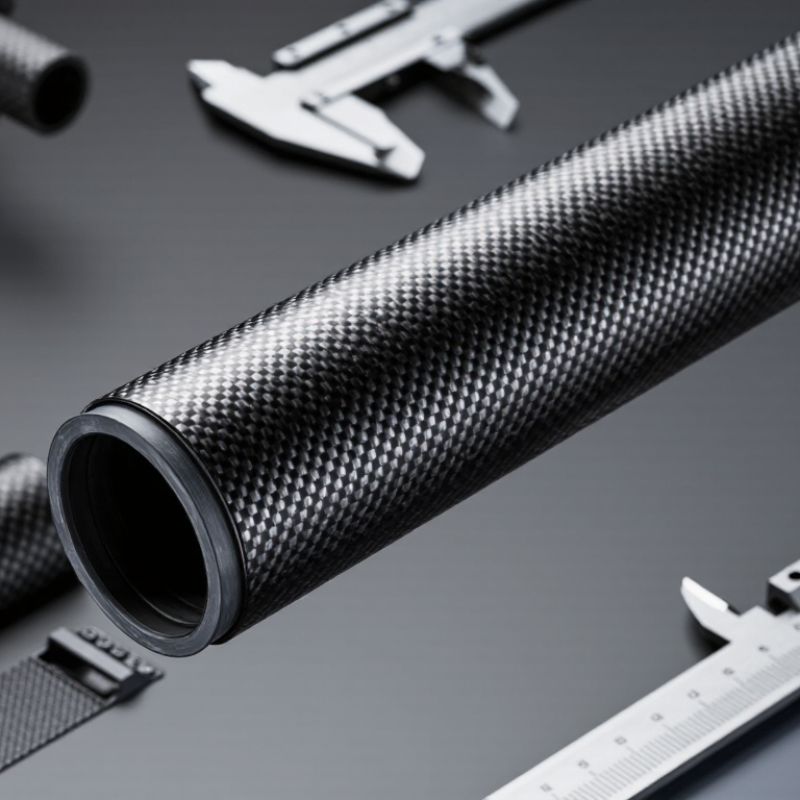
A carbon fiber tube is a hollow composite structure, not a piece of solid carbon. Fine carbon filaments are bundled into tows, then aligned or woven into layers and combined with resin. The fiber carries much of the load; the resin binds the fibers and transfers stress between them. That distinction matters. A tube’s behavior depends on fiber direction, wall thickness, resin, and curing—not simply on the words “carbon fiber.”
Manufacturing starts with a design for the loads the tube must handle. In pultrusion, fibers pass through resin and a shaped die, producing continuous tubes with fibers mainly running lengthwise. In filament winding, resin-coated fibers wrap around a removable mandrel at selected angles. The layup is then cured in an oven or pressure vessel, cooled, and trimmed. Small details count: a cut edge can expose fibers, while a poorly controlled cure can leave voids. Real production is less tidy than a diagram.
The U.S. Department of Energy’s Vehicle Technologies Office reports that a 10% reduction in vehicle weight can improve fuel economy by 6–8%. That is a vehicle-level estimate, not a guarantee for any single tube. Carbon fiber can help reduce mass, but it may cost more and can be vulnerable to impact damage that is hard to see. Check the tube’s load direction, dimensions, and test data against the actual job. Not just its weight.
Why Choose a Carbon Fiber Tube?
Typical Material Density
Carbon fiber composite is typically much less dense than aluminum or steel, which can help reduce weight. Actual tube performance depends on its fiber orientation, resin, dimensions, and manufacturing process. Carbon fiber tubes are commonly made by laying or winding resin-impregnated fibers around a mandrel, then curing the material and removing the mandrel.
Where Are Carbon Fiber Tubes Commonly Used?
Carbon fiber tubes are commonly used wherever a long, slender part must stay stiff without adding much weight. In aerospace, they serve as support booms, instrument mounts, and structural links in aircraft and unmanned vehicles. In cycling and other sports equipment, tubes form frames, poles, and shafts that feel light in the hand. That difference matters on a steep climb or when equipment must be carried all day. In industrial automation, tubes also appear in robot arms, inspection rigs, and moving gantries, where lower mass can help reduce inertia and vibration.
Vehicles and renewable-energy equipment are further applications. The U.S. Department of Energy’s 2015 Automotive Lightweighting Materials report estimates that carbon-fiber-reinforced polymer can reduce component weight by up to 50 percent compared with steel, though results depend on the part and design. In wind-energy systems, carbon-fiber composites can help strengthen long blade structures; related tube-like sections may be used in supports and equipment frames. Carbon fiber is not automatically the best choice. It can be costly, and impact damage may be hard to spot, so designers must consider inspection and repair needs—not just weight. A useful reminder.
How Do Carbon Fiber Tubes Compare With Other Materials?
A carbon fiber tube can deliver high stiffness with less weight than a comparable aluminum or steel tube. That matters in a camera boom, lightweight frame, or robotic arm, where every gram affects handling. But the comparison depends on the tube’s fiber direction, wall thickness, and construction. Carbon fiber is strong along its fibers, yet a sharp impact can cause hidden damage or splitting. Not always obvious.
Aluminum is usually easier to drill, cut, and join with standard hardware. It can also bend before failing, giving a visible warning. Steel often offers greater toughness and lower material cost, but adds weight. Fiberglass may cost less and resist electrical conduction, though it is generally less stiff. Carbon fiber can be costly, and heat, crushing loads, or poorly designed joints may limit its performance. I would not choose it on weight alone; the right comparison starts with the actual load and service conditions.
Tips: Check load direction, impact risk, and operating temperature before choosing. Ask for test data for the specific tube, and inspect cut edges and attachment points carefully.
