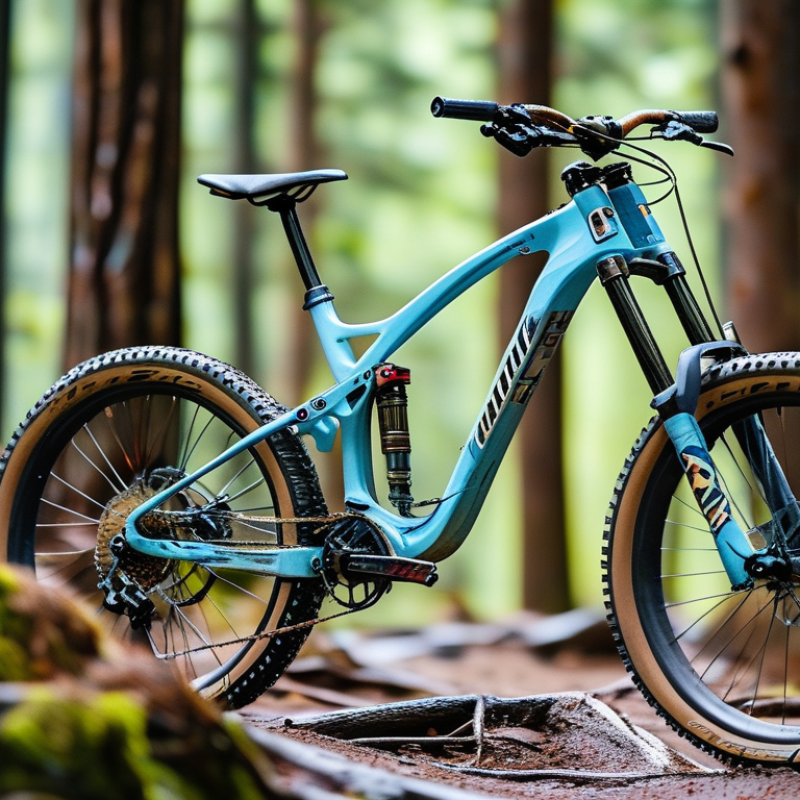
| Complete Bike Weight | Approximately 9.5–12.5 kg, depending on frame size, materials, wheels, drivetrain, and equipment | The bike feels easier to lift, carry, accelerate, and maneuver | Lower overall mass can reduce effort during climbs, transport, and frequent changes of direction |
| Frame Construction | Commonly an aluminum alloy or carbon-fiber hardtail frame with no rear suspension linkage | The frame provides direct power transfer from the pedals to the rear wheel | A rigid rear triangle reduces mechanical complexity, weight, and maintenance requirements |
| Rear Suspension | None; the rear wheel is connected directly to the frame | Pedaling input is transmitted efficiently on smooth climbs and firm surfaces | Eliminating the rear shock and linkage generally saves weight and simplifies setup |
| Front Suspension Travel | Approximately 100–130 mm on many cross-country and trail-oriented designs | The fork absorbs impacts from roots, rocks, braking bumps, and uneven ground | Front suspension adds control and comfort while keeping the design lighter than a full-suspension bike |
| Wheel Size | Most commonly 27.5 or 29 inches | Smaller wheels can feel agile, while larger wheels roll over obstacles more easily | Wheel size affects handling, rolling efficiency, frame fit, and total bike weight |
| Tire Width | Approximately 2.1–2.4 inches for many lightweight cross-country and trail setups | Moderate-width tires balance grip, puncture protection, rolling speed, and weight | Narrower or faster-rolling tires can improve efficiency, while wider tires offer more traction and comfort |
| Drivetrain Configuration | Often a single front chainring with a wide-range rear cassette, such as 10–12 speeds | The rider can select low gears for climbs and higher gears for flatter sections | A single-chainring system reduces parts, shifting complexity, and potential maintenance points |
| Climbing Performance | Efficient on sustained climbs, fire roads, smooth singletrack, and firm technical ascents | More of the rider’s pedaling effort is directed toward forward motion | A light frame and rigid rear end can make repeated elevation gains less tiring |
| Handling and Agility | Typically responsive, with geometry designed for cross-country or light-trail riding | The bike changes direction quickly and feels manageable at lower speeds | Lower mass and fewer moving suspension components can make technical positioning easier |
| Braking System | Hydraulic or mechanical disc brakes, commonly with rotors around 160–180 mm | Disc brakes provide controlled stopping in dry and wet conditions when properly maintained | Reliable braking improves confidence on descents and helps manage speed on varied terrain |
| Energy Efficiency | Generally efficient on paved connectors, gravel, smooth trails, and long climbs | Less suspension movement and lower weight can make steady-distance riding feel less demanding | The design suits riders who value speed, distance, and efficient pedaling over maximum impact absorption |
| Maintenance Requirements | Fewer suspension components than a full-suspension mountain bike | Routine care focuses on the fork, drivetrain, brakes, tires, wheels, and frame | A simpler layout can reduce service time and long-term maintenance complexity |
| Carrying and Storage | Usually easier to lift onto a vehicle rack, carry upstairs, or store in a small space | Lower weight improves everyday convenience before and after a ride | Practical handling encourages more frequent use and makes transport less strenuous |
| Best-Suited Terrain | Cross-country routes, gravel paths, forest roads, moderate singletrack, and rolling terrain | Performs best where efficient pedaling is as important as obstacle control | It is a versatile choice for riders who do not regularly tackle large drops or highly rough downhill trails |
| Limitations | Less rear-wheel impact absorption and traction than a comparable full-suspension design | Rough descents may feel harsher and require more active body positioning | Riders should match the bike to their terrain, riding style, speed, and comfort preferences |