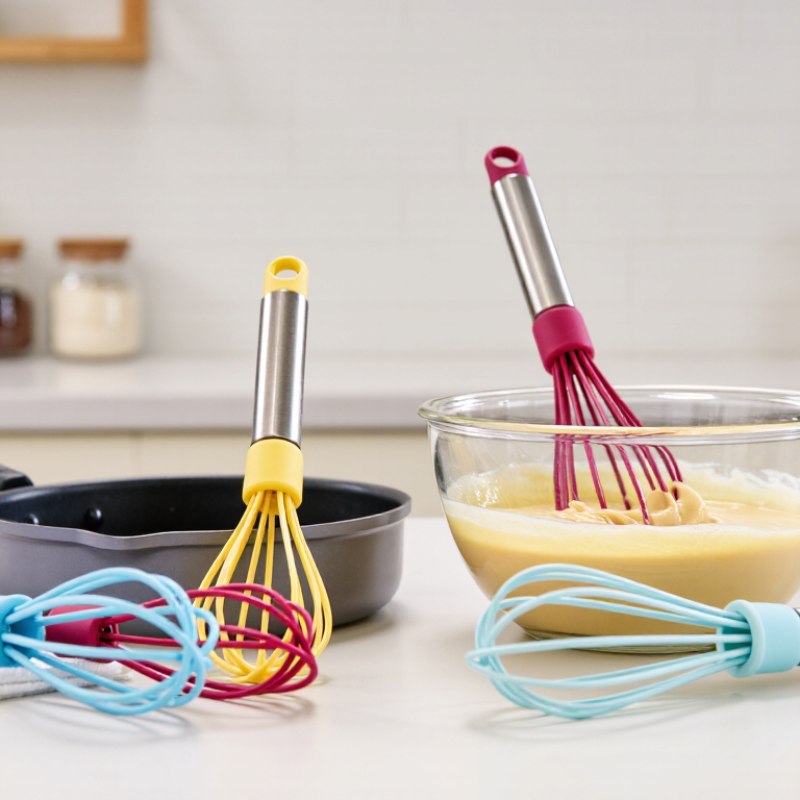
| Food-contact suitability | Request documentation for the materials used in the whisk heads and handles, and confirm that the product is suitable for the intended market and food-contact use. | Requirements vary by destination market and product construction. Suitable documentation supports compliance checks and more informed purchasing. | Review declarations, test reports, and material details for the exact model being purchased. Do not rely on a general claim without supporting documents. |
| Heat resistance | Check the supplier’s stated temperature range and whether it applies to the complete whisk or only to the silicone component. | Cooking and food-service environments can expose utensils to heat. A whisk should be used within its verified limits. | Compare the stated range with the intended tasks, such as mixing warm sauces or batters. Follow product instructions and avoid assuming all silicone products share the same rating. |
| Core and whisk-head construction | Ask whether the wires have a metal core and how the silicone is attached and sealed. | Construction affects flexibility, handling, cleaning, and durability. Poorly sealed joints may be harder to clean thoroughly. | Inspect samples for loose wires, gaps, rough edges, and visible separation. Test the whisk in the types of bowls and mixtures customers will use. |
| Set composition | Confirm the number of whisks, sizes, head shapes, and any included storage or hanging features. | A well-matched assortment can serve different mixing tasks while helping buyers avoid paying for unnecessary pieces. | Choose sizes based on the expected applications, such as small-batch mixing and larger-volume preparation. Verify each item in the set matches the product listing. |
| Handle design and ergonomics | Evaluate grip, balance, handle length, surface finish, and whether the whisk has a hanging loop or other storage feature. | Comfort and control matter for repeated use in commercial kitchens, retail demonstrations, and home-kitchen product lines. | Have intended users handle samples. Check that the handle feels secure when wet and that its length suits the target cookware. |
| Cleaning and care | Confirm the recommended cleaning method and whether the product is suitable for dishwasher cleaning, if that feature is required. | Clear care instructions can reduce misuse and help businesses set realistic expectations about maintenance. | Verify care claims for the complete product, including handle and joins. Review the supplier’s instructions before printing care information on packaging. |
| Quality consistency | Ask about inspection procedures, acceptable defect criteria, and how production samples are compared with the approved sample. | Consistent appearance and performance help reduce returns, customer complaints, and variation between orders. | Agree on measurable checks for dimensions, color, finish, assembly, and packaging. Keep an approved reference sample where practical. |
| Packaging and shipping | Review individual and bulk packaging, protection from deformation, carton quantities, and shipping dimensions. | Packaging affects storage, transport protection, shelf presentation, and the amount of space required in a warehouse. | Request packed samples and carton specifications. Check that packaging protects the whisk heads and provides any required care or material information. |
| Order terms and supply capacity | Confirm minimum order quantity, production lead time, reorder availability, and how changes to specifications are handled. | These terms affect inventory planning, launch timing, and the ability to replenish products reliably. | Obtain current written terms for the specific configuration and order volume. Build in time for sample approval and any required testing. |
| Cost and product positioning | Compare total landed cost, including product, packaging, freight, duties, testing, and any customization charges. | The lowest quoted unit price may not represent the lowest overall cost or the best fit for the intended sales channel. | Compare like-for-like specifications and order quantities. Balance cost with verified quality, documentation, packaging, and service requirements. |
| Supplier claims and verification | Check claims such as “food-grade,” “heat-resistant,” or “dishwasher-safe” against product-specific evidence and instructions. | Clear, substantiated claims help businesses make accurate product descriptions and avoid overpromising. | Treat performance figures and certifications as product-specific. Request current supporting documents before using claims in marketing or procurement materials. |