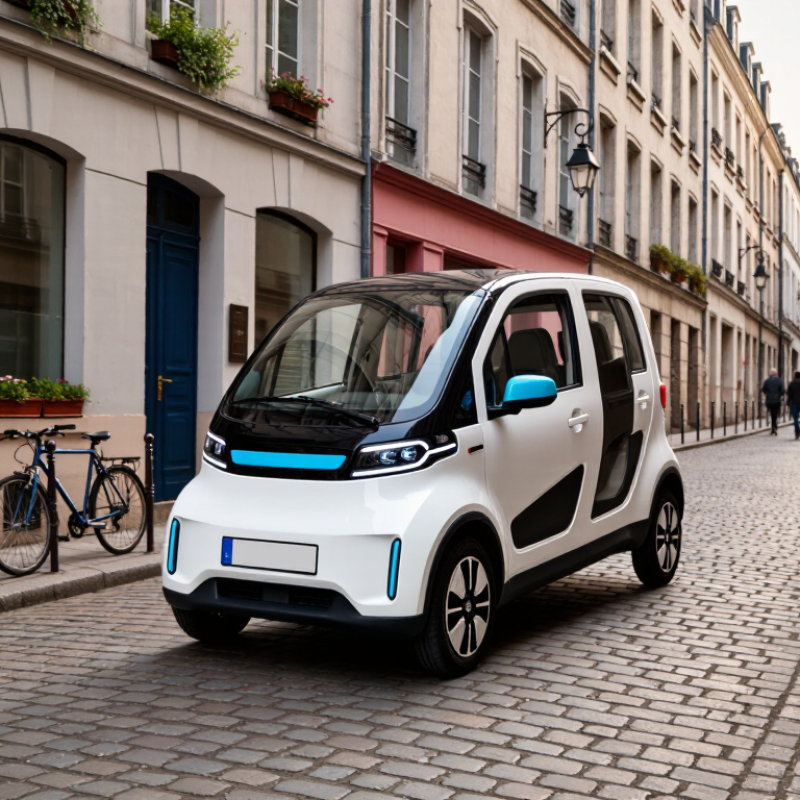
| Vehicle Category | L6e light quadricycle under the European Union vehicle-type approval framework | An L6e is a four-wheeled motor vehicle positioned between a powered two-wheeler and a conventional passenger car. Exact registration and driving rules may differ outside the European Union. |
| Maximum Design Speed | Not more than 45 km/h | The speed limit is suitable for urban streets, residential areas, campuses, resorts and short-distance commuting. It may restrict access to motorways or high-speed roads, depending on local law. |
| Maximum Mass | Unladen mass must not exceed 425 kg, excluding the mass of traction batteries for electric vehicles | The low mass can support efficient energy use and easier low-speed handling. Buyers should confirm the certified mass, payload and battery-treatment rules for the target market. |
| Maximum Continuous Rated Power | Not more than 6 kW for electric powertrains and other applicable propulsion systems | The power ceiling is designed for light urban mobility rather than high-speed or long-distance performance. Actual acceleration depends on vehicle mass, gearing, battery output and road conditions. |
| Internal-Combustion Engine Limit | For positive-ignition engines, engine capacity is generally limited to 50 cm³ under the L6e definition | This supports the classification as a light quadricycle. Other engine types may be subject to different technical limits within the applicable approval rules. |
| Electric Powertrain Option | Battery-electric propulsion is commonly used, but the L6e category itself does not require a specific energy-storage technology | Electric versions can provide quiet operation, zero tailpipe emissions and simplified urban maintenance. Total environmental impact still depends on electricity generation, battery production and vehicle usage. |
| Driving Environment | Best suited to urban and low-speed road networks | A compact footprint and a 45 km/h speed ceiling make the vehicle practical for city errands, commuting, delivery routes and shared-mobility services where full-size car performance is unnecessary. |
| Energy Consumption | Usually lower than that of a full-size passenger car because of the vehicle's lower mass, power and speed | Actual electricity or fuel consumption varies with battery size, weather, payload, traffic, driving style, tyre pressure and road gradient. Buyers should compare certified test data with real operating conditions. |
| Charging Consideration | Electric models require compatibility between the vehicle, charger, plug type, voltage and local electrical standards | Before importing, confirm the charging connector, onboard charger rating, charging time, household-voltage compatibility and availability of replacement charging equipment. |
| Vehicle Dimensions | No single universal length, width or height is prescribed for every L6e model | Dimensions are model-specific. Verify overall length, width, height, turning circle, door clearance and parking-space requirements before selecting a vehicle for a particular city or facility. |
| Occupant Capacity | Occupant layout is model-specific and may include one or more seating positions, subject to the approved vehicle design | Check the certified number of seats, seat-belt configuration, interior dimensions, luggage capacity and accessibility requirements for the intended use. |
| Safety Equipment | Required equipment depends on the applicable type-approval and national registration rules | Review braking systems, lighting, mirrors, seat belts, occupant protection, tyres, battery safety and any local requirements before purchase or importation. Safety equipment can differ between markets. |
| Driving Licence | Licence requirements are jurisdiction-specific | Some jurisdictions recognize an L6e-related light-vehicle or moped licence category, while others require a regular car licence or impose minimum-age rules. Confirm local requirements before delivery. |
| Registration and Type Approval | A vehicle approved for one market is not automatically approved for every other market | Global buyers should verify conformity documents, VIN information, certificates, customs classification, lighting requirements, emissions rules and registration procedures in the destination country. |
| Typical Use Cases | Short-distance personal transport, campus mobility, tourism, hotel operations, local delivery and urban fleet services | The category is attractive where low operating speed, compact parking and lower energy demand are more important than highway capability, large cargo volume or long-range travel. |
| Key Buying Checks | Confirm legal classification, certified specifications, after-sales support and replacement-part availability | A reliable purchase decision should include checks on warranty coverage, battery warranty, service network, spare parts, software support, insurance, import taxes and total cost of ownership. |