| Load Standard | Common Pallet Footprint | Defines the conveyor width, roller pitch, guides, and transfer clearances. | 1,200 × 800 mm and 1,200 × 1,000 mm are widely used industrial pallet footprints. | Improves system compatibility and simplifies pallet-handling calculations. | Distribution centers, manufacturing warehouses, and automated storage areas. |
| Load Standard | Design Load Capacity | Supports the total pallet, product, and packaging weight. | Common conveyor designs handle approximately 500–1,500 kg per pallet; heavier designs may exceed this range. | Allows stable transport of dense or irregular loads without manual intervention. | Bulk goods, finished products, raw materials, and production-line buffers. |
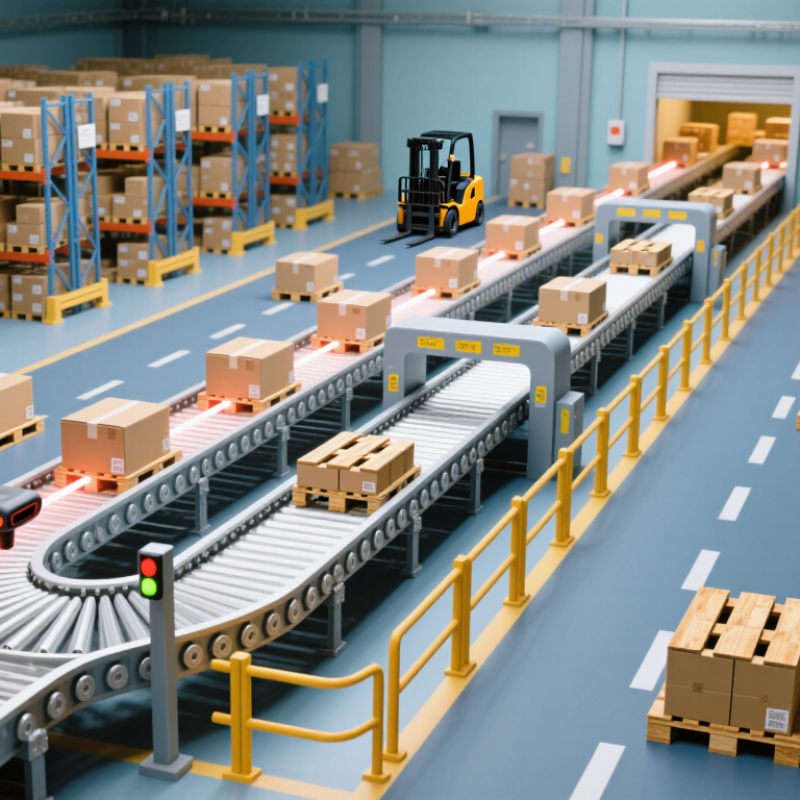
| Conveyor Type | Powered Roller Conveyor | Moves pallets using motor-driven rollers. | Typical operating speed: about 0.1–0.5 m/s; load capacity commonly ranges from 500–1,500 kg per pallet. | Provides controlled movement, accumulation, and accurate pallet positioning. | Main transport lines, accumulation zones, pallet infeed, and pallet dispatch. |
| Conveyor Type | Chain Conveyor | Transfers pallets on parallel chains with minimal contact between the pallet deck and the conveyor. | Typical capacity: approximately 500–2,000 kg per pallet; useful for pallets with uneven or damaged bottom boards. | Offers strong traction and reliable handling of heavy or non-standard pallet bases. | Heavy-duty transfer sections, production interfaces, and pallet turntables. |
| Conveyor Type | Belt Pallet Conveyor | Uses continuous belts to transport pallets or palletized loads. | Typical speed: about 0.1–0.4 m/s; capacity depends on belt width, belt type, and drive configuration. | Provides smooth movement and good traction for loads that may slip on rollers. | Clean handling areas, packaged goods, and applications requiring low-impact conveying. |
| Conveyor Type | Non-Powered Roller Conveyor | Uses gravity or manual force to move pallets over free-rolling rollers. | Requires a suitable slope for gravity flow; commonly used for short distances and low-throughput zones. | Reduces energy consumption and equipment cost where powered movement is unnecessary. | Staging lanes, inspection points, manual loading, and low-volume work areas. |
| Conveyor Type | Pallet Transfer Unit | Moves pallets laterally between parallel conveyor lines. | Common configurations use chain transfer, belt transfer, or lift-and-carry mechanisms; travel is generally 90° to the main flow. | Connects production lines, storage aisles, and routing lanes without manual handling. | Cross transfers, lane changes, sorting areas, and workstation connections. |
| Conveyor Type | Pallet Turntable | Rotates a pallet to change its travel direction or orientation. | Common rotation angles include 90° and 180°; positioning accuracy depends on the drive and control system. | Enables compact layouts and controlled pallet orientation at intersections. | Warehouse corners, aisle entrances, packaging lines, and routing junctions. |
| Conveyor Type | Lift Conveyor | Raises or lowers pallets between different elevations. | Vertical travel and capacity are project-specific; typical systems include safety gates, position sensors, and mechanical brakes. | Connects mezzanines, production floors, storage levels, and elevated conveyor lines. | Multi-level warehouses and facilities with limited floor space. |
| Drive System | Geared Motor and Drive Unit | Provides torque to rollers, chains, or belts. | Variable-speed drives commonly enable controlled acceleration, deceleration, and speed adjustment. | Improves energy efficiency, reduces product shock, and supports synchronized movement. | High-throughput lines, accumulation zones, and variable-load applications. |
| Control System | PLC and Conveyor Controller | Coordinates motors, sensors, zones, routing logic, and fault responses. | Supports zone control, interlocks, emergency-stop logic, and communication with warehouse-management or warehouse-control systems. | Enables automatic routing, status monitoring, diagnostics, and scalable expansion. | Integrated pallet conveyor systems and automated distribution centers. |
| Detection | Photoelectric and Presence Sensors | Detect pallet position, occupancy, gaps, and transfer completion. | Common sensing methods include diffuse, retro-reflective, and through-beam detection. | Prevents collisions and allows each conveyor zone to operate according to real-time pallet conditions. | Accumulation conveyors, transfers, lifts, and loading or unloading points. |
| Identification | Barcode or RFID Identification | Associates a pallet with its product, destination, batch, or storage location. | Identification can be performed at conveyor entry, routing points, storage interfaces, and dispatch stations. | Improves traceability and supports automatic sorting and inventory accuracy. | Order fulfillment, batch control, return handling, and automated storage systems. |
| Accumulation | Zero-Pressure Accumulation | Stores pallets in separate zones without direct pallet-to-pallet contact. | Each zone is controlled independently using sensors and motor or clutch logic. | Reduces product damage, minimizes congestion, and maintains controlled spacing. | Buffer storage, order sequencing, production staging, and dispatch preparation. |
| Guidance | Side Guides and Pallet Stops | Keeps pallets aligned and controls their stopping position. | Guide spacing and stop height must be matched to the pallet footprint and load overhang. | Improves positional accuracy for scanning, transferring, wrapping, and robotic handling. | Conveyor curves, transfer points, scanners, lifts, and robotic workstations. |
| Safety | Emergency Stops and Guarding | Protects personnel from moving equipment and hazardous access points. | Typical provisions include emergency-stop devices, fixed guards, access doors, safety switches, and warning indicators. | Supports safe operation, controlled maintenance access, and compliance with applicable local regulations. | All automated pallet conveyor installations, especially high-speed and restricted-access zones. |
| Maintenance | Modular Conveyor Sections | Allows individual conveyor zones or components to be isolated and replaced. | Common modules include straight sections, curves, transfers, turntables, lifts, sensors, and drive assemblies. | Shortens troubleshooting time and supports phased system expansion. | Large warehouses requiring high availability and planned maintenance. |
| Business Benefit | Warehouse Automation Integration | Links pallet movement with storage, picking, production, and shipping processes. | Integration may include warehouse-management, warehouse-control, manufacturing-execution, and enterprise-resource-planning systems. | Improves throughput, labor utilization, inventory visibility, and repeatable handling performance. | Facilities seeking consistent pallet flow and reduced manual transport. |