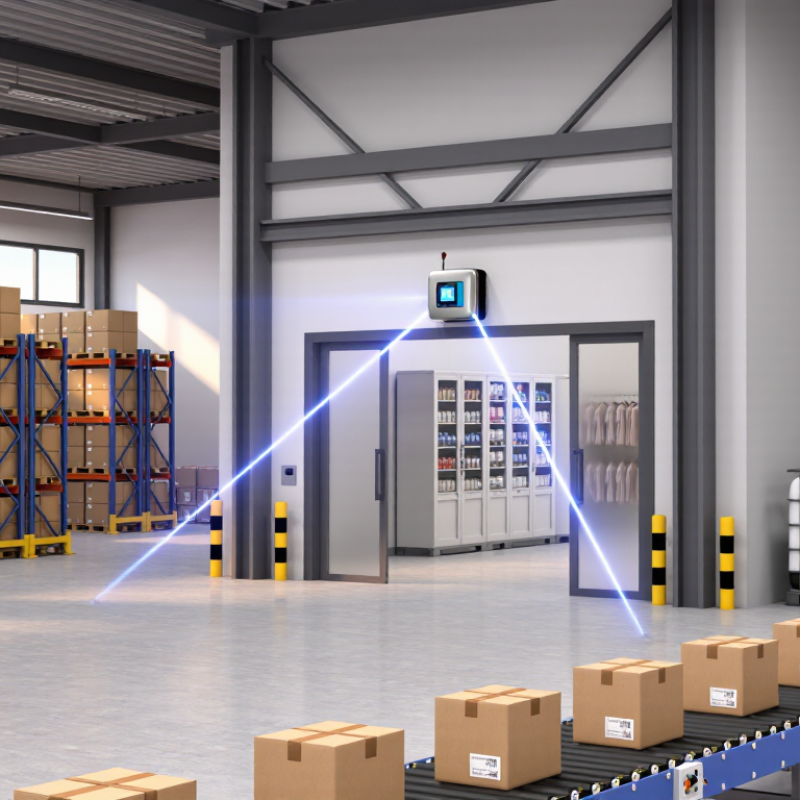
| Operating Frequency | Ultra-high-frequency RFID systems generally operate within the regional 860–960 MHz range. | Supports long-range identification and sensor data collection across many logistics and industrial applications. | Permitted frequencies and channel plans differ by country or region, so local compliance should be confirmed before deployment. |
| Typical Reading Distance | Passive UHF tags and sensor tags commonly support reading distances from approximately 1 to 15 meters, depending on the reader, antenna, tag design, and environment. | Enables monitoring of cartons, pallets, containers, shelves, and equipment without requiring close-range scanning. | Metal, liquid, tag orientation, antenna placement, and surrounding structures can significantly reduce the actual range. |
| Non-Line-of-Sight Operation | Radio communication can identify tagged items without direct optical visibility between the reader and the sensor tag. | Reduces dependence on barcode alignment and improves automation in warehouses, production lines, and distribution centers. | Read performance still depends on packaging materials, shielding, installation geometry, and radio-frequency interference. |
| Multi-Tag Reading | UHF readers are designed to identify multiple tags during a single reading event through anti-collision communication methods. | Helps speed up inventory checks, dock-door receiving, shipment verification, and asset counting. | The number of successfully read tags depends on reader settings, tag density, antenna configuration, and operating conditions. |
| Sensor Parameters | Depending on the sensor design, UHF systems can support monitoring of parameters such as temperature, humidity, moisture, pressure, or shock. | Allows condition monitoring to be integrated with item identity, improving traceability throughout international supply chains. | Measurement range, resolution, accuracy, sampling interval, and data storage are model-specific and must be checked in the technical specification. |
| Power Options | Passive sensor tags can obtain operating energy from the reader field, while battery-assisted versions use an internal battery for added sensing capability or range. | Battery-free designs can reduce maintenance, shipping restrictions, and replacement requirements for large-scale deployments. | Battery-assisted products require battery-life planning, temperature evaluation, and suitable procedures for international transport and disposal. |
| Standards Compatibility | Many UHF RFID deployments use the ISO/IEC 18000-63 air-interface standard, which is aligned with EPC UHF Class 1 Gen 2 technology. | Standards-based equipment can make multi-site deployment, system integration, and supplier replacement easier. | Standards compatibility does not guarantee identical performance; reader, antenna, middleware, and sensor specifications must also match. |
| Regional Deployment | Common regional allocations include approximately 865–868 MHz in Europe and 902–928 MHz in North America, subject to local regulations. | A properly selected regional configuration can support international rollouts while respecting local spectrum requirements. | Importers should verify radio approval, permitted transmit power, frequency channels, and certification requirements in the destination market. |
| Operating Environment | Industrial versions may be supplied with protective housings and ingress ratings; the appropriate rating varies by product design. | Supports use in warehouses, factories, cold-chain operations, outdoor logistics, and other demanding environments when correctly specified. | Buyers should compare IP rating, operating temperature, chemical resistance, vibration tolerance, and mounting method against the application. |
| Data Integration | Reader systems can pass tag identity and sensor records to inventory, warehouse, manufacturing, or supply-chain software through application interfaces. | Combines automatic identification with digital records, supporting real-time visibility and event-based traceability. | Successful integration requires compatible data formats, network connectivity, security controls, and clear ownership of sensor data. |
| Total Cost of Ownership | UHF systems can reduce manual scanning labor and support reusable or disposable tag formats, but total cost depends on readers, antennas, software, installation, and tags. | Offers scalable automation potential for organizations managing high item volumes or geographically distributed operations. | A pilot test should measure read reliability, installation effort, consumables, maintenance, integration, and compliance costs before full deployment. |