Request Quote

Request a quote from Nidec Drive Technology America Corporation.

This quote form is intended for customers and partners in North America seeking information about Nidec Drive Technology America Corporation’s Precision Gearing Technologies. For inquiries related to the Nidec motor group division or from outside this region, please visit the global Nidec Group website to find the appropriate regional or product-specific contact.

Subscribe to Nidec Newsletter

Subscribe to our email newsletter to stay current with our precision gearing solutions, featured products, company updates, and industry news.

What Is Yellow Side Double Sided Tape Used For?

Yellow Side double-sided tape is used to bond two surfaces without visible screws, wet glue, or bulky fasteners. Common jobs include mounting lightweight signs, securing trim, attaching foam or plastic parts, and holding decorative panels in place. The yellow color usually identifies a release liner or product variant; it does not, by itself, prove the tape’s strength or chemical makeup. That distinction matters.

Market reports help explain why these tapes appear across many industries. Grand View Research’s Adhesive Tapes Market Size, Share & Trends Analysis Report estimated the global market at about US$78.5 billion in 2023 and forecast continued growth through 2030. MarketsandMarkets’ Pressure-Sensitive Adhesives market analysis also tracks demand across packaging, automotive, electronics, and other applications. These broad figures describe market activity, not the performance of a particular Yellow Side tape. For a real project, check the manufacturer’s technical data sheet for adhesive type, liner details, recommended surfaces, temperature limits, and peel strength. A clean metal panel may bond differently from dusty painted wood. Small detail, big difference.

This guide explores what Yellow Side double-sided tape is designed to do, where it performs well, and where it may fail. Color can mislead. Adhesive choice, surface preparation, pressure, and curing time all affect the result. Even a good tape can disappoint when the surfaces are damp or poorly matched. That part deserves more attention than it often gets.

What Is Yellow Side Double Sided Tape Used For?

What Yellow-Liner Double-Sided Tape Is Made Of: Adhesive, Carrier, and Liner

Yellow-liner double-sided tape is a layered material, not simply adhesive with colored backing. In a typical construction, pressure-sensitive adhesive coats both sides of a carrier. The adhesive creates the bond; the carrier gives the tape structure. Acrylic and rubber-based adhesives are common options, but their grip, temperature tolerance, and aging behavior vary. Check the product data for the surfaces and conditions involved. There is no single adhesive formula for every yellow-liner tape.

The carrier may be tissue, nonwoven fabric, plastic film, or foam. A thin film can help keep the tape stable during handling, while foam can conform to slightly uneven surfaces. The yellow liner, often release-coated paper or film, protects the adhesive until application and peels away when needed. Not a strength rating. Its color mainly makes the liner easier to spot and remove; it does not identify the adhesive type. For example, when mounting a small panel, press the tape firmly onto a clean, dry surface, then remove the liner without touching the exposed adhesive. A small trade-off remains: the most conformable carrier may not be the easiest to position precisely. Test a sample on the actual materials first. That detail is easy to overlook.

How Tack, Peel Adhesion (N/25 mm), and Shear Strength Shape Bonding

What Is Yellow Side Double Sided Tape Used For?

How Tack, Peel Adhesion (N/25 mm), and Shear Strength Shape Bonding

Yellow double-sided tape is often chosen for mounting, laminating, and joining parts where a visible liner helps workers identify the adhesive during handling. Its color does not determine bond strength.

Tack describes how quickly the exposed adhesive grabs on contact. Press a short strip onto a clean panel: immediate grip is useful, but it cannot predict long-term performance. Dust, surface texture, and pressure can change the result.

Peel adhesion, commonly reported in N/25 mm, measures the force needed to remove a standard-width strip. ASTM D3330/D3330M describes peel-adhesion test methods and reporting; results depend on the test setup and surface. A higher reading can help when edges may lift, such as on a curved trim piece. But it is not a universal ranking. A tape tested on smooth steel may behave differently on painted wood or low-energy plastic.

Shear strength matters when a bonded object hangs under a steady load. ASTM D3654/D3654M covers shear-adhesion testing, including holding power under sustained stress. For a small mounted sign, peel may govern at the corners while shear carries the downward weight. That distinction is easy to miss.

In practice, test the actual substrate, clean it, apply firm pressure, and allow the adhesive’s stated dwell time. One small test can prevent a frustrating rework. Even then, temperature and aging deserve a second look.

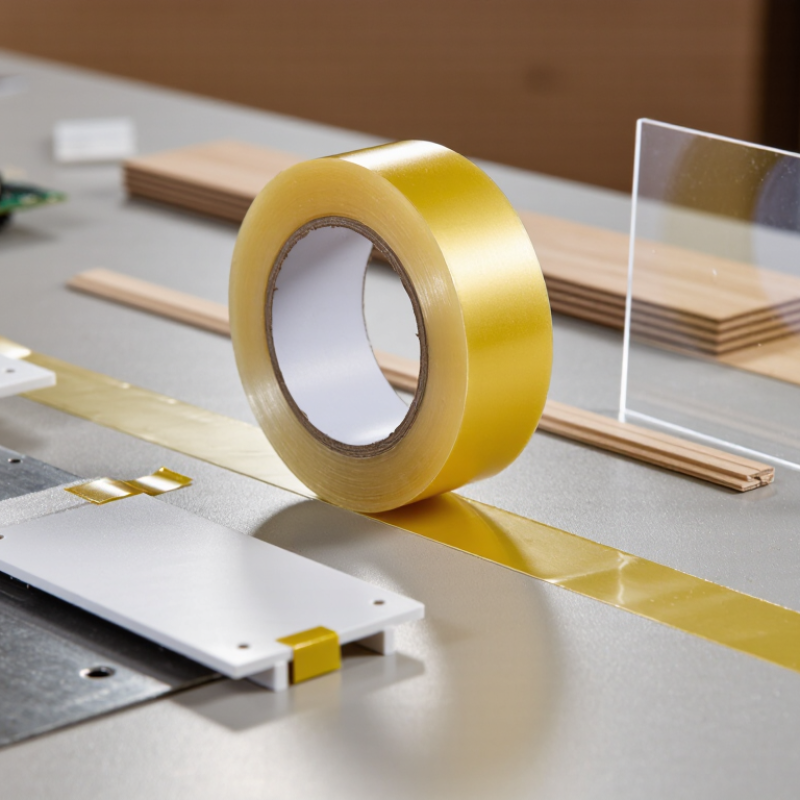
Where Yellow-Liner Tape Is Used in Packaging, Crafts, and Assembly

Yellow-liner double-sided tape is useful when a bond needs to stay hidden and the backing must be easy to spot. The yellow release liner gives workers a clear visual cue during packing, crafting, and light assembly. It does not indicate adhesive strength; that depends on the tape construction and the surfaces being joined.

At a packing bench, tape can secure paper inserts, labels, foam pads, or lightweight protective pieces inside a carton. Press the adhesive firmly onto a clean, dry surface, then peel away the liner without touching the exposed adhesive. Small detail.

The U.S. Environmental Protection Agency’s Advancing Sustainable Materials Management: 2018 Fact Sheet reports that containers and packaging made up 82.2 million tons, or 28.1%, of U.S. municipal solid waste that year. That figure covers packaging broadly, not tape specifically, but it shows why careful material use matters.

For crafts, the tape can attach card layers, fabric trims, or thin decorative pieces without a wet glue mark. In assembly, it can hold nameplates, small panels, or cable guides in place while parts are positioned.

Check compatibility first: textured, dusty, or oily surfaces may weaken the bond. I still test a small hidden area. A quick press-and-peel trial can reveal whether the tape suits the job before pieces are cut to size.

How to Match Tape Thickness (mm) and Temperature Rating to a Job

Yellow release liner identifies the tape’s protective backing, not its performance. Match thickness to the surfaces being joined. A thin tape, around 0.1–0.2 mm, can suit smooth, closely fitted panels. A thicker tape may help bridge slight texture or unevenness, but it cannot reliably fill large gaps. Small gap. Clean, dry surfaces matter more than adding thickness.

Check the product’s temperature rating for both application and service conditions. Some tapes need warm conditions during application, while their bonded joint can tolerate a different temperature range afterward. A cold workshop can slow initial bonding; a hot panel may soften an unsuitable adhesive. Read the technical data sheet, and allow the recommended dwell time before loading the joint. Ratings vary.

For example, joining a flat plastic trim piece indoors may call for a thin tape and a moderate service rating. An exterior metal panel exposed to summer heat needs a rating that covers expected peaks, plus a thickness suited to its surface finish. Press firmly across the full bond area. I would test a small sample first, especially on textured or low-energy plastics; the right choice is not always obvious from the liner color.

What Is Yellow Side Double-Sided Tape Used For?

Match tape thickness to the gap and surface, and check the adhesive’s temperature rating for the job.

Representative selection examples, not universal product specifications: thicker foam can help bridge gaps and conform to uneven surfaces; it does not automatically provide greater heat resistance. Yellow usually describes the release liner, not the tape’s temperature capability. Always confirm the exact tape’s datasheet, including continuous and short-term temperature limits, before use.

How ASTM D3330, D3652, and D3654 Measure Peel, Thickness, and Holding Power

What Is Yellow Side Double Sided Tape Used For?

How ASTM D3330, D3652, and D3654 Measure Peel, Thickness, and Holding Power

Yellow double-sided tape can help mount lightweight signs, secure foam panels, or hold trim during assembly. Its color makes the liner or tape easier to spot, but color alone says nothing about bond strength. For a useful comparison, check test data alongside the tape’s intended surface and working conditions. Small differences matter.

ASTM D3330 measures peel adhesion: the force needed to pull tape from a specified surface at a controlled angle and speed.

ASTM D3652 measures tape thickness, including the backing and adhesive as specified by the test method. Thickness can affect how well tape fills a small gap, but it does not prove stronger adhesion.

ASTM D3654 evaluates holding power under a sustained load, often by measuring how long a bonded sample resists slipping. Results depend on test setup, surface preparation, temperature, and load. A number without those details can mislead.

Tips: Compare results only when the test method and conditions match. Clean dust and oil from the surface, then press the tape down evenly. For a vertical sample, watch for gradual edge lift or sliding. Real installations can behave differently from lab tests, and that uncertainty is worth checking with a small trial.

Article Source: